

Quest for inmedium modifications in p A, A, A collisions PowerPoint PPT Presentation
1 / 48
Title: Quest for inmedium modifications in p A, A, A collisions
1
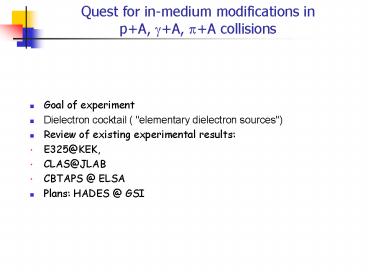
Quest for in-medium modifications in pA,
?A, ?A collisions
- Goal of experiment
- Dielectron cocktail ( "elementary dielectron
sources") - Review of existing experimental results
- E325_at_KEK,
- CLAS_at_JLAB
- CBTAPS _at_ ELSA
- Plans HADES _at_ GSI
2
Why to study in-medium modifications Origin of
masses 2 mechanisms
Standard model
- Mass generation via Higss mechanism
- current quark masses
- What is the origin of hadron masses?
- Mprotongtgt 3mu/d (20 MeV) !
- Breakdown of chiral symmetery
3
Chiral symmetry and hadron masses
For massless 2-flavour quarks (q(u,d))
is invariant
4
Quark condensate in dense and hot matter
Brown,Rho Phys.Lett.66(1991)2720
- Dropping mass scenario m? /? ? if ? ?
investigate hadron masses inside nuclear
matter
5
Main goal
- Studies of vector meson (?/?/?) spectral
functions in nuclear medium via e, e- pair
spectroscopy at ?N ? ?0 and T0
- Dielectron two-body decays of light Vector Mesons
r, w, f - High resolution spectroscopy of ee- pairs, no
final state interaction !
Decay length LD ?? c? ? R (decay in
medium) N(L)N(0)exp(-L/LD)
6
Theoretical predictions (some examples)
effective chiral lagrangian
quark-meson-exchange
15
K. Saito et.al Phys.Rev.C55(1997)2637
T. Renk et.al Phys. Rev. C 66 (2002) 014902
- Brown-Rho scaling('92) mV mV(1-?/?0)
meson masses scale with density as
, order parameter of ChSB
7
Hadronic scenario meson spectral function
Vacuum
In medium
- m, ? depends on meson momentum (q) ? A(m,p)
spectral function - Connection to chiral symmetry?
8
Mass (width) changes "trivial" effects
- Broad resonances (?) modification of line shape
due mass dependent widths ?(m) and due to
available phase space important for HI and NN
collisions at low energy (see second lecture) - Collision broadening
M. Effenberger at al PHYS. REV. C 60 044614
? decay in Pb nucleus
?(?) ?vac (?) ?coll(?)
9
- Experimental considerations
- cross sections
- "inside" vs "outside" decays
10
? cross sections for pp and ?p
SAPHIR (Bonn) CBELSA (Bonn) DAPHNE, TAPS
(Mainz) GRAAL (Grenoble)
Lund String Model
?p
?pA? ?A2/3
KEK (4.6 mb)
exclusive
- ? ? ? ? o
- ? ? ? -
- ? ? ? o
- ? ? o ? o
- ? ? ?
- ? K ? ? K ?o
- ? Ko ? ? ? ? ?
3.5 12 GeV GeV
11
"Tomography" of vector meson decay
- Transport calculations for p/?/? A collisions
HSD -E.
Bratkovskaya, V. Cassing Phys. Rep. 308(1999) 65)
- vacuum spectral functions
- full in-medium meson propagation (scattering in
medium)
? production on 93Nb with p/?
production decay
Decay length LD ?? c? ? R (decay in
medium) N(L)N(0)exp(-L/LD)
3.5 GeV
1.17 GeV
12
Beam energy dependence for ?/?
pions
protons
protons
pions
for 12 GeV pA 6 ? decays 55 ? decays
For ? factor 2 less in-medium decays as
compared to ? beams
- for ?/? Ebeam 1.1-1.5 GeV is optimum (but
100 times less ? for ? !) - for p/? beams less decays inside
13
- e,e- spectrum components "dielectron cocktail"
14
Dielectron sources free hadron dielectron
cocktail
- Two body meson decays (peaks)
?
V ? ee-
- 3-body Dalitz- decays (continuum)
V ? ee- X
Mee GeV/c2-
- CB e e- combinatorial background
- Signal/CB usually lt1 !
15
Meson Dalitz (3 bodyee-X ) decays
Vector Meson Dominance (VMD) or Vector Dominance
Model (VDM)
Dielectron spectrum
BR(?0?ee-?) 1.210-2 BR(??ee-?) 610-3
F(q2) - electromagnetic form factor
time-like q2gt0 q2lt0 space like probed via
electron scattering experiments
16
Electromagnetic transition form-factors
- known from di-muon G-experiment
337 events
600 events
608 events
17
Dielectron decays Dalitz decays of Baryons
- Baryon decays ? (1232), N(1440), ...?Nee-
- N( ?)-gtNe,e- - not measured in elementary
reactions ! - ?(1232) 3 Form. factors (GE(q2), GM(q2),
Gc(q2)) not known ? electromagnetic structure of
nucleon
Various treatments
C. Fuchs Phys. Rev. C67 025202(2003) M.
Krivoruchenko et al. Ann.Phys296 (2002)299
Extended Vector Meson Domince Contribution from
several vector mesons interferences !
1.
???Nee-5.02 KeV (BR410-5)
2. Baryons are treated as point like particles
(QED)
B. Lautrup, J.Smith Phys.Rev D3(1971)1122, C.
Ernst et al. PRC 58 (1998) 447, M. Thomere et al
PRC 75(2007) 0604902,... gives similar BR as 1
18
Two body Vector Meson decays
JP 1- Vector Mesons carry same quantum
numbers as photon ...quark em.current!
I 0,1
2? 3?...
At meson pole !
19
??ee- example thermal source
- A(m)- Breit-Wigner resonace formula
- ? (m) Mass dependent decay width
- for ee- reads
- fB(M,T) Boltzmann thermal factor
- fB(M,T) p E exp(-E/T)
??ee- from CC _at_ 2AGeV
thermal source
- no cut-off at M2m?
20
Combinatorial Background
?
Combinatorial Background
?0
e
- Multi ?0 Dalitz decays ? small ?ee-
- External Pair Conversion (EPC) of photons from
?0 ? small ?ee- - ?ee- from Dalitz and EPC small but their
combination can form large ?ee- and large mass!!
e-
?
?0
e-
?
- Combinatorial background (CB)
- ? e and e- comming from different vertices
- Nee- unlike-sign pairs
- Ne-Ne- and NeNe like-sign pairs
- absolute normalization CB
- Signal
- S- Nee- - CB-
dedicated talk in student session !
21
E325 Experiment
Measures Invariant Mass of ee-, KK- at KEK
(1996-2002) in 12GeV p A ? ?/?/? X
reactions, ?s5.1 GeV Mass Resolution for ee-
8.0MeV/c2 for ? 10.7MeV/c2 for ?
Beam
Primary proton beam (7108/s)
Target
Five targets Carbon x 1 and Copper x 4 aligned
in line Very thin targets to suppress g
conversion
22
Target Configuration
Very thin target with clean and high intensity
beam
Cu
C
Beam
23mm
Vertex Distribution
23
Experiment KEK-PS E325
24
Detector Setup
B
1m
25
Accepted ee- distributions mass, pT, y
w
YCM
Note p m0??
r / w
Cu
26
E325 Model calculations of meson line shape
- ?/? mesons are generated uniformly at surface of
target nucleus (? A2/3) - momentum distribution as measured in xp
- pole mass downward shift m/m 1 k1 r/r0
- ? k1 parameter
- decay width increase G/G 1 k2 r/r0
- ? k2 parameter
- density distribution
- Woods-Saxon
- R C2.3fm/Cu4.1fm
e-
- Detector response
- Blue histogram Detector Simulation
- Red line Breit-Wigner (gaussian convoluted)
fitting result - agrees with measured Ks? ? ?-
27
pA _at_ 12 GeV KEK-PS E325
M. Naruki Phys.Rev.Lett 96 (2006) 092301
28
??ee- modification in KEK-PS E325
- only small fraction of ? decays is inside
medium ? selection on ??
?? distribution ?
29
Mass modification of ? for Cu targets
Integrate the amount of the excess in the above
region(0.951.01 GeV/c2) ? Nexcess
Fit again excluding the region where the excess
was seen 0.951.01GeV/c2
Yokkaichi Meson2006
- Best fit (both nuclei) achieved for k10.035 and
k22.6 (? ? ) . Mass shift of ?
30
Photon experiment G7 _at_ JLaB
31
Photon beam E? 0.6-2.85 GeV
E?gt1.1 GeV needed for ?/? production
32
G7 (CLAS) _at_ JLaB
- ? A (C, Fe-Ti, Pb)?ee- (since 2002)
- Beam 5x10⁷ ?/s from 3 GeV (2/3) and 4 GeV(1/3)
electrons
33
(No Transcript)
34
Toroid with 6 coils 6 sectors
35
Electron identification in CLAS
C Fe C Pb C Ti C
1.1
D2
dedicated talk in student session !
36
Detector acceptance
- e-,e ID only for 8-450 EmCal. coverage
- electrons in same sector forbidden!
Pair acceptance
37
Pair spectra
- Combinatorial background CB from mixed events
with normalization from like-sign pairs
38
Signal pairs (CB subtracted)
39
Final result for the ? meson spectral function
cocktail of free ?/?/? meson decays subtracted ?
? spectral function
k10.020.02 consistent with 0!
- contradiction to KEK PS E325
40
Why CLAS result contradicts KEK-E325?
- KEK-E325 fits CB (no absolute determination!)
- G7 spectra with CB fitted (no absolute
normalization!) ? different results ? CB
normalization essential !
41
Crystal Barrel TAPS (CBTAPS) _at_ ELSA
42
Detector (photon calorimeter)
43
Strategy of the experiment ???0?
- A ? ? A ? (?0?) A with photons from 3 GeV e-
beam
44
Reference experiment ? N
45
CB/TAPS _at_ ELSA
D. Trinka Phys. Rev, Lett (2005) 192303
m? 722 at averaged ?0.6?0
- m? m0 (1 - k ?/?0) k 0.14
- mass shift of ?
46
In-medium ? spectral function
??in_medium? 90 MeV !
47
HADES experiment _at_ GSI
- 2007 FW hodoscope added
- ?lt 70
- proton/pion/HI beams
- ee-/p/?/K id
- mass resolution
- ?M/M2 at ?/?
more details in second lecture !
48
?/? momentum distributions
???1.2
- HADES is sensitive to both ? /? ?M (?)1.5
at low p (??lt1.2)
- ?A smaller ltp?/? gt momentum
- ?A low beam intensity, broad focus
- proton beams
- higher intensity
- excellent beam focus (1-2 mm)
- reference reaction p p _at_ 3.5 GeV done
49
Expectations for in-medium effect
similar effect for pA
50
Background for pA - ? conversion
beam
- segmented target
106 p/sec
4x Nb segments 4 x 0.5 I0 1x Be segment (2)
Larger CB!
51
Pairs from pp _at_ 3.5 GeV
"HADES online pair spectrum from April 2007"
- 5.5109 LVL1 events collected (Apr07 -12 days
running time) - 70 "online" analyzed (with reasonable
calibration and tracking alignment) - signal pairs 54 k (all)
- ? visible i on-line spectrum ?35 MeV/c2 !
0.5 1.0 Mee
to be continued with pA and ?A with HADES..
52
Summary
- Meson line shape modifications seen in pA/?A
reactions - E325/KEK downward ? mass shift ( 9)
- E325/KEK downward ? mass shift (3) and
broadening - CBTAPS downward ? mass shift (14) and
10-fold! broadening. Strong momentum dependece
?m(p). No sensitivity to ? - .. but
- G7/CLAS no mass shift of ? but broadening ?
possible explanation of contradiction to E325/KEK
CB normalization in E325 - G7/CLAS no effect on ? mass shift ?... but CLAS
acceptance is not sensitive to CBTAPS? no
contradiction to CPTABS - New HADES experiment _at_ GSI sensitive to both ?/
?
53
Line shape modification of ? in pp?
intermediate resonaces
D. Schumacher , S. Vogel et.al (UrQMD)
- ? produced through Baryonic resonance
- N(1520), N(1720) and
- ?(1700), ?(1905) involved
N
N(?)
e e-
to be continued with pA and ?A with HADES..
54
m, pt, y distributions
- HADES acceptance and reconstruction efficiency
filter
3.5 GeV
1.17 GeV
- HADES acceptance is flat for Mgt 0.5 GeV/c2
55
HADES acceptance
e,e- pairs with ?ee-gt 90
Recommended

