

Chapter 14 The Renaissance and Reformation Section 1 The Italian Renaissance PowerPoint PPT Presentation
1 / 24
Title: Chapter 14 The Renaissance and Reformation Section 1 The Italian Renaissance
1
Chapter 14 - The Renaissance and Reformation
Section 1 - The Italian Renaissance
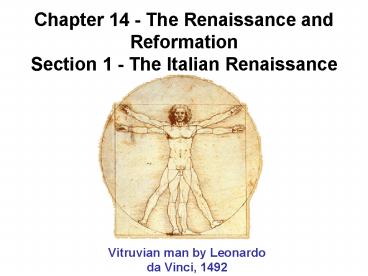
Vitruvian man by Leonardo da Vinci, 1492
2
This century, wrote philosopher Marsilio
Ficino, like a golden age has restored to light
the liberal arts, which were almost extinct
grammar, poetry, rhetoric, painting, sculpture,
architecture, music. What a glorious time to be
alive, he thought As Ficino recognized, a new age
had dawned in Western Europe. Europeans called it
the Renaissance, meaning rebirth. It began in
the 1300s and reached its peak around 1500.
3
I. The Italian City-States
- Result of a new interest in the cultures of
ancient Greece and Rome
SPQR Senatus Populusque Romanus ("The Senate
and Roman People")
Greek Pantheon
4
I. The Italian City-States
- Began in Italy - cities became centers of trade
and manufacturing
5
I. The Italian City-States
- Florence came to symbolize the Italian Renaissance
Skyline of Florence with the Duomo cathedral (R)
6
I. The Italian City-States
- The wealthy merchant class promoted cultural
rebirth
7
I. The Italian City-States
- Wealthy patrons played a major role by sponsoring
artists
8
I. The Italian City-States
- The Medici Family of Florence were some of the
richest bankers and merchants in Europe
Bottecilli's "The Adoration of the Magi" (1476)
with the Medici family and friends
9
I. The Italian City-States
- Lorenzo Medici was a patron supporting poets,
philosophers, and artists
Raphael's Lorenzo de' Medici
10
II. What was the Renaissance?
- A change in the way people viewed themselves and
their world
Auguste Rodin - The Thinker
11
II. What was the Renaissance?
- Renaissance thinkers explored the human
experience in the here and now
12
II. What was the Renaissance?
- It also supported a spirit of adventure
13
III. Humanism
- Focused on worldly subjects rather than only
religious issues
14
III. Humanism
- Emphasis was on education and individual
achievement
15
III. Humanism
- Based on study of classical culture grammar,
rhetoric, poetry, and history
16
III. Humanism
- Believed education should stimulate the
individuals creative powers
17
IV. A Golden Age in the Arts
- Renaissance art reflected humanist concerns
The Birth Of Venus by Sandro Botticelli (1485)
18
IV. The Arts
- Artists developed techniques such as perspective
for realistic paintings
19
IV. The Arts
- Architects adopted Greek and Roman
- columns, arches, and domes
Roman Aqueducts
The Pantheon in Rome
20
IV. The Arts
- Three of the most celebrated artists were
Leonardo da Vinci
Mona Lisa
Self-portrait
Vitruvian man
21
- Michelangelo
The Pieta
David
The Creation of Adam
22
- Raphael
Raphaels School of Athens is famous for
depicting figures of the Classical past with the
features of his Renaissance contemporaries
The Crucifixion
23
(No Transcript)
24
IV. The Arts
- Renaissance writers included Castiglione and
Machiavelli
Baldassare Castiglione
Niccolò Machiavelli
Recommended

