

The Influence of Radiative Transfer on SPH Simulations of Star Formation PowerPoint PPT Presentation
1 / 1
Title: The Influence of Radiative Transfer on SPH Simulations of Star Formation
1
The Influence of Radiative Transfer on SPH
Simulations of Star Formation
Stuart C. Whitehouse and Matthew R. Bate E-mail
scw_at_astro.ex.ac.uk, mbate_at_astro.ex.ac.uk School
of Physics, University of Exeter, Stocker Road,
Exeter EX4 4QL
We have performed a series of calculations of
star formation using a smoothed particle
hydrodynamics (SPH) code which includes radiative
transfer in the flux-limited diffusion
approximation. Previous calculations of star
formation using SPH have shown that a large
proportion of binary systems are formed by disc
fragmentation (e.g. the large simulations of Bate
et al (2002)). However, these simulations used a
simple barotropic equation of state, and a study
performed by Boss et al (2000) shows that the
amount of fragmentation is sensitive to the
equation of state. We have performed SPH
calculations including radiative transfer to
investigate how the barotropic equation of state
has affected previous results.
Introduction Simulations of star formation play
an important role in determining how protostars
form and evolve. Over the past few years large
simulations have given us insight into the
chaotic nature of star formation (Bate et al
2002). However, such simulations have used an
equation of state based on an approximation of
grid-based radiative transfer codes. We show the
evolution of a collapsing sphere of gas using an
SPH code including radiative transfer.
Method We have developed a three-dimensional
smoothed particle hydrodynamics code with
radiative transfer in the flux-limited diffusion
approximation based on the one-dimensional code
of Whitehouse Bate (2004). The results of a
supercritical shock with the one-dimensional code
can be seen in figure 1.
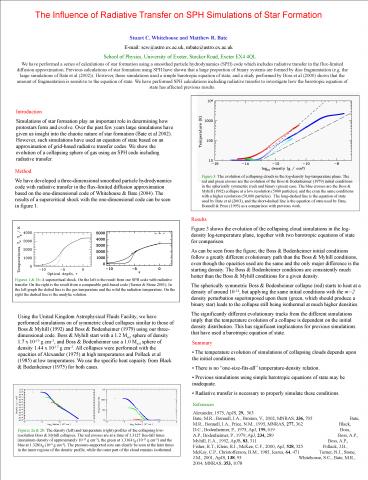
Figure 3 The evolution of collapsing clouds in
the log-density log-temperature plane. The red
and green crosses are the evolution of the Boss
Bodenheimer (1979) initial conditions in the
spherically symmetric (red) and binary (green)
case. The blue crosses are the Boss Myhill
(1992) collapse at a low resolution (5000
particles), and the cyan the same conditions with
a higher resolution (50,000 particles). The
long-dashed line is the equation of state used by
Bate et al (2003), and the short-dashed line is
the equation of state used by Bate, Bonnell
Price (1995) as a comparison with previous work.
Results Figure 3 shows the evolution of the
collapsing cloud simulations in the log-density
log-temperature plane, together with two
barotropic equations of state for comparison. As
can be seen from the figure, the Boss
Bodenheimer initial conditions follow a greatly
different evolutionary path than the Boss
Myhill conditions, even though the opacities used
are the same and the only major difference is the
starting density. The Boss Bodenheimer
conditions are consistently much hotter than the
Boss Myhill conditions for a given density.
The spherically symmetric Boss Bodenheimer
collapse (red) starts to heat at a density of
around 10-14, but applying the same initial
conditions with the m2 density perturbation
superimposed upon them (green, which should
produce a binary star) leads to the collapse
still being isothermal at much higher
densities. The significantly different
evolutionary tracks from the different
simulations imply that the temperature evolution
of a collapse is dependent on the initial density
distribution. This has significant implications
for previous simulations that have used a
barotropic equation of state.
Figures 1 1b A supercritical shock. On the
left is the result from our SPH code with
radiative transfer. On the right is the result
from a comparable grid-based code (Turner Stone
2001). In the left graph the dotted line is the
gas temperature and the solid the radiation
temperature. On the right the dashed line is the
analytic solution.
Using the United Kingdom Astrophysical Fluids
Facility, we have performed simulations on of
symmetric cloud collapses similar to those of
Boss Myhill (1992) and Boss Bodenheimer
(1979) using our three-dimensional code. Boss
Myhill start with a 1.2 Msol sphere of density
1.7 x 10⁻¹⁹ g cm-3, and Boss Bodenheimer use a
1.0 Msol sphere of density 1.44 x 10⁻¹⁷ g cm-3.
All collapses were performed with the opacities
of Alexander (1975) at high temperatures and
Pollack et al (1985) at low temperatures. We use
the specific heat capacity from Black
Bodenheimer (1975) for both cases.
- Summary
- The temperature evolution of simulations of
collapsing clouds depends upon the initial
conditions. - There is no one-size-fits-all
temperature-density relation. - Previous simulations using simple barotropic
equations of state may be inadequate. - Radiative transfer is necessary to properly
simulate these conditions.
References Alexander, 1975, ApJS, 29, 363
Bate, M.R., Bonnell,
I.A., Bromm, V., 2002, MNRAS, 336, 705
Bate, M.R., Bonnell, I.A.,
Price, N.M., 1995, MNRAS, 277, 362
Black, D.C., Bodenheimer, P.,
1975, ApJ, 199, 619
Boss, A.P., Bodenheimer,
P., 1979, ApJ, 234, 289
Boss, A.P., Myhill,
E.A., 1992, ApJS, 83, 311
Boss, A.P.,
Fisher, R.T., Klein, R.I., McKee, C.F., 2000,
ApJ, 528, 325 Pollack, J.B.,
McKay, C.P., Christofferson, B.M., 1985, Icarus,
64, 471 Turner, N.J., Stone,
J.M., 2001, ApJS, 138, 95
Whitehouse, S.C., Bate,
M.R., 2004, MNRAS, 353, 1078
Figures 2a 2b The density (left) and
temperature (right) profiles of the collapsing
low-resolution Boss Myhill collapses. The red
crosses are at a time of 1.3127 free-fall times
(maximum density of approximately 10-13 g cm-3),
the green at 1.3164 tff (10-11 g cm-3) and the
blue at 1.3281tff (10-9 g cm-3). The
pressure-supported core can clearly be seen at
the later times in the inner regions of the
density profile, while the outer part of the
cloud remains isothermal.
Recommended

