

Chapter 11 The Islamic World Section 2: Islam Spreads PowerPoint PPT Presentation
1 / 24
Title: Chapter 11 The Islamic World Section 2: Islam Spreads
1
Chapter 11 - The Islamic WorldSection 2 Islam
Spreads
2
- The Story Continues
- According to the Quran and the Hadith (sayings
of the Prophet,) during a journey to Jerusalem,
Muhammad traveled through seven heavens to visit
the throne of God. Although some followers
refused to believe the stories at first, one
faithful convert named Abu Bakr accepted it
immediately. For this faithfulness he was called
The Upright.
3
I. From Victory to Victory
- Muhammad died in A.D. 632. Abu Bakr was
- chosen as leader
Muhammad and Abu Bakr visit poor Bedouins who
have no sustenance to share until the Prophet
makes their ewe give milk
4
I. From Victory to Victory
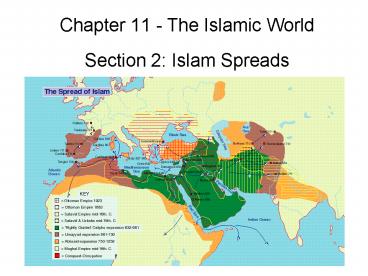
- As caliph, Abu Bakr united the Arabic tribes
- and expanded Islam northward
5
I. From Victory to Victory
- Umar succeeded Abu Bakr as caliph and
- conquered the Persian Empire and Iraq
6
I. From Victory to Victory
- Other caliphs expanded into India, North
- Africa, Mediterranean islands and Spain
7
II. Reasons for Success
- Arabs won because
- - the Byzantine and Persian empires were weak
- - superior fighting methods
- - most importantly, a common faith
8
III. Conquered People
- Non-Muslims could convert to Islam or pay
- extra taxes and practice their own religions
9
III. Conquered People
- Many conquered people converted to Islam
- it emphasized the equality of all believers
10
IV. Movements Within Islam
- Disagreement about the next caliph split the
- Muslims when Umars successor, Uthman,
- was murdered
11
IV. Movements Within Islam
- Muhammads son-in-law, Ali, was chosen as
- caliph, but Uthmans relative Muawiyah
- protested
12
IV. Movements Within Islam
- War broke out Ali was assassinated in 661,
- Muawiyah became caliph and established the
- Umayyad dynasty
Imam Ali mosque in Najaf
13
V. Sunni and Shiites
- Most Muslims agreed to accept Muawiyah as
- caliph and became known as the Sunni
14
V. Sunni and Shiites
- Alis followers, the Shiites, believed only
- Muhammads descendants should be caliphs
15
V. Sunni and Shiites
- Sunni believed the caliph should be chosen
- by Muslim leaders, not a religious
- authority
- Shiite believed the only true successors to
- the prophet were descendants of
- Muhammads daughter and son-in-law
16
VI. Sufi
- The Sufi - Muslim mystics that lived simple
- lives centered on God through meditation and
- fasting
Whirling Dervishes
17
VI. Sufi
- The Sufis helped spread Islam through their
- missionary work
18
VII. Empire of the Caliphs
- Berbers from North Africa converted to Islam
- in 711, the Berber general Tariq conquered
- Spain
Gibraltar (from Arabic, Jebel-al-Tarik, Tarik's
mountain
Tariq ibn Ziyad
19
VII. Empire of the Caliphs
- Muslims in Spain were called Moors ruled
- parts of Spain for more than 700 years
20
VII. Empire of the Caliphs
- The Umayyad Dynasty ruled until AD 750,
- when it was overthrown by the Abbassids
21
VII. Empire of the Caliphs
- The Abbassids ended Arab dominance of
- Islam and established their capital at Baghdad
The Abbasid Palace in Baghdad, built in the 13th
century
22
VIII. Decline of the Caliphate
- Seljuk Turks from Central Asia came into
- contact with Muslims and many converted
23
VIII. Decline of the Caliphate
- Turks settled around Baghdad, were ruled by
- a sultan, and became the dominant Islamic
- force
24
IV. Decline of the Caliphate
- 1250s - Muslim expansion slowed as
- Crusaders captured Muslim cities and
- Mongols destroyed Baghdad
Recommended

