

Request for Approval Local Nitrogen Strategies TarPamlico Agriculture Rule PowerPoint PPT Presentation
1 / 47
Title: Request for Approval Local Nitrogen Strategies TarPamlico Agriculture Rule
1
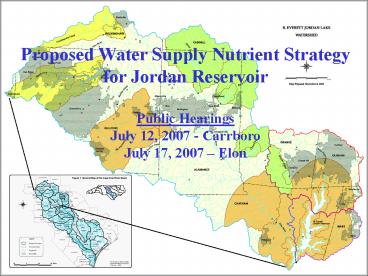
Proposed Water Supply Nutrient Strategyfor
Jordan Reservoir
Public Hearings July 12, 2007 - Carrboro July
17, 2007 Elon
2
Outline of Talk
- A Valuable Resource with Problems
- Management History
- Lake Needs, Watershed Sources
- Proposed Strategy
- Costs
- Implementation Timeframes
- Issues Raised
3
Benefits of Jordan Reservoir
- Recreation 1.1 1.5 million visitors / yr.
- Drinking Water 460,000 people, 6 communities
- Habitat aquatic and water-dependent
- Boon to local economy and property values
4
Jordan is so Popular What Problems?
1960s, 1970s - Nutrient problems predicted
1981-82 Reservoir constructed 1983
Nutrient Sensitive, 2 mg/l TP discharge limits
1983 present Consistently rated
overenriched Frequent blue-green algal
blooms, Summer 1996, 2003 Taste odor
complaints, Cary
1997 - Clean Water Responsibility Act tighter
N, P limits 2000 UNH Dischargers 0.5
mg/l Summer TP 2002 - Upper New Hope
Arm Impaired (303d) - EMC approves
reservoir model 2003-2004 - Jordan
Stakeholder Project
2005 Oct Entire reservoir impaired Mar
2006 Fish kill, Upper New Hope 2006
Algal blooms, user impacts
5
- Algae Surface Film, Morgan Creek Arm
- of Jordan Lake, August 29, 2005
6
- Filamentous Algal Mat
- on Haw River at Bynum, Dec 7, 2001
7
Nutrient Conditions
Oligotrophic vs. Eutrophic
Phelps Lake in July 2005
Haw River Arm in August 2005
8
How was Nutrient Impairment Quantified?
- Nutrient-related wq standards violated
- Chlorophyll-a
- pH
- Turbidity
- Lake model estimated nutrient reductions needed
to meet chl-a standard - Percent N, P goals based on lake model
9
Upper New Hope Arm
35 N 5 P
Lower New Hope Arm
Haw River Arm
0 N 0 P
8 N 5 P
10
Jordan Reservoir Watershed
Haw 8 N, 5 P
Upper New Hope 35 N, 5 P
Lower New Hope 0 N, 0 P
11
Land Uses in Jordan Watershed
From Tetra Tech, 2003. B Everett Jordan Lake
Watershed Model Development.
12
(No Transcript)
13
Is the Environmental Management Commission
Mandated to Act?
- 143B-282 Protect water quality, Rules
- Clean Water Responsibility Act of 1997
- Set goals for Nutrient Sensitive Waters
- Fair, reasonable, and proportionate reductions
- Discharge concentration limits
- Federal Clean Water Act
- Requires states address impaired waters
14
Stakeholder Activities on these Rules
- 2003-2004
- 1½ yr goal-setting conceptual strategy
development - Facilitated by TJCOG, broad range stakeholders
- Evaluated options based on models
- Recommendations to EMC
- 2005
- Public Meetings, Comment Period, Conceptual
Strategy - 2006
- Total 27 stakeholder meetings during 2006
- Point sources, stormwater, Ag, NM, DOT, modeling
- Rule refinements, better understanding of issues
15
Strategy Principals
- Goals reflect problems in each arm
- All sources meet same goals
- Fair, reasonable, and proportionate
- Credit for past actions
- Offsets, trading gt more cost-effective
- Adaptive Management flexibility over time
16
Proposed Jordan Nutrient Rules
- 15A NCAC 2B
- .0262 Goals
- .0263 Nutrient Management
- .0264 Agriculture
- .0265 Stormwater - New Development
- .0266 Stormwater - Existing Development
- .0267 Riparian Buffers - Protection
- .0268 Riparian Buffers - Mitigation
- .0269 Options for Offsetting (Trading)
- .0270 Wastewater Discharge
- .0271 Stormwater - State and Federal Entities
- .0272 Riparian Buffer Mitigation Fees
- .0311 Cape Fear River Basin (Schedule of
Classifications)
17
Goals .0262
Haw Subwatershed 8 N, 5 P
Upper New Hope Subwshed 35 N, 5 P
Lower New Hope Subwshed 0 N, 0 P
Relative to a baseline period ending 2001.
18
Nutrient Management .0263
- Education tool
- Fertilizer applicators take training or
implement certified plan w/in 5 years - Exempt - homeowners, commercial industrial
property owners who apply
19
Agriculture .0264
- Collectively meet N goal 5 yrs.
- Individual option standard BMPs
- New in Jordan
- Formalize LACs if needed after initial accounting
- P per Tar PTAC, qualitative accounting
- Large pasture element separate accounting
20
Jordan Stormwater Rules
- New Development .0265
- Existing Development .0266
- State and Federal Entities .0271
21
Stormwater, New Development .0265
- Local governments administer
- Treat to NP rate targets, flow control, buffers
- Offsite options
- New to Jordan
- All local governments
- Local buffer enforcement
- Explicit new dev. thresholds, BMP design specs
- Lowered offsite thresholds
22
Stormwater, Existing Development .0266
- All local governments
- Load-reducing activities toward goals
- Feasibility studies yrs 1-3
- Submit plan yr 3 - implementation rate, nature
- Begin implementing yr 5
- Option interlocal agreements
- Illicit discharges, education
- 2006 Revisions per comments
- Dropped retrofit sites i.d., volume control
- Clarified 2001-2011 load changes included
- Added example activities
- Added criteria for program submittals
23
Potential Load-Reducing Practices for Existing
Development
- Stormwater
- Street sweeping
- Require treatment redevelopment
- Require over-treatment new development
- Remove existing impervious cover
- Retrofit BMPs conventional, LID
- Buffer restoration
- Improve erosion control programs
- Wastewater
- Over-treat
- Remove illicit discharges
- Connect onsite ww where appropriate
- Remove discharging sand filters
24
Stormwater State Federal .0271
- Parallels local govt stormwater rules
- DOT, universities
- DWQ administers
- New Roads export rate targets, stream
protection - Existing Roads retrofits toward long-term
goals - Maximum latitude to meet wshed objectives
25
Riparian Buffers .0267, .0268, .0272
- Neuse/Tar Catawba refinements
- 50 existing buffers protected
- Establish buffers on land use change
- New in Jordan
- Local governments administer
- Mitigation fee to EEP lowered .96 to .70/ft2
- In WSWs, replaces 30 100 setbacks
26
Wastewater Discharges .0270
- Goal loads allocated to 45 existing WWTPs
- (no reserve for new expanding)
- N, P limits (lb/yr) for permits gt 0.1 MGD
- Revised compliance dates 2009 (P), 2016 (N)
- Optimization meantime
- Group compliance option
- Allocation trading
- New/expanding tech limits buy alloc or EEP
27
Discharger Allocations
- Equivalent Concentrations
- Haw majors (9) 5.29 mg/L N 0.66 mg/L P
- UNH majors (4) 3.04 mg/L N 0.23 mg/L P
- LNH major (1) 5.35 mg/L N 0.37 mg/L P
- All lt 0.1 MGD (31) 12.0 mg/L N 2.0 mg/L P
- For comparison
- CWRA by 2003 5.5 mg/L N 2.0 mg/L P
28
(No Transcript)
29
Options for Offsetting .0269
- New in Jordan
- Potential more cost-effective option
- Additional to EEP offsets
- Minimum onsite reductions first
- Substitute reduction must
- exceed strategy goals for that source
- be in same subwatershed
- account for spatial differences, uncertainty,
timing - ensure compliance over time, provide tracking
- EPA grant to COGs evaluating potential
30
DWQ Cost Estimates
One-Time Costs - WW Existing Dev.
31
DWQ Cost Estimates (contd)
Annual Costs All Sources
32
Rule Compliance Timeframes
33
Jordan Rulemaking Process
Turbidity, SR 751 bridge, Upper New Hope Arm,
4/22/07
34
(No Transcript)
35
Responses on Certain Comments
36
(No Transcript)
37
Existing and Currently Projected State Stormwater
Rules in NC
July 12, 2007
38
Additional Information
39
(No Transcript)
40
New Development Rate Targets
41
Clean Water Responsibility Act
- NCGS 143-215.1(c1) through (c6)
- Provides TN and TP limits of 5.5 mg/L and 2 mg/L,
respectively, for wastewater discharges to NSW
waters - Provides a basis for transfer of mass allocation
- Provides for alternative limits, given a
calibrated nutrient response model - Provides a compliance period for wastewater
discharges.
42
40CFR130.7(c)
- States (and EPA) shall establish TMDLs for the
water quality limited segments (identified in the
303(d) list) - TMDLs shall be established at levels necessary to
attain and maintain the applicable narrative and
numerical water quality standards, with seasonal
variations and a margin of safety - Determinations of TMDLs shall take into account
critical conditions for stream flow, loading, and
water quality parameters - All TMDLs for water quality limited segments
(303(d) list) will be submitted to EPA for review
and approval.
43
Elements of a TMDL
1. Problem identification
2. Target analysis
3. Source assessment
4. Linkage of source and target
5. Determine maximum allowable load
6. Allocation of load/wasteload
7. Public participation
44
Discharge/Withdrawal Relative Locations
Greensboro Burlington Mebane Reidsville Graham
Haw River
45
Stakeholders Represented
- Local governments
- Alamance County
- Town of Apex
- City of Burlington
- Town of Carrboro
- Town of Cary
- Town of Chapel Hill
- Chatham County
- City of Durham
- Durham County
- City of Graham
- Local governments
- City of Greensboro
- Guilford County
- Town of Kernersville
- City of Mebane
- Town of Morrisville
- Orange County
- Orange Water and Sewer Authority
- Town of Pittsboro
- Wake County
46
State, Federal Agencies Represented
- State Agencies
- Clean Water Management Trust Fund
- NCDENR
- Ecosystem Enhancement Program
- Environmental Health
- Parks Recreation
- Soil and Water Conservation
- Water Quality
- Wildlife Resources
- State Agencies
- NC Environmental Management Commission, WQC
- NC General Assembly, District 63 (Alamance)
- Federal Agencies
- USEPA Region IV
- USDA Farm Service
- USDA Natural Resources Conservation Service
- USGS
47
Non-Governmental Orgs Represented
- Cape Fear River Assembly
- Centex Homes
- Chatham Citizens for Effective Communities
- Clean Water for North Carolina
- Haw River Assembly
- Haw River Land and Trails Association
- Home Builders Association of Durham and Orange
Counties
- Jordan Lake Task Force, Chatham County
- New Hope Audubon Society
- North Carolina Conservation Network
- North Carolina Farm Bureau Federation
- Toll Brothers, Inc.
Recommended

