

Road Map for High Energy Physics The DESY View PowerPoint PPT Presentation
1 / 25
Title: Road Map for High Energy Physics The DESY View
1
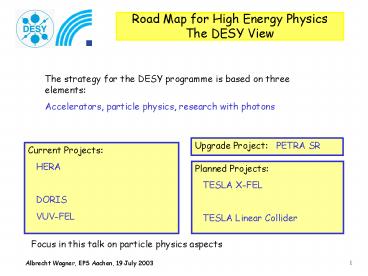
Road Map for High Energy PhysicsThe DESY View
The strategy for the DESY programme is based
on three elements Accelerators, particle
physics, research with photons
Upgrade Project PETRA SR
Current Projects HERA DORIS VUV-FEL
Planned Projects TESLA X-FEL TESLA Linear
Collider
Focus in this talk on particle physics aspects
2
HERA II
- 2000-2002 substantial modifications of HERA
HERA experiments - Goal for HERA II
- H1 und ZEUS 1000 pb-1 (ep e-p) with polarised
e/e- and improved detectors - HERMES first measurements of transversal
spin structure of proton and analysis of nucleon
structure in terms of Skewed Parton
Distributions - HERA-B (until 2003) production b-Quarks in p-N,
- production of charmonium-states and their
propagation in nuclear matter
3
HERA II
Luminosity Goal 7 1031cm-1s-1 by - stronger
focussing - increase in beam current
(background!) Reached in 2003 (with reduced
bunches) 3 1031 (HERA I-nominal 1,5
1031) High background has created delay of 1
year Efficiency of operation Still needs
improvements
- e polarisation
- -gt 50 für H1/ZEUS/HERMES
4
Status of HERA
- The background and operational issues of HERA
have been largely solved - However, the background is still a concern
- Shut down is finished
- start up with p,e in early August.
- luminosity run in 2003 October December
- the HERA experiments are in a good shape and
eager for (more) data taking - goal for integrated luminosity of 1 fb-1 until
end of 2006 (scheduled end of HERA II) -gt
challenging - Recent proposal for a HERA III programme -gt
5
Open Questions in QCD HERA III
- Measure the behavior of inclusive, diffractive
and exclusive reactions in the region near Q21
GeV2 to understand parton to hadron transition. - Measure FL over widest possible kinematic range,
as this is a crucial observable for testing our
understanding of radiation processes in QCD. - Measure exclusive processes (VM production,
DVCS) over wide W range to precisely pin down
energy dependence of cross section. Need
t-dependence of cross sections to get 3-D map of
proton. - Measure forward jet cross sections over widest
possible rapidity range, to study radiation
processes over the full rapidity range from the
proton to the scattered quark. - AND, do it all with nuclei !
6
PRC, ESC Recommendation
- measurements would provide a significant step in
the understanding of the strong hadronic
interactions. - agrees that many of the proposed measurements
cannot be done at other existing or foreseen
facilities. - present level of the theoretical understanding of
QCD does not allow predictions of the proposed
measurements at the level of the precision
achievable by the experiments. - The PRC/ESC rate the HERAIII program at lower
priority compared to the Linear Collider
programme. - Given the other priorities of DESY and its
resources, PRC and ESC do not recommend the
continuation of HERA III
7
Transformation of PETRA
Today PETRA is the injector for HERA e,
p. Transformation into a 3rd generation SR light
source reconstruct 1/8 of arc
German government has agreed to fund PETRA
III Transformation scheduled to start in 2007
8
TESLA Linear Collider and X-ray Laser
X-FEL now a stand-alone facility
- Daresbury, 23 25 September 2002
TESLA LC and X-FEL are based on SC RF
technology The linac designs are essentially
identical
9
The Scientific Case
Consensus document http//sbhep1.physics.sunysb.
edu/grannis/wwlc_report.html
- A world-wide consensus has formed for a baseline
LC project in which positrons collide with
electrons at energies up to 500 GeV, with
luminosity above 1034 cm-2s-1. - The energy should be upgradable to about 1 TeV.
- The LHC and LC will offer mutually supporting
views of the new physics world at the TeV scale. - OECD GSF Consultative Group on High-Energy
PhysicsThere should be a significant period of
concurrent running of the LHC and the LC,
requiring the LC to start operating before 2015.
10
The Status of SC Cavities
SC RF structures for accelerators were developed
in many countries To meet the challenge of
high gradients needed for high energy Linear
Colliders the TESLA collaboration has attracted
all the world expertise in SC, thus leading to
major progress
11
The TESLA Collaboration
- The TESLA Collaboration
- - at present 51 Institutes in 12 countries and
still growing
12
International TRC
Results from International Technical Review (Feb.
2003)
13
Progress on TESLA Technology
First high power test of an electro-polished
cavity Completely new final preparation sequence
(no etching after tank welding) very good result,
similar to vertical test Continuing the RD is
one of the top priorities
Due to the XFEL DESY and partners will focus in
the preparation of collider on linac related
issues (industrialisation, reliability, high
gradient programme)
14
High Power Test of a complete EP nine-cell cavity
HERA plant
Calib.Measurement
- 1/8th of a TESLA cryomodule
- 5 Hz, 500 ms fill, 800 ms flat-top
- 33- gt35 MV/m
- with no interruption related to
cavity-coupler-klystron for more than 600 hours - No field emission
Power/kW
Eacc/MV/m
15
TESLA Energy Strategy
Assuming that cavities will reach 35 MV/m
- TDR (March 2001)
- Base line design for 500 GeV, upgrade possibility
outlined - initially operate at an energy of about 500
GeV, to explore the Higgs and related phenomena,
and then - increasing the energy to 800-1,000 GeV, to more
fully explore the TeV energy scale.
16
Experience with TTF
- Proof of principle and first FEL-experiments at
TTF I
17
VUV-FEL User Facility at TTF II
250 MeV 1 GeV
- RF commissioning in 2003, start of FEL
operation in 2004
18
Recommendations concerning TESLA
The German Science Council has issued in November
2002 its recommendations
- The Science Council requests the Federal
Government to give its binding consent to German
participation in the LC as soon as possible after
the project proposal has been submitted with
specific details concerning international funding
and international cooperation.
The Science Council requests the Federal
Government to give its binding consent to German
participation in the TESLA X-FEL project as soon
as possible after the revised project proposal
has been submitted .
DESY submitted answers to these requests
19
Government Decision
The decisions of the German Ministry for
Education and Research concerning TESLA was
published on 5 February 2003
DESY in Hamburg will receive the X-FEL as
European Project Germany is prepared to carry
half of the 673 MEuro investment cost.
Today no German site for the TESLA linear
collider will be put forward. This decision is
connected to plans to operate this project within
a world-wide collaboration DESY will continue its
research work on TESLA in the existing
international framework, to facilitate German
participation in a future global project
20
Next Steps
- X-FEL
- Continuation of the RD work for the X-FEL
accelerator - Formation of a planning group with all interested
partners (including future users) - Analysis of the present concept for the linear
accelerator, as described in the TDR supplement,
and the laser facility by the planning group - Adaptation of the project parameters to include
the findings and recommendations of the planning
group
- Linear Collider
- Continuation of the high gradient programme
(construction, optimisation and tests of cavities
with 35 MV/m) - Build-up of a European LC Design Teams as part
of an international Design Team - Participation in the LC working groups of ICFA
and ECFA
21
Next Steps for the X-FEL
- Site and some of the technical parameters for
XFEL Laboratory are currently reconsidered. - Formation of European Working Groups under way.
- Aim for decision on construction in 2005!
22
Consequences of the Decision for the Linear
Collider
- Given the decision of the German government the
community will now take a path used for other
international projects (e.g. ITER) - unite first behind one project with all its
aspects, including the technology choice, in 2004
and then - approach all possible governments in parallel
in order to trigger the decision process,
definition of structure of organisation and site
selection - Aim at approval of LC around 2006/2007
- The ILCSG agrees that it would be highly
desirable to form a Core Group to begin the
international design, based on accumulated work
to date, but reexamined in a completely
international context.
23
Technology Decision
Aim at joint selection of one technology in 1
year.
- How
- Gather a committee of wise persons, who use
criteria to be developed by the ILCSC, to
recommend a technology choice to the ILCSC. - The regional steering committees will each
nominate 4 persons from which the ILCSC will
choose three from each list for a total of 9 wise
persons. - First discussion of the make-up of the committee
in August. - Advice in this will be widely sought from the
community.
24
How to Realise Big Accelerator Projects?
Global Accelerator Network
- Collaboration of interested accelerator
laboratories and institutes world-wide with the
goal to build, operate and utilise large new
accelerators - Follows example of major detector collaboration
in particle physics - Partners contribute through components or
subsystems - Facility would be the common property of the
participating countries, these would also share
the responsibility and cost for operation. - Project of limited duration (25 years)
- A new model of international cooperation
25
Strategy for Particle Physics at DESY
- Present Programme
- HERA II, astroparticle physics (Amanda/Icecube),
theory - HERA will end 2006/2007
- For DESY the LC is the top priority after LHC,
in accordance with the world wide agreed
recommendations - Discussion of strategy for research in particle
physics at DESY in the time between HERA end and
LC has started - Strategy group has been set up in spring 2003
- (DESY and users, members of advisory committees)
- Similar groups exist at SLAC, FNAL, KEK
Recommended

