

The Compressed Baryonic Matter Experiment at the future GSI facility PowerPoint PPT Presentation
1 / 30
Title: The Compressed Baryonic Matter Experiment at the future GSI facility
1
The Compressed Baryonic Matter Experiment at the
future GSI facility Peter Senger, GSI Strange
Quark Matter 2001
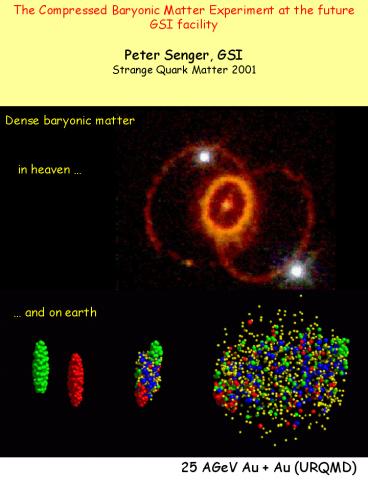
Dense baryonic matter
in heaven
and on earth
25 AGeV Au Au (URQMD)
2
Models of neutron stars
F. Weber, J.Phys. G27 (2001) 465
"Chemistry" of dense matter ? In-medium
properties of hadrons ? Deconfinement at high
baryon densities ?
3
Matter under extreme conditions
restoration of chiral symmetry
in-medium modifications of hadrons
4
The phase diagram of strongly interacting matter
CERN-SPS, RHIC, LHC high temperature, low
baryon density AGS, GSI (SIS200) moderate
temperature, high baryon density
(almost) terra incognita !
5
Our approach Produce high baryon densities in
heavy ion collisions at 5 40 AGeV. Build an
universal experiment which measures
simultaneously both hadrons and electrons ?,
K, ?, ?, ?, p, ?, ?, ?, ?, D, J/? (multiplicities,
phase-space distributions, centrality, reaction
plane). Based on detector technologies developed
for LHC experiments. Perform systematic
measurements using a dedicated accelerator High
beam intensity and duty cycle, Excellent beam
quality, High availability
6
Mapping the QCD phase diagram with heavy ion
collisions
P. Braun-Munzinger
?B ? 6 ?0
?B ? 0.3 ?0
Lattice QCD at finite ? Z. Fodor and S.D. Katz,
hep-lat/0106002
baryon density ?B ? 4 ( mT/2?)3/2
exp((?B-m)/T) - exp((-?B-m)/T)
baryons - antibaryons
7
Pion production excitation function
ltn?gt/Apart 12 at 1040 AGeV
8
Relative enhancement of strangeness production in
AA collisions around 30 AGeV
AuAu AGS E866, E917 PbPb CERN NA49
Statistical model calculation P.
Braun-Munzinger J. Cleymans H. Oeschler K.
Redlich
?s
9
Physics topics and observables
1. In-modifications of hadron properties
? onset of chiral symmetry restoration at high
?B measure ?, ?, ? ? ee-
open charm (D mesons) 2.
Indications for deconfinement at high ?B
? enhanced strangeness production ?
measure K, ?, ?, ?, ? ? anomalous
charmonium suppression ? measure
J/?, D ? softening of EOS
measure flow excitation function 3.
Critical point ? event-by-event
fluctuations 4. Color superconductivity
? precursor effects at TgtTc ?
Note In heavy ion collisions ?, ?, J/? not
measured below 158 AGeV (?, ?, ? ) ? ee- not
measured from 2 158 AGeV D mesons not
measured at all
10
Looking into the fireball
using penetrating probes short-lived vector
mesons decaying into electron-positron pairs
11
Electron-positron pairs from AA collisions
DLS-data R.J. Porter et al. Phys. Rev. Lett.
79 (1997) 1229 BUU calculation E.L.
Bratkovskaya et al. Nucl. Phys. A634 (1998) 168
DLS (LBNL)
next generationHADES_at_GSI
CERES (CERN-SPS)
12
Measure spectral functions of vector mesons via
their decay into electron-positron pairs
(penetrating probes!) using Ring Imaging
Cherenkov detectors
NA45/CERES _at_ CERN-SPS
CH4 radiator gas ?thr 32
s
HADES _at_ GSI
C4F10 radiator gas ?thr 18.3 UV-det. fast CsI
cathode
13
Strangeness and charm production
SIS18 strangeness production at threshold
? probing in-medium properties at ?
1 -3 ?0 SIS200 charm production near
threshold ? probing in-medium
properties at ? 5 -10 ?0
14
Strange mesons in nuclear matter
G.E Brown, C.H. Lee, M. Rho, V. Thorsson, Nucl.
Phys. A 567 (1994) 937 T. Waas, N. Kaiser, W.
Weise, Phys. Lett. B 379 (1996) 34 J.
Schaffner-Bielich, J. Bondorf, I. Mishustin
, Nucl. Phys. A 625 (1997)
pK 0
Charmed mesons in nuclear matter
A. Sibirtsev, K. Tsushima, A.W. Thomas, Eur.
Phys. J. A 6 (1999) 351
Measure yields in AA collisions at beam
energies close to production threshold
15
Charmed mesons
D (cd), D- (cd), m 1869.3 MeV D0 (cu), D0
(cu), m 1864.6 MeV Production pn ? D-?c p
(threshold energy Epkin 11.9 GeV) pp ? D
D-pp (threshold energy Epkin 14.9 GeV) Some
hadronic decay modes D? (c? 317 ?m) D ? K0?
(2.9?0.26) D ? K-?? (9 ? 0.6) D0 (c?
124.4 ?m) D0 ? K-? (3.9 ? 0.09) D0 ? K-? ?
?- (7.6 ? 0.4)
experimental challenge large combinatorial
background measure displaced vertex with
resolution of ? 30?m
16
Charm production in pp collisions
Hidden charm (cc)
Open charm D-mesons
Figure taken from W. Cassing, E. Bratkovskaya, A.
Sibirtsev, nucl-th/0010071
17
Probing quark-gluon matter with charmonium
NA50 Collaboration at CERN J/? (cc) ? ??-
(6)
PbPb 158 GeV/c
18
Upgrade of NA50 at CERN-SPS indirect measurement
of D-mesons
Idea identify prompt dimuon pairs and those from
decaying DD pairs by precise vertex-determination
Radiation-hard silicon pixel detectors (LHC
development)
19
Multistrange hyperons
Identification by decay pattern
WA97
WA97 Collaboration (CERN)
pp ? K ?0 p ( Ep? 1.6 GeV ) pp ?
KK-pp (Ep ? 2.5 GeV) pp ? K K ?- p
( Ep ? 3.7 GeV ) pp ? KKK0?- p ( Ep ?
7.0 GeV ) pp ? ?0 ?0 pp ( Ep ? 7.1 GeV ) pp
? ? ?- pp ( Ep ? 9.0 GeV ) pp ? ? ?- pp
( Ep ? 12.7 GeV )
?0 (s d u) m 1116 MeV ?- (s s d) m 1321
MeV ?- (s s s) m 1672 MeV
In heavy ion collisions cooking of
multistrange hyperons by strangeness exchange
reactions ?0 K- ? ?-?0
?0 K ? ??0 ?- K- ? ?- ?-
? K ? ? ?
Enhanced yield at high densities
20
critical point
gas
liquid
coexistence
Below Tc 1. order phase transition above Tc
no phase boundary At the critical point Large
density fluctuations, critical opalescence
21
The critical point
In the proximity of the critical point
critical fluctuations measure
even-by-event e.g multiplicity and transverse
momentum of (soft) pions as function of control
parameters like beam energy, centrality, rapidity
and ion size
Event-by-event analysis by NA49 5 most central
PbPb collisions at 158 AGeV
temperature
chemical composition
purely statistical fluctuations compatible with
hadron gas in equilibrium (new data taken at
40 and 80 AGeV)
Critical point not yet observed scan energy range
10 - 30 AGeV
22
Central baryon densities in AA at 20 AGeV
AuAu ? 7 ?o for about 4 fm/c (? ?
1.1 GeV/fm3) UU (tip-tip) ? 10 ?o for about
5 fm/c (? ? 1.6 GeV/fm3)
23
The future GSI project
HADES
CBM
Dileptons from 1 40 AGeV NiNi
24
Experimental concept
- Requirements
- ? identification of electrons and hadrons
- (2 electron detectors pion suppression by
104- 105) - ? reconstruction of particle vertices with high
resolution - (1000 charged particles in central AuAu
collisions at 25 AGeV) - ? 107 AuAu reactions/sec
- (beam intensities up to 109 ions/sec, 1
interaction target) - ? good momentum resolution
- ? large acceptance
Silicon 7 planes, 3 Mio pixel, 1.5 Mio strips
25
Second generation fixed target experiment
TRD
TOF
RICH
magnet
Detector components 1. Dipole magnet (1-2T) 2.
Silicon pixel/strip detectors ?, ?, ?, ? 3.
RICH particles with ? 10-100 electrons,
(pions, kaons) 4. TRD electrons (? ? 2000) J/?
5. TOF-start (diamond pixel detector) and
TOF-stop (RPC) particle identification (
pions, kaons, protons, ) 1.-5. needed for D
mesons Trigger 1. level reactions,
centrality, hits in TRD and RICH 2. level
electrons, momentum, hit matching, rings in
RICH 3. level displaced vertex
26
Schematic spectrum of dilepton mass
J/? experiments a count rate estimate
25 AGeV AuAu
158 AGeV PbPb J/?? multiplicity in central
collisions 1.510-5
110-3 beam intensity 2108/s
2107/s interactions
8106/s (4) 2106/s (10) central
collisions 8105/s
2105/s J/? rate 12/s
200/s 6 J/???ee- (??-)
0.7/s 12/s spill
fraction 0.8
0.25 acceptance 0.25
? 0.1 J/? measured
0.14/s ? 0.3/s
? 8104/week ?
1.8105/week
combinatorial background ???ee- ? misidentified
pions ? conversion ?? ee- ?
27
e, e- transverse momentum
?0??ee-
J/? (x105)
cut pT? 1 GeV/c
counts
? (x10-4)
???ee-
e, e- opening angle
?
counts
?
cut ? ? 10o
J/? (x105)
?
28
AuAu 25 AGeV ee- invariant mass spectra
PLUTO simulations 10 Mio. events
without cuts (incl. misident. pions)
???ee-
sum
counts
???ee-
??ee-
J/??ee-
DD?ee-X
with cuts pt(e,e-) gt 1 GeV/c, ?lab? 25o, ? gt 10o
NJ/? 1.6
counts
signal/background ? 10
29
Summary
- Exploring highest baryon densities
- in AA collisions at 10 - 40 AGeV
- Searching for
- ? modification of hadron properties
- the deconfinement and chiral transition
- the critical point
- Key observables
- multistrange hyperons, light vector mesons,
- charmonium and open charm, flow of hadrons
- Experimental challenge
- rare signals, high particle multiplicities,
- high beam intensities, universal setup
Working group
A. Andronic P. Braun-Munzinger Ch. Finck B.
Friman N. Herrmann R. Holzmann W. König M.
Lutz P. Senger Y. Shin R. Simon H. Ströbele J.
Stroth
30
- Collaborators from following institutes
- 1. GSI Darmstadt
- 2. Institut für Kernphysik, TU Darmstadt,
- 3. Institut für Kernphysik, Univ. Frankfurt,
- 4. Physikalisches Institut, Univ. Heidelberg,
- 5. Kirchhoff Institut für Physik, Univ.
Heidelberg - 6. Instituto Nazionale di Fisica Nucleare, LNS,
Catania, Italy - 7. Institut de Recherches Subatomiques, IReS ,
IN2P3-CNRS/ULP, Strasbourg, France - 8. Institute of Physics, Jagiellonian University,
Cracow, Poland - 9. Institute of Experimental Physics, Nuclear
Physics Division, Warszawa, Poland - 10. ISEC/LIP, Coimbra, Portugal
- 11. Institute for Physics and Nuclear Engineering
IPNE, Bucharest, Romania - 12. Research Institute for Particle and Nuclear
Physics, KFKI, Budapest, Hungary
Recommended

