

End to End Simulation of LIGO Hiro Yamamoto LIGO Lab/CIT PowerPoint PPT Presentation
Title: End to End Simulation of LIGO Hiro Yamamoto LIGO Lab/CIT
1
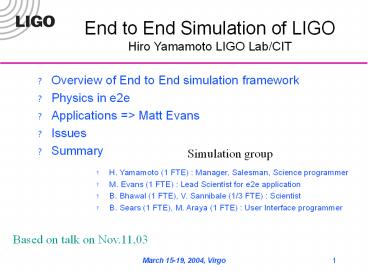
End to End Simulation of LIGOHiro Yamamoto LIGO
Lab/CIT
- Overview of End to End simulation framework
- Physics in e2e
- Applications gt Matt Evans
- Issues
- Summary
Simulation group
- H. Yamamoto (1 FTE) Manager, Salesman, Science
programmer - M. Evans (1 FTE) Lead Scientist for e2e
application - B. Bhawal (1 FTE), V. Sannibale (1/3 FTE)
Scientist - B. Sears (1 FTE), M. Araya (1 FTE) User
Interface programmer
Based on talk on Nov.11,03
2
LIGO End to End simulationwhat is it
- Time domain simulation written in C
- simulating realistically with non linearity
automatically included - Like MATLAB with Interferometer toolbox
- Major physics components and tools relevant for
LIGO - fields optics, mechanics, digital and analog
electronics, measured noise, STATE SPACE using
ABCD, etc - Flexible to design wide varieties of systems
- from simple pendulum to full LIGO I to adv.LIGO
- from fast prototyping to full design
- Easy development and maintenance
- use of graphical front end written in JAVA for
the system design - object orient design for easy addition of new
physics
3
LIGO End to End Simulation the motivation
- Assist detector design, commissioning, and data
analysis - To understand a complex system
- back of the envelope is not large enough
- complex hardware pre-stabilized laser, input
optics, core optics, seismic isolation system on
moving ground, suspension, sensors and actuators - feedback loops length and alignment controls,
feedback to laser - non-linearity cavity dynamics to actuators
- field non-Gaussian field propagation through
non perfect mirrors and lenses - noise mechanical, thermal, sensor,
field-induced, laser, etc amplitude and
frequency creation, coupling and propagation - wide dynamic range 10-6 10-20 m
- As easy as back of the envelope
4
End to End Simulation overview
- End to End simulation environment
- Simulation programs - program to run
- modeler time series generator
- modeler_freq spectrum analyzer
- Description files defining what to simulate -
input files - Simple pendulum full LIGO
- Graphical Editor to create and edit description
files - alfi - editor - LIGO I simulation packages
- Han2k used for the lock acquisition design
500 parts - SimLIGO to assist LIGO I commissioning 3000
parts
5
End to End Simulation perspective
- e2e development started after LIGO 1 design
completed (1997 ) - LIGO 1 lock acquisition was redesigned
successfully using e2e by M.Evans (2000 2001) - Major on going efforts (2001 )
- Realistic noise of the locked state
interferometer - Effect of the thermal lensing on the lock
acquisition - Alignment control system in realistic condition
- Effect of radiation pressure (for LIGO I and
adv.LIGO) - e2e LIGO I simulation generates linear noise
- Preparation for adv.LIGO
- Dual recycling cavity code for fast simulation
- State Space support
- Better Modal Model class for simulating realistic
optics - Better Matrix class with expression template for
better coding - Efref t Ebin Mref Efin
- more extensive thread support
6
FUNC X primitive modulehow to add a new function
in OO way
- How to develop a new physics, like locking
algorithm? - Day 1
- use 100s of built-in elements in a cumbersome
way or write C code and recompile and test - Day 2
- use expression parser module, a simplified c like
environment. No compilation needed, but limited
(no print, no struct ) use and slow simulation. - Day 3
- provide code, and automatically compiled and
linked dynamically at run time - like MATLAB mex-file, but automated. Or MATLAB m
files are automatically compiled and linked
dynamically with matlab - Easy development and fast simulation
7
e2e physicsTime domain simulation
- Analog process is simulated by a discretized
process with a very small time step (10-7 10-3
s) - single time step in the entire system
- Linear system response is handled using digital
filter and State Space - e2e DF internally the same as the one used at
the LIGO site - Transfer function -gt digital filter
- Pendulum motion
- Analog electronics
- Easy to include non linear effect
- Saturation, e.g.
- A loop should have a delay
- Strict chronological ordering
- Need to put explicit delay when needed
- Simulation time step ltlt time constant of the
system - Not practical to simulate Core Optics and Mode
Cleaner together
8
e2e physicsState Space model by ABCD matrix
- Advanced LIGO Seismic Isolation and Suspension
teams have developed their models, available by
SS - More complex LIGO I model (violin, etc) by SS
- Runge-Kutta with adoptive time step to achieve
given accuracy - Can use quad precision internally
- Input for SS module to simulate x'' 2a x'
w02 x 0 - a and w0 given as macro
- as row separator
- A2x2, B2x1, C1x2, Dappropriate empty matrix
A 0,1 -omega0omega0, -2a B
0 omega0omega0 C 1,0 accuracy 1e-12
9
e2e physics Fields and optics
- Time domain modal model
- field is expanded using Hermite-Gaussian eigen
states - number of modes (nm) lt4 for most of the study
- Reflection matrix
- tilt
- vertical shift
- curvature mismatch
- Completely modular
- Arbitrary planar optics configuration can be
constructed by combining mirrors and propagators - Photo diodes with arbitrary shapes can be
attached anywhere - Adiabatic calculation for short cavities for
faster simulation - Thread is used to calculate multiple sideband
evolution at the same time
10
e2e physics optics imperfection
n gt n
- Simple lens model
- LIGO 1
- lock, mode mixing
- Mode decomposition matrix - tbd
- LIGO 1
- actual mirror phase map
- more accurate
- Adv. LIGO
Rcurv R curv
Thermal lensing
ITM
ITM
TEMmn
TEMmn
Tmn-gtmn
TEMmn
Rmn-gtmn
11
Sensing noiseShot noise for an arbitrary input
Average number of photons by the input power of
arbitrary time dependence
Average number of photons Actual integer number
of photons Simulation option
Actual number of photons which the detector
senses.
photons
Shot noise can be turned on or off for each photo
diode separately.
time
12
Radiation Pressure and noise
- Radiation pressure and torque based on modal
model - Radiation linear force has noise based on the
photon counting - no noise on torque yet
- Radiation pressure is applied to the mechanical
calculation of the mass in the next time step
position
pos(RPF,)
Ein
optical mass
mechanical mass
Eref
Rad Pressure Force(pos,Ein,Eref)
13
e2e physicsMechanics simulation
- Seismic motion from measurement
- correlations among stacks
- fit and use psd or use time series
- (2) Parameterized HYTEC stack
- (3) Simple single suspended mirror
- 4/5 sensors and actuators
- imbalance of sensors and actuator for the length
and alignment coupling - violin mode excitation?
3
2
4
1
14
MSE Mechanical Simulation Engine
- C Library to simulate a fully three dimentional
mechanical system, developed by G.Cella - modular environments
- automatic search for working points
- thermal noise and realistic damping simulation
- system asymmetries properly propagated
- Stand alone simulation package, with interface to
e2e taken into account - frequency and time domain
- build and debug a model and integrate to e2e by
placing wrapper - integration with other mechanical simulation
- For adv. LIGO, there are several sub-system level
modeling efforts are already doing on, and MSE
can interface to those models.
15
Mechanical noise of one mirrorseismic thermal
noises
suspended mirror (transfer function or 3d model)
seismic isolation system (transfer function)
(power spectral density)
seismic motion (power spectral density)
16
Is double precision enough?will be OK for LIGO
I, probably not OK for adv.LIGO
Comparision of suspension simulations using
double and quad precision internally.
17
e2e Graphical Editor - alfi
Laser
mirror
mirror
Photo diode
propagator
Photo diode
18
e2e exampleFabry-Perot cavity dynamics
1 m / s
ETMz -10-8 10-6 t
Resonant at
Reflected Power
Transmitted Power X 100
Power 1 W, TITM0.03, TETM100ppm, Lcavity
4000m
19
Inputs and outputs
- Description files - box files
- what to simulate
- use I/O primitives to read and write data
- Macro definitions
- all numerical values in box files can be written
using symbolic names - LHO4k.mcr optical path lengthsLeng_RM2BS
4.397 m "RM-HR to BS-HRLeng_BS2ITMx 4.965
m "BS-HR to ITMx-HRLeng_BS2ITMy 4.609
m "BS-HR to ITMy-HRLeng_ArmX 3995.055
m "ITMx-HR to ETMx-HRLeng_ArmY 3995.055
m "ITMy-HR to ETMy-HRLeng_PRC Leng_RM2BS
(Leng_BS2ITMx Leng_BS2ITMy) / 2SnpAsy
Leng_BS2ITMx - Leng_BS2ITMy - Outputs
- no built in analysis tools
- time series
- psd
- spectrum analyzer
20
LIGO simulationwithout programming
- Package distributed
- SimLIGO box files
- auxiliary files
- macro files, run instructions, support apps
- matlab files for easy analysis of e2e outputs
- modeler lt run.in to generate time series and psds
- 5 lines in unix terminal to generate the
sensitivity curve - Macro files - text file
- lengths and mirror quantities
- noise on-off
- control on-off
- shaking mirrors length and angle - linear,
periodic, random - configurations FP, PRM, full LIGO
21
Main box of SimLIGOtwo views of alfi and
ptimitive menu
22
COC boxsuspension, core optics and analog stuff
23
OpticsPRM, arm, radiation pressure, telescope,
f-l hack, etc
24
COCwhen you want to know what is MMTref, just
25
Profile of SimLIGOcpu usage point of view
Profiler of 3352 action calls per time step ltlt
built-in functions
Profile of 41 module
usage sorted by total times index frac
total time/tick module name
() (sec) (microsec)
------------------------------------------------
---------- 0 45.24 16.99 2179
1 rec_sum ltlt mnlt2, 1 thread 1
10.6 3.981 510.4 278
FUNC_2x2 2 7.929 2.979 381.9
119 FUNC_16x16 3 7.679 2.885
369.8 210 FUNC_1x1 4 4.922
1.849 237 29 pd_demod 5
4.615 1.733 222.2 122
FUNC_4x4 6 4.075 1.531 196.2
12 mirror2 Profile of 583 box usage
sorted by total times ltlt use-defined functions
index frac total time/tick module
name () (sec) (microsec)
--------------------------------------------
-------------- 0 100 37.57
4816 1 Detector 1 94.34
35.44 4543 1 Detector.COC
2 54.08 20.31 2604 1
Detector.COC.CoreOptics 3 24.56 9.224
1183 1 Detector.COC.Suspensions
4 16.54 6.215 796.8 6
Controller 5 7.916 2.974 381.2
6 Mech
26
Summary
- Simulation engine and interface are ready
- LIGO I simulation is ready
- Good playground for length and alignment control
design - Sensitivity curve properly simulated - ready to
go beyond - LIGO I simulation needs improvements
- Michelson cavity is degenerate and badly mode
mismatched (better now by thermal compensation) - Better frequency response of cavities
- Lock loss study demands more reality
- more noise, more reality
- scattering noise, acoustic coupling, beam
clipping - adv.LIGO simulation demands more
- physics (dual recycling cavity)
- speed
- accuracy,
Recommended

