

Faraday to Pharos a successful EU collaboration in radioastronomy PowerPoint PPT Presentation
1 / 25
Title: Faraday to Pharos a successful EU collaboration in radioastronomy
1
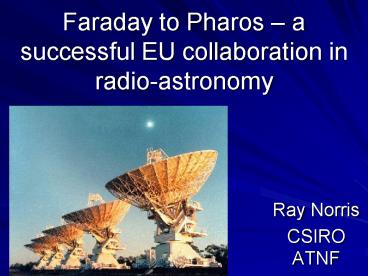
Faraday to Pharos a successful EU collaboration
in radio-astronomy
- Ray Norris
- CSIRO ATNF
2
The Australia Telescope
3
The first stars in the Universe the Hubble Deep
Field South
4
Radio-astronomy and innovation
- Australian radio-astronomy has a quantifiable
track record of delivering benefits to Australian
industry - Radiata - IEEE802.11A - CISCO (600m)
- Antennas (60m)
- (Artificial dielectrics) (???m)
- Current focus is to develop the next-generation
radio-telescopes - Replace dishes by
- smart software
- State-of-art signal processing
- Grid computing
5
Radioastronomy the next generation
OLD
NEW
6
PHAROS objective
This is a conventional radio-telescope!
7
PHAROS objective
This is a next-generation (hybrid)
radio-telescope!
or a satellite downlink or whatever
8
Where to locate the worlds next-generation
radio-telescopes?
- Australias Strength in astronomy
- Australias Radio-quiet competitive advantage
9
Future Radio Telescopes in Australia
- Our Strength in astronomy
- Our Radio-quiet competitive advantage
- Means that Australia is being considered as host
for two future radio telescope projects - LOFAR
- A200M
- Start 2004
10
Future Radio Telescopes in Australia
- Our Strength in astronomy
- Our Radio-quiet competitive advantage
- Means that Australia is being considered as host
for two future radio telescope projects - LOFAR (Australia now selected as best site)
- A200M
- Start 2004
- SKA (Square Kilometre Array)
- A2b
- Start 2012
11
SKA an e-Science telescope
12
Industry involvement in SKA/LOFAR
- Technologies
- Complex systems (large fault tolerant, adaptive
network) - Grid computing
- Sustainable Energy generation in remote areas
- Signal processing
- Desert Knowledge
- Smart antennas,
- Industry Partners
- Connell Wagner
- CEA
- Dell
- Advanced Powder Technologies
- Etc
13
Does Australia have the capability to develop the
next generation radio-telescopes?
- Not on our own!
- But we can be a leading global player
14
- FARADAY an FP5 program
- FARADAY Focal-plane Arrays for Radio Astronomy
Design, Access, and Yield - Started November 2001
- Finishes November 2005.
- Partners
- Jodrell Bank, University of Manchester (UK)
- CNR (Italy)
- ASTRON (Netherlands)
- Nicolaus Copernicus University (Poland)
- CSIRO (Australia)
- Funding
- Total development value (all contributions) 5M
(AUD) - CSIRO contribution 500k
- 200k matching grant recently received from DEST
(IAP) Thanks! - DEST grant will capture greater value for
Australia
15
- FARADAY deliverables
- 30 GHz continuum horn array
- cooled 8-beam array
- 10GHz bandwidth,
- 21-26 GHz spectroscopic horn arrays
- 5-beam array
- Phased array 2-5 GHz
- 16 element, 2 beam instrument
- tested on Luneberg Lens
- 4. Data acquisition and software systems for
horn arrays AIPS - environment.
16
- Technologies to be developed by FARADAY
- Indium Phosphide MMIC (monolithic millimetre
integrated circuits) - Wide-bandwidth phased array antennas
- Software and algorithms for analysing
phased-array data - Strong alignment with CSIRO initiative for MMIC
developments
17
Deliverables to Australia
- A working prototype phased array for testing and
characterisation based on InP MMICs. - A continuum single dish multi-beam software
package at Parkes. - A study of very large element multi-beam arrays
for future large facilities (e.g. SKA)
18
E.g. 30 GHz integrated receiver pair with MMIC
circuits designed by ATNF
19
- FP6 Program PHAROS
- PHAROS Phased Arrays for Reflector Observing
Systems. - Start February 2004
- End December 2006.
- Partners
- CSIRO (Australia)
- Jodrell Bank, University of Manchester (UK)
- ASTRON (Netherlands)
- Nicolaus Copernicus University (Poland)
- CNR (Italy)
- MECSA (consortia of IC/electronics), Italy
- University of Birmingham (UK)
- Total value of PHAROS project A8.5M
20
- PHAROS Deliverables
- Prototype cooled phased 8-beam array receiver,
- 4-8 GHz
- Use on Westerbork (Netherlands), Lovell
telescope (UK), Parkes (Australia) - CSIRO contribution
- signal processing
- antenna design
- software
21
Outcomes for Australia
- Access to the generic prototype phased array for
testing and characterisation - Access to beam-forming software and signal
processing IP. - 3. Access to an integrated chip foundry within
Europe (MECSA) free of export licence
constraints. - 4. A study of phased arrays for future large
facilities (e.g. SKA) and a pathway to tiled
phase array technologies.
22
Next EU initiative SKA Design Study EU
Partners Canada CSIRO, ANU Builds on Faraday
PHAROS technologies Proposal will be submitted
to EU in March 2004 Before then identify
areas of involvement (incl Universities) -
identify strategic technology areas for ATNF -
overlap with LOFAR
23
Why are Faraday/Pharos successful?
- Projects are well-aligned with our strategic
goals - Clearly-defined outcomes for all participants,
including Australia - We get the best labs in Europe working on our
projects! - and vice-versa -gt win-win!
24
How could Australia get even better value out of
EU FP5/FP6 programs
- Extend DEST IAP funding beyond 2006 (to match
FP6) - Align IAP scheme with EU in terms of funding
existing positions at 50 - EU proposals and DEST proposals have different
formats, deadlines, criteria - This disadvantages Australian researchers in
negotiations - Need dedicated DEST funding schemes to match EU
processes and timescales - Once a proposal has been accepted by EU, only
criterion for Australian funding should be
value to Australia
25
The End - or is it just the beginning?
Recommended

