

Expressing to whom or for whom Indirect Object Pronouns PowerPoint PPT Presentation
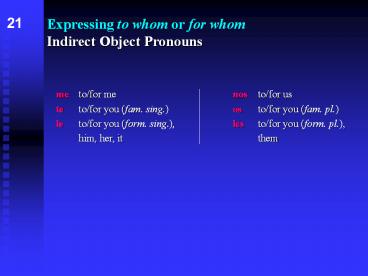
Title: Expressing to whom or for whom Indirect Object Pronouns
1
Expressing to whom or for whomIndirect Object
Pronouns
21
- me to/for me nos to/for us
- te to/for you (fam. sing.) os to/for you (fam.
pl.) - le to/for you (form. sing.), les to/for you
(form. pl.), - him, her, it them
2
Expressing to whom or for whomThe Verbs dar and
decir
21
- dar decir (i)
- (to give) (to say to tell)
- doy damos digo decimos
- das dais dices decís
- da dan dice dicen
3
Expressing Likes and DislikesThe Verb gustar
22
- Spanish
- Me gusta la playa.
- No le gustan sus cursos.
- Nos gusta leer.
Literal Equivalent The beach is pleasing to
me. His courses are not pleasing to him. Reading
is pleasing to us.
English Phrasing I like the beach. He doesnt
like his courses. We like to read.
4
Talking About the Past (1)Preterite of Regular
Verbs
23
comer comí comimos I ate (did eat) we
ate comiste comisteis you ate you (fam.,
pl. Sp.) ate comió comieron you/he/she ate
you/they ate
hablar hablé hablamos I spoke (did
speak) we spoke hablaste hablasteis you spoke
you (fam., pl. Sp.) spoke habló
hablaron you/he/she spoke you/they spoke
vivir viví vivimos I lived (did live)
we lived viviste vivisteis you lived
you (fam., pl. Sp.) lived vivió
vivieron you/he/she lived you/they lived
5
Talking About the Past (1) Preterite of dar,
hacer, ir, and ser
23
- dar hacer ir/ser
- di dimos hice hicimos fui fuimos
- diste disteis hiciste hicisteis fuiste fuistei
s - dio dieron hizo hicieron fue fueron
Recommended

