

What are the implications of the Zone of Proximal Development PowerPoint PPT Presentation
1 / 1
Title: What are the implications of the Zone of Proximal Development
1
What are the implications of the Zone of Proximal
Development to learning and leading
workshops? Maria Mukovoztchick, Peer Leader, City
College of The City University of New York.
"... when a learner is stretched beyond the
comfort of his or her learning maximum learning
will be achieved." -Vygotsky
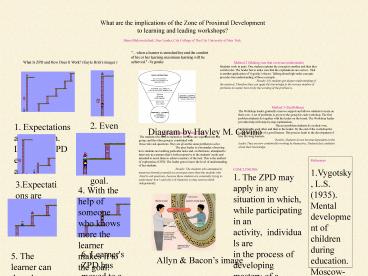
What Is ZPD and How Does It Work? (Gayle Britts
images )
Method 2 (Making sure that everyone
understands) Students work in pairs. One student
explains the concept to another and then they
switch roles. The leader has to make sure that
the explanations are correct. That is another
application of Vygotskys theory. Talking about
high-order concepts precedes true understanding
of those concepts. Results My students got
deeper understanding of the material. Therefore
they can apply this knowledge to the various
number of problems no matter how tricky the
wording of the problem is.
Method 3 (Scaffolding) The Workshop leader
gradually removes support and allows students to
learn on their own. A set of problems is given to
the group for each workshop. The first problem
students do together with the leader on the
board. The Workshop leader provides help with
step-by-step explanations. The next problem
students do on their own, explaining to each
other and then to the leader. By the end of the
workshop the leader plays the role of a good
listener. This process leads to the development
of true life-long learners. Results Students do
not become dependent on the leader. They are now
comfortable working by themselves. Students feel
confident about their knowledge.
2. Even with help learner cannot reach the goal.
1. Expectations are too high. Learner's ZPD ends
at red arrow.
Diagram by Hayley M. Cavino
Method 1(working within ZPD) The students who
tend to memorize formulas are separated into one
group, and the other group is constituted with
those who ask questions. They are given the same
problem to solve. The peer leader is a
bystander, observing how students are tackling
particular tasks and, on that basis, attempted to
intervene in a manner that is both responsive to
the students needs and intended to assist them
to achieve mastery of the task. This is the
method of exploration of ZPD. The leader gets to
know the level of understanding of her
students. Results The students who attempted to
memorize formulas needed an assistance more than
the students who liked to ask questions, because
those students are constantly trying to
understand how's and whys of chemistry so they
learn to think independently.
CONCLUSIONS 1. The ZPD may apply in any
situation in which, while participating in an
activity, individuals are in the process of
developing mastery of a practice or
understanding of a topic. 2. The ZPD is
constructed in the interaction between
participants in the course of their joint
engagement in a particular activity. 3. To
teach in the ZPD is to be responsive to the
learner's current goals and stage of
development and to provide guidance and
assistance that enables him/her to achieve those
goals and, at the same time to increase his/her
potential for future participation 4. To learn
in the ZPD does not require that there be a
designated teacher whenever people collaborate
in an activity, each can assist the others, and
each can learn from the contributions of the
others. 5. Learning in the ZPD involves all
aspects of the learner and leads to the
development of identity as well as of skills and
knowledge. For this reason, the affective
quality of the interaction between the
participants is critical. Learning will be most
successful when it is mediated by interaction
that expresses mutual respect, trust and
concern.
References 1.Vygotsky, L.S. (1935). Mental
development of children during education.
Moscow-Leningrad 2.Vygotsky, L.S. (1978). Mind
in society The development of higher
psychological processes. (M. Cole, V.J. Steiner,
S. Scribner, E. Souberman, Eds.) Cambridge 3.
Vygotsky, L.S. (1934/1987) Thinking and speech.
In R.W. Rieber and A.S. Carton (Eds.), The
collected works of L.S. Vygotsky, Volume 1
Problems of general psychology, Trans. N. Minick.
New York Plenum. 4. Wells G. (1999) Dialogic
inquiry Towards a sociocultural practice and
theory of education. New York Cambridge
University Press 5. web.syr.edu/hcavino/
cognitive_theory.htm (04-18-04) 6.
www.abacon.com/slavin/ t14.html (04-18-04)
3.Expectations are within the ZPD.
4. With the help of someone who knows more the
learner makes it to the goal.
6. Learner's ZPD has moved to a different level
and learner, with help, achieves another goal.
5. The learner can then do what was learned
alone.
Allyn Bacons image
Recommended

