

DEVELOPMENT OF CANINE MODEL FOR THE STUDY OF OBSTRUCTIVE SLEEP APNEA PowerPoint PPT Presentation
1 / 21
Title: DEVELOPMENT OF CANINE MODEL FOR THE STUDY OF OBSTRUCTIVE SLEEP APNEA
1
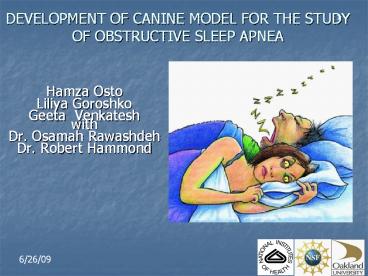
DEVELOPMENT OF CANINE MODEL FOR THE STUDY OF
OBSTRUCTIVE SLEEP APNEA
- Hamza Osto
- Liliya Goroshko
- Geeta Venkateshwith
- Dr. Osamah Rawashdeh
- Dr. Robert Hammond
6/26/09
2
Outline
- Sleep apnea basics
- Current treatments for obstructive sleep apnea
- SIBHI Project goals of Summer 2009
- Options for Detecting Sleep Stage
- Current Status
- References
3
What is Sleep Apnea?
- Sleep apnea is a disorder characterized by
a reduction or cessation (pause of breathing,
airflow) during sleep. - Three types of apnea
- Central sleep apnea
- Mixed sleep apnea
- Obstructive sleep apnea
4
Central and Mixed sleep apnea
- Central Sleep Apnea
- Breathing starts and stops throughout night
- brain doesn't send proper signals to the muscles
that control your breathing - Mixed Sleep Apnea
- a transition from central to obstructive features
during the events themselves - Very rare
5
Obstructive Sleep Apnea (OSA)
- Muscles and tissues in rear of throat collapse
- Complete/partial obstruction of airway
- 84 of people with sleep apnea have OSA
6
Factors Contributing to OSA
- The occurrence of obstruction is depends
not only to deep stage of sleep and the
resulting relaxation, but also due to - Obesity-Fat deposits around upper airway may
obstruct breathing - High blood pressure OSA is more common with
people with high blood pressure - Diabetes- type 2 diabetes caused by obesity,
lack of exercise - Men are at higher risk- Have more body mass in
torso region, so more mass in throat region is
found - Over age of 40- Ability of brain signals to keep
the throat muscles stiff during sleep gets
limited, so the airway is more likely narrow or
collapse - Genetics-one may inherit a naturally narrow
throat or small jaw structure or large tonsils or
adenoids which can block your airway.
7
OSA Side Effects
8
Treatments for Obstructive Sleep Apnea
- Positional therapy
- Apneas tend to be worse when sleeping on the
back (the supine position) as gravity makes it
more likely for the tongue and other tissue to
collapse and block the airway. Hence, not
sleeping on the back may reduce the number of
apneas. - Avoiding alcohol and other CNS depressants
- Weight loss
- For overweight people, especially those with
mild cases, losing weight can be an effective
treatment. - Continuous Positive Airway Pressure (CPAP)
9
Treatments for Obstructive Sleep Apnea, contd
- Oral appliances
- Oral appliances, sometimes called dental
appliances, are intended to treat apnea by
keeping the airway open in one of three ways. - Surgery
- The intention of surgery is to create a more open
airway so obstructions are less likely to occur.
10
Overall Goal
- Using a dog as a test subject, create a device
that will mimic the effects of obstructive sleep
apnea by occluding the airway. - The device should contain a computer controlled
procedure capable of closing and opening a valve
implanted into the dogs trachea.
11
Project Proposal
12
Motivation For Current Work
- In 1994, Dr. Kimoff and other scientists in
Toronto, Ontario, built a canine model for
inducing obstructive sleep apnea. - Shortcomings of this project
- Limited functionality
- Underfunding
- Vague conclusion
- Improvements of previous project in our current
work - Latest sensing devices
- Implantable sensors
- Silent electromechanically valves
13
Objectives for the SIBHI 2009
13
- 1. Development of a sleep-phase sensing system.
- 2. Development of the data acquisition and
control system. - 3. System evaluation.
14
Different Sleep phases
14
There are five stages of sleep phases in a sleep
cycle in human / animal. The REM sleep state is
one of the sleep stages when throat muscles
relaxes completely and occurrence of sleep apnea
is most. For laboratory purpose, OSA is induced
in REM sleep state.
There are five stages of sleep phases in a
sleep cycle in human /animal. The REM sleep
phase is the one when throat muscles relaxes
completely and occurrence of sleep apnea is
most. The OSA is induced in REM sleep phase for
laboratory purpose.
There are five stages of sleep phases in a
sleep cycle in human /animal. The REM sleep
phase is the one when throat muscles relaxes
completely and occurrence of sleep apnea is
most. The OSA is induced in REM sleep phase for
laboratory purpose.
There are five stages of sleep phases in a
sleep cycle in human /animal. The REM sleep
phase is the one when throat muscles relaxes
completely and occurrence of sleep apnea is
most. The OSA is induced in REM sleep phase for
laboratory purpose.
15
Options for detecting sleep state
- oXbo alarm clock -wakes you when you're in the
shallowest stages of sleep. - Watch-PAT 100(peripheral arterial tone )- finger
tip sensor that detects REM sleep state. - Ultrasonic Oscillosensor- detects the sleep
state by detecting even low frequency vibrations
in sleep state.
16
Options for Detecting Sleep State, contd.
- Piezo Eye Film - generate a electric signals and
responds to changes in mechanical stress with the
up and down movement of the eyelids in REM sleep
stage. - Kvasar Dream mask- has IR sensors and 940nm LEDs
are used to look through the eyelid and pupil
movement and changes in reflected IR is measured.
17
SIBHI 2009 Idea for detecting sleep state
- REM eyeliner sleep phase detection
- When dogs reach REM sleep, their eyelids move up
and down rapidly. - If eyeliner is applied to the dogs eye lid, then
an algorithm can be created which can highlight
the movement of the eyelid. This in turn will
notify the examiner when the dog is in REM,
because the computer will be able to recognize
the pattern of the eyelid.
18
Trachea Airflow Control
- Developed hardware using an actuator controlled
by the Dragon12 microcontroller. The canines
implanted trachea will be attached to the linear
actuator. - When a command is sent through user interfacing,
the linear actuator pinches the tracheal tube. - Controlling the motor by potentiometer
19
Next Steps
- Algorithm to control the airflow by the actuator
- User interface
- Choosing wireless transceivers
- Develop REM Eyeliner algorithm
20
References
- http//www.cfs-recovery.org/sleep_apnea.htm
- http//www.sleepapnea.org/info/index.html
- http//www.sleepapnea.org/
- http//www.nhlbi.nih.gov/health/dci/Diseases/Sleep
Apnea/ - SleepApnea_WhatIs.html
- http//www.sleepdisorderchannel.com/osa/index.shtm
l - http//www.axbo.com/axbo/CMS/CMS.aspx?LanguageE
- http//www.pubmedcentral.nih.gov/articlerender.fcg
i?artid2276832
21
Cohort of 2009
Recommended

