

Certificate programme in Science: Astronomy Core Module 4 Cosmology PowerPoint PPT Presentation
1 / 32
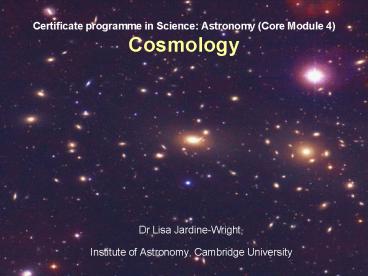
Title: Certificate programme in Science: Astronomy Core Module 4 Cosmology
1
Certificate programme in Science Astronomy (Core
Module 4)Cosmology
- Dr Lisa Jardine-Wright,
- Institute of Astronomy, Cambridge University
2
(No Transcript)
3
(No Transcript)
4
Review of Cosmological Concepts
- The Big Bang did not occur at a single point in
space as an "explosion." - It is better thought of as the simultaneous
appearance of space everywhere in the universe.
That region of space that is within our present
horizon was indeed no bigger than a point in the
past. - Nevertheless, if all of space both inside and
outside our horizon is infinite now, it was born
infinite. - If it is closed and finite, then it was born with
zero volume and grew from that. In neither case
is there a "center of expansion" - a point from
which the universe is expanding away from. - In the ball analogy, the radius of the ball grows
as the universe expands, but all points on the
surface of the ball (the universe) recede from
each other in an identical fashion. - The interior of the ball should not be regarded
as part of the universe in this analogy.
5
Review of Cosmological Concepts
- WMAP website describes the common misconceptions
about the Big Bang and expansion - By definition, the universe encompasses all of
space and time as we know it, so it is beyond the
realm of the Big Bang model to postulate what the
universe is expanding into. In either the open or
closed universe, the only "edge" to space-time
occurs at the Big Bang (and perhaps its
counterpart the Big Crunch), so it is not
logically necessary (or sensible) to consider
this question.
6
Review of Cosmological Concepts
- It is beyond the realm of the Big Bang Model to
say what gave rise to the Big Bang. There are a
number of speculative theories about this topic,
but none of them make realistically testable
predictions as of yet. - To this point, the only assumption we have made
about the universe is that its matter is
distributed homogeneously and isotropically on
large scales. - There are a number of free parameters in this
family of Big Bang models that must be fixed by
observations of our universe. - The most important ones are the geometry of the
universe (open, flat or closed) the present
expansion rate (the Hubble constant) the overall
course of expansion, past and future, which is
determined by the fractional density of the
different types of matter in the universe. - Note that the present age of the universe follows
from the expansion history and present expansion
rate.
7
Lecture Overview CMBR
- What is the CMBR?
- How was it discovered?
- Its nature and temperature
- Why is it important?
- Black Body Radiation?
- Power Spectrum and Parameters?
8
What is the CMBR?
- The Big Bang theory predicts that the universe
should be filled with radiation that is literally
the remnant heat left over from the Big Bang,
called the cosmic microwave background
radiation, or CMB(R). - thus providing a detailed picture of the very
early Universe.
9
How was it discovered?
- The existence of the CMB radiation was first
predicted by George Gamow in 1948, and by Ralph
Alpher and Robert Herman in 1950. - In 1965 Arno Penzias and Robert Wilson at the
Bell Telephone Laboratories discovered it but
werent sure what it was at first. - The radiation was acting as a source of excess
noise in a radio receiver they were building. - Penzias Wilson shared the 1978 Nobel prize in
physics for their discovery.
10
How was it discovered?
11
How was it discovered?
- Coincidentally, researchers at nearby Princeton
University, led by Robert Dicke and including
Dave Wilkinson of the WMAP science team, were
devising an experiment to find the CMB. - When they heard about the Bell Labs result they
immediately realized that the CMB had been found.
- The result was a pair of papers in the Physical
Review one by Penzias and Wilson detailing the
observations, and one by Dicke, Peebles, Roll,
and Wilkinson giving the cosmological
interpretation. (see additional handout)
12
Radiation Electromagnetic Spectrum
13
Temperature of the CMB
- Today, the CMB radiation is measured at a
temperature of, only 2.725K. - The radiation shines primarily in the microwave
portion of the electromagnetic spectrum, and is
invisible to the naked eye. - This uniformity of the CMB is one compelling
reason to interpret the radiation as remnant heat
from the Big Bang - A local source of radiation that would not be
this uniform. - In fact, many scientists have tried to devise
alternative explanations for the source of this
radiation but none have succeeded.
14
Why is it important?
- When visible universe was 1/2 its present size,
- the density of matter was 8x
- the cosmic microwave background was twice as hot.
- When visible universe was 1/100 of its present
size, - the CMB was a hundred times hotter - 273K (the
temperature at which water freezes). - In addition to this CMBR, the early universe was
filled with hot hydrogen gas with a density of
about 1000 atoms per cubic centimetre.
15
Why is it important?
- When visible universe was only 1/100000000 its
present size, - its temperature was 273,000,000K
- the density of matter was comparable to the
density of air at the Earth's surface. - At these high temperatures, hydrogen was
completely ionized into free protons and
electrons.
16
Why is it important?
- Since the universe was so very hot through most
of its early history, there were no atoms in the
early universe, only free electrons and nuclei.
(Nuclei are made of neutrons and protons). - CMB photons easily scatter off electrons. Thus,
photons wandered through the early universe, just
as optical light wanders through a dense fog.
17
Why is it important?
P n e-
P n e-
P n e-
P n e-
P n e-
P n e-
P n e-
18
Why is it important?
19
Why is it important?
- Since the universe was so very hot through most
of its early history, there were no atoms in the
early universe, only free electrons and nuclei.
(Nuclei are made of neutrons and protons). - CMB photons easily scatter off electrons. Thus,
photons wandered through the early universe, just
as optical light wanders through a dense fog. - This process of multiple scattering produces what
is called a thermal or blackbody spectrum of
photons. - The accurate measurement of the shape of the CMB
spectrum was another important test for Big Bang
Theory.
20
Cosmic Black Body Radiation
21
Black Body Radiation
- Energy per unit volume per unit wavelength
- The following numbers are constants
22
Black Body Radiation
23
Variations in Temperature
- Tiny variations in the density of matter in the
early universe leave an imprint in the cosmic
microwave background radiation in the form of
temperature fluctuations from point to point
across the sky. - These temperature fluctuations are minute one
part of the sky might have a temperature of
2.7251 K (degrees above absolute zero), while
another part might have a temperature of 2.7249
K. - Combination of different physics has caused these
fluctuations - providing cosmologist with a
fossil record of the condition of the early
Universe
24
CMB Power Spectrum
25
Variations in Temperature
- On the largest scales (small l) the main source
of temperature fluctuations are due to variations
in the strength of gravity at the time of last
scatter. - Thus this low before the peak is determined by
the amount of dark matter. - As one moves to smaller angular scales (to the
right on the graph) one starts to see the imprint
of sound waves moving through the ionized
hydrogen gas. - a region in compression at this time will appear
to us as a region that is brighter or hotter than
average and vice-versa.
26
Variations in Temperature
- The succesive peaks correspond to higher
frequency waves alternately caught in periods of
rarefaction and compression at the time of last
scatter. - The relative heights and locations of these peaks
contains signatures of the properties of the gas
at the time of last scatter.
27
- Map at 150 GHz Map at 220 GHz
28
The Peak in the Fluctuations
29
The Peak in the Fluctuations
30
The Peak in the Fluctuations
31
Our Universe - According to WMAP
- WMAP determined that the universe is flat, from
which it follows that the mean energy density in
the universe is equal to the critical density
(within a 2 margin of error). This is equivalent
to a mass density of 9.9 x 10⁻³⁰ g/cm3, which is
equivalent to only 5.9 protons per cubic meter.
Of this total density, we now know the breakdown
to be - 4 Atoms, 23 Cold Dark Matter, 73 Dark Energy.
- Thus 96 of the energy density in the universe is
in a form that has never been directly detected
in the laboratory. The actual density of atoms is
equivalent to roughly 1 proton per 4 cubic
meters.
32
Our Universe - According to WMAP
- Fast moving neutrinos do not play any major role
in the evolution of structure in the universe.
They would have prevented the early clumping of
gas in the universe, delaying the emergence of
the first stars, in conflict with the new WMAP
data. - The data places new constraints on the Dark
Energy. It seems more like a "cosmological
constant" than a negative-pressure energy field
called "quintessence". But quintessence is not
ruled out.
Recommended

