

Young Star PowerPoint PPT Presentation
1 / 1
Title: Young Star
1
in COSMIC
particle
- Why is light scattering important in astronomy?
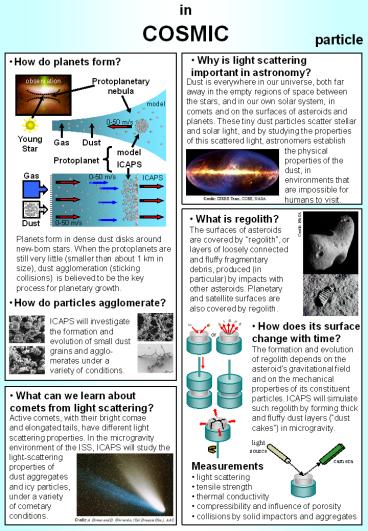
- How do planets form?
Protoplanetarynebula
observation
Dust is everywhere in our universe, both far away
in the empty regions of space between the stars,
and in our own solar system, in comets and on the
surfaces of asteroids and planets. These tiny
dust particles scatter stellar and solar light,
and by studying the properties of this scattered
light, astronomers establish the physical
properties of the dust, in environments
that are impossible for humans to visit.
model
0-50 m/s
YoungStar
Gas
Dust
Protoplanet
Gas
0-50 m/s
ICAPS
Credit DIRBE Team, COBE, NASA
Dust
0-50 m/s
Credit NASA
Planets form in dense dust disks around new-born
stars. When the protoplanets are still very
little (smaller than about 1 km in size), dust
agglomeration (sticking collisions) is believed
to be the key process for planetary growth.
- How do particles agglomerate?
ICAPS will investigate the formation and
evolution of small dust grains and agglo-merates
under a variety of conditions.
- What can we learn about comets from light
scattering?
Active comets, with their bright comae and
elongated tails, have different light scattering
properties. In the microgravity environment of
the ISS, ICAPS will study the light-scattering
properties of dust aggregates and icy
particles, under a variety of cometary conditions
.
light source
camera
Credit A. Dimai and D. Ghirardo, (Col Druscie
Obs.), AAC
Recommended

