

Building the Knowledge Transfer Network: the Platform for Cooperation PowerPoint PPT Presentation
1 / 25
Title: Building the Knowledge Transfer Network: the Platform for Cooperation
1
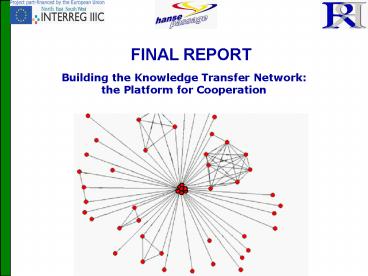
Building the Knowledge Transfer Network the
Platform for Cooperation
- FINAL REPORT
2
PRESENTATION OUTLINE
- Framework of the report
- Highlights of the current reality
- Main conclusions about the networking capacity
and abilities - Highlights of the concept of KTN
- Stakeholder groups of KTN
- Model of KTN
- Network management
- Strategic
- Operational
- Necessary improvements and follow up to finish
the work
3
Results of the WP2
Results of the WP4 WP2
Results of the WP2
Results of the WP3
Results of the WP2 WP3
Results of the WP3 WP4
Results of the WP3 WP4
Results of the WP3
Results of the WP3
Results of the WP5 WP4
4
- WP2 had acquired information about the situation
in the Hanse Passage regions - Final report
- presents more detailed data summary of the
current situation - raises importance to assess both - the regions
as separate players as well as evaluate the
network environment as a common ground of the
activity - considers access to resources ( technology,
know-how and funding) as a shared platform of
Hanse Passage regions that potentially can
provide opportunities to benefit from each other
by exchanging experiences of good case practices
and transferring a valuable knowledge
5
GPD/head in Hanse Passage regions
6
Unemployment rate in Hanse Passage regions
7
Number (approximate) of Research and technology
organizations
8
Number of scientists in Hanse Passage regions
9
Number of graduate spin outs start-ups and
number of patent applications
- call for attention to the regions where the
data is not available - to reconsider the value
of keeping the record and track of this
information
10
Number of Universities
11
- Diverse base of access to know-how technology
within the regions, totally - 57 universities in all the regions
- 150 thousand scientists
- 459 graduate start ups and spin-offs initiated
annually - 107 Research and technology organizations
identified totally in all the regions etc. - The strongest leadership - Lower Saxony - within
the key indicators, like number of scientists,
number of universities, funds spent on RD by
universities, patent applications and also the
number of graduate start ups and spin offs - - the specific platform of know-how and
technology development players has been
identified that could be targeted first to be
involved in the network activities.
12
- Networking capacity is referred in the report
as networking abilities and current networking
practice. - WP2 identified relevant networking
organizations and activities already existing in
the regions - WP4 identified best case practices
in the region that underlines the level of the
networking
- Final report
- - highlights of the current networking practice
by profiling every region in terms of - major regional activities for stimulating the
networking culture - identifying the variety of organizations that
have concentrated number of companies around
them and thus can support and facilitate the
business networking - - Summarizes the key features to emphasize the
current ability of networking derived from the
regional best case practice
13
- Figure of number of BICs and incubation
facilities - Leadership - Lower Saxony (BICs are the same that
offer Incubation facilities). - - Flevoland and Haute Normany regions do not have
any Business and Innovation Centres - - Kurzeme region - incubation facilities are not
yet available (few initiates are on the way)
14
ROLE OF KTN strengthening the capacity and
capability of the regional innovation environment
to stimulate the open innovation activity by
means of extensive and effective networking as
locally as internationally
CORE WORK of KTN facilitation of the networking
and knowledge transfer, which will involve full
set of related services as those regarded to
the exploitation of research results as well as
business problem solving issues.
- CONCEPT OF KNOWLEDGE TRANSFER
- The concept of knowledge will include both
perspectives - the regional development and innovation system
approach (technology transfer)- meeting the
demand of SMEs (business development problem
solving)
15
(No Transcript)
16
THREE LEVEL APPROACH
- The first level - the basic network
- WHO founders organizations with a
responsibility of regional development
(municipalities, regional governments etc.) - ROLE initiators for the whole KTN creation
process and further key coordinators of activity
of the KTN.
- The second level
- WHO intermediary organizations (technology
transfer organizations, business incubators,
consultancies and others) - ROLE the actual facilitators of the knowledge
transfer .
- The third level- knowledge users and providers
- WHO actual target group organizations that
will directly benefit from the activities and
networking provided by the KTN (companies,
clusters, universities etc.) - ROLE performing knowledge transfer providing
and taking advantage of it.
17
Informal style of network operations - No
duplication of existing or emerging schemes,
continuous opportunity generation, lowering the
role of strict control
Effectiveness - Existing schemes should be
enforced, popularized - existing opportunities,
synergy effects, learning opportunities
Subsidiarity principle - transparency,
tailor-made services packaging, peer-reviewing
processes, ongoing emerging initiatives by
various partners
18
Transnational institutional capacity building
principle - membership of relevant professional
associations networks
- Financial sustainability principle
- Responsibility of regional public organizations
acting as KTN initiators - Search for European funding
Growth oriented management principle - Acting as
door openers for other partners in the
network.
19
Cross-relational and relationship specific
network management tasks
Cross relational tasks- mainly related to the
whole network management. Includes planning,
organizing, staffing and controlling, which is
widely used functions in general management The
relationship specific tasks - activities to
establish a single relationship. Includes
initiation, exchange/transfer, and coordination.
(Ritter,Gemunden, 2003)
20
Coordination underlying initiatives
A. The Charter - statutes, management issues,
decision making principles, organizational
matters, code of conduct, roles, responsibilities
etc
B. The knowledge platform. design the
organizational means to enable keeping record of
instruments, tools, innovation circles methods
for innovation management and document case
studies
C. Strategic outlook. For the 2007-2013 timeframe
and a subsequent business plan
D. Alignment with the key European policy
documents (Cohesion policy 2007-2013, EU
Innovation Policy)
E. Consistent management means (a strategy and
marketing plan based on convergence of IRC BiC
strategies for 2007-2013)
F. Information and knowledge sharing.
international versions of web-based services that
can be syndicated to enable mutual signposting
door opener, sharing knowledge, blogging
networking, joint calendar of events .
H. Shared internet platform. The network
executive will maintain a trans-regional portal
21
KTN management board representatives of
regional development organizations (e.g.
municipalities, agencies and other public
organizations)
Accreditation mechanism accreditation mechanism
for new applicants of the Hanseatic Innovation
Support Structures based on pre-set
membership-criteria should be proposed
22
Internet platform for feeding and stimulating
the knowledge transfer within the network
Networking guide- tools and instruments for the
use to develop successful networking. Will be
available for any individual organization within
the network to improve its networking competence
23
Questions to consider for drawing explicit model
of KTN
- Will KTN be considered after launching as
organic network or created and high
maintenance network? - A. Industrial network approach argues that
networks just are, which highlights that it is
more about the ability to manage and coordinate
the opportunities that are organically evolving
by demand of target audience - B. Other approaches consider network as something
that can be and should be created - that would
involve stronger focus on planning and pushing
certain networking topics and opportunities by
the KTN initiators (regional development
organizations) that are considered of a higher
regional importance.
24
Questions to consider for drawing explicit model
of KTN
- In case A
- allows to leave the single focus on internet
platform with interaction features - Necessary to agree upon the communication flows
to ensure updated and open environments among
regional actors
- In case B
- Necessary to consider strong central
organization of network management involving
representatives of all involved regions - Necessary to draw systematic means (finances,
meetings, communication mechanisms etc.) of
management (considering different physical
locations) - Need to propose explicit roles
responsibilities division plan among partners to
ensure the continuous maintenance and
coordination of KTN - Need to introduce official cooperation contracts
to formally tie the first and second level KTN
partners and ensure commitment
25
- In order to enable the activities and value of
KTN both cases require to consider the promotion
plan of KTN .
Recommended

