

The interface between air and sea is almost always in motion PowerPoint PPT Presentation
1 / 49
Title: The interface between air and sea is almost always in motion
1
Waves
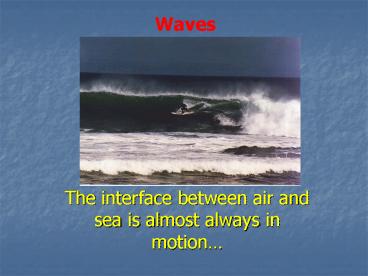
- The interface between air and sea is almost
always in motion
2
What is a wave?
- Waves represent a water surface displacement from
still water level - Surface displacement is formed by a disturbing
force (Example Wind Stress) - Restoring force is Gravity
- However, the wave continues because an upward
force (buoyancy) exceeds the restoring force
3
Terms
- Crest highest point of wave, portion above sea
surface - Trough lowest point of a wave, portion below
sea surface - Wavelength distance between any two equivalent
points on successive waves (ex distance between
two crests)
4
Terms
- Wave Height The vertical distance between the
top of the crest and bottom of the trough - Period The time required for 2 successive
crests or troughs to pass a point - Celerity speed of the wave
5
Terms
- Amplitude distance wave moves water above or
below sea level, equals ½ wave height - Frequency number of waves passing a point in a
given period of time - Propagation rate number of waves passing a
point in a given period of time
6
Wave Period ( T ) time interval between the
passage of successive crests
Wave Height ( H ) vertical distance between any
crest and succeeding trough
Wavelength ( L ) horizontal distance between
successive crests or troughs
Celerity (Wave Speed) ( C ) C L / T (or
wavelength / period)
7
Wave Motion
- Wave motion is oscillatory a sequence repeated
with passage of each wave. Parcels move up and
downnot forward.
The slinky does not move with the wavethe wave
displaces the slinky
Each orbit that a particle in water experience
with passage of waves has diameter H
http//www.gmi.edu/drussell/Demos/waves/wavemotio
n.html
8
Wave Equations
- c L / T
- T L / c
- L cT
- L wavelength
- SWL still water level
- n water displacement from
- H wave height (distance from the crest to
trough) - c celerity (velocity)
- T wave period
9
Relative wavelengths of different types of waves
- Capillary waves - lt 1.73 cm
- Wind Wave 60 150 m
- Seiche Large, variable a function of basin
size - Tsunami 200 km
- Tide ½ circumference of Earth
10
Wave Generation by Wind
- Wind waves are gravity waves
- Begin as small capillary waves (lt1.73 cm)
Fine wrinkling of the surface
Restoring force is surface tension
Also known as Wavelets or ripples
11
Gravity or wind waves
- Formed when capillary waves overtake one another
- Restoring force is gravity
- Progressive groups of swell with the same origin
and wavelength are called wave trains. - Occurs when wind is brisk whitecaps
- Periods between 1 and 30 seconds
12
Wind Waves breaking on shore
13
Swells
- Waves that leave the fetch or generating area
(could have left a storm at sea) - Have long periods and wavelengths, fast
celerities - Energy transported a considerable distance
- At sea, swells are hardly noticeable
14
Swells at sea are hardly noticeablebut, as they
reach the shore of Hawaii they are!
15
Wave Trains
- Wave trains can be followed from storm source to
distance shoresoften ahead of the storm
16
Main factors in development of wind waves
- Wind strength
- Wind duration (time that wind blows in one
general direction) - Fetch (distance over which wind blows
uninterrupted in one direction) - There is a maximum wave size for a combination of
the 3 called a fully developed sea
17
- Wind waves associated with storm winds mature
into swells at a distance - Swells are more rounded and regular sets of
waves - propagating at a distance from region of
formation. - Regional sets or wavetrains form as groups of
larger - waves
- Note storm winds generally blow across areas of
relatively small fetch for short periods. Fully
developed seas rarely occur. Nonetheless, large
storms are important wave generators.
18
Role of Water Depth in Wave Behavior
- Water surface waves behave differently depending
on the relationship between water depth and
wavelength of the wave series. - Waves behave differently in deep and shallow
water.
19
Deep and Shallow Water Waves
- A deep water wave is when
- dgtL/2
- A shallow water wave is when
- dltL/20
- Intermediate waves are in-between dgtL/2 and
dltL/20 - ddepth of water, Lwavelength
20
Differences between deep-water and shallow water
waves
- The paths of water molecules in a wind wave are
circular only when the wave is traveling in deep
water, that is water that is deeper than one half
of the waves length. - Once water depth is less than one half of the
waves length, the circle becomes more and more
elliptical.
21
- Path of particle in a deep water wave is circular
Kinetic energy cuts a circular path or ORBIT
b. Path of a particle in a shallow water
wave becomes more elliptical as the wave
moves further into shore
22
Speed of a Deep Water Wave
- The celerity of a deep water wave is independent
of wave height and density of water (applies to
salt or fresh water) - Can be expressed in terms of Period (T)
- cgT/2p
- Simplified, c1.56T
- Thus, the longer the wavelength, the greater the
celerity
23
Period of a deep water wave
- L(g/2p)(T2)
- Since we know LcT we can substitute
- LgT2/2p or L1.56T2
24
Waves in Shallow Water
- As waves move into shallow water (dltL/20) where
d depth of water
25
- Waves break when oversteepened and
- whitecaps are observed
- Observations through time suggest maximum wind
waves with L at 800 meters, T23 s, c36 m/s
suggest wave height to 36 meters!
26
How Big is Big?
- There is a limitation on height, such that the
steepness of a wave lank does not usually exceed
about 60 vertically. - Rule of Thumb 1/7 ratio of H/L
- Ex A wave with L156m can have a Height of 22 m!
- Highest observed winds West Wind Drift (strong
winds, long fetch)
27
Characteristics of shallow water waves as they
feel the bottom
- Crest becomes more peaked
- Trough becomes more flattened
- Wave resembles a solitary wave
- where H (wave height) is above SWL
- in other wordstop half is a sinusoidal wave
- Path of particles are more elliptical
- All water in the wave moves in the direction of
the wave
28
Celerity of Shallow Water Waves
- Related only to water depth (not wavelength or
period as in deep-water waves) - c(gd)/2
- Thus, waves move slower in shallow water
29
At the Shore
- The celerity of the base of a wave is c(gd)/2.
- Butthe crest moves faster than the base of the
wave - c(g(dH))/2
- Also, H0.75d
- Therefore, a 3 meter wave breaks in 4 meters of
water depth
30
Types of wave breaks
- Type of wave break depends on bottom
- Plunging waves from steeply sloping bottoms
- Spilling wave from gentle slopes
31
Wave Power!
- Wave energy is proportional to the square of H.
- Energy/Unit Area1/8pgH2
- pdensity of water
32
Longshore Currents
- Occur when hits shore at angle
- Water transported along beach until an exposed
point reflects it seaward
33
Rip Currents
- Occur where long shore currents flow out to sea
- Water moves rapidly, cutting channels in off
shore sand bars - Swimming hazard!
34
Seismic Waves or Tsunamis
- Origin
- Sudden movement in Earths crust causes rise in
sea level - Under water volcanoes/earthquakes
- Characteristics
- Long periods of 1-2 hours
- Waves exceed 30 meters
- on shore
- Wave speed can
- equal 400 mph
35
Tsunamis
- Properties
- Water rushes to the central point of disturbance
- Waves of long wavelength ( 100-200 meters )
- Periods of 10-20 minutes
- Ocean depth in excess of 400 meters, thus does
not affect depth of the wave
36
Tsunamis
- As wave approaches the shore the speed is Cvgd
- Average speed is 200 m/s or 400 mph
- At sea, average height is only 0.5 m -gt hardly
noticeable!! - At shoreif trough arrives first, sea level
dropsif crest, a rapidly forming high wave
appears
37
(No Transcript)
38
(No Transcript)
39
(No Transcript)
40
Tides
- Real tidal waves
- Largest wavelength ½ the circumference of Earth
41
Storm Surge
- Form during periods of excessively high water
- Caused by changes in atmospheric pressure and
wind - When combined with high tide, can produce
disaster on coastal regions - http//hurricanes.noaa.gov/prepare/surge.htm
42
Causes of storm surge
- Major storms under a low pressure system, the
sea will rise to dome or hill of water - As the storm approaches, the dome of water
approaches
43
Internal Waves Surface
- Occur at a boundary between air and water
- Occur because fluids are of different density
- Therefore, surface waves will form along a
boundary between two fluids of different density
44
Internal Waves beneath surface
- Although differences are small, waves form along
boundary of any to fluids of different density
(differences between salinity or temperature) - Waves are large in amplitude and slow in speed
45
Internal Wave Packets
46
Slicks
- Occur when sub surface internal wave crest breaks
surface layer - Most likely to occur in coastal areas where fresh
water overlays salty water
47
Standing Waves
- Non-progressing
- Crests appear to alternate about a fixed point
called a node - End points of wave called antinodes
- Properties the period of oscillation can
increase if - Either the length of the basin increases
- The depth of the water decreases
48
Seiches
- Are standing waves
- Triggered by tectonic waves or storm surges
- Water oscillates by a period defined by the
dimensions of the basin
49
(No Transcript)
Recommended

