

Binary Classification Problem Learn a Classifier from the Training Set PowerPoint PPT Presentation
1 / 49
Title: Binary Classification Problem Learn a Classifier from the Training Set
1
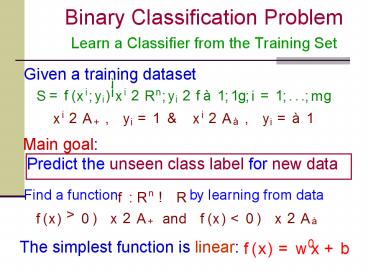
Binary Classification ProblemLearn a Classifier
from the Training Set
Given a training dataset
Main goal Predict the unseen class label for
new data
2
Binary Classification ProblemLinearly Separable
Case
Benign
Malignant
3
Support Vector MachinesMaximizing the Margin
between Bounding Planes
4
Why We Maximize the Margin? (Based on Statistical
Learning Theory)
- The Structural Risk Minimization (SRM)
- The expected risk will be less than or equal to
empirical risk (training error) VC (error) bound
5
Summary the Notations
6
Support Vector Classification
(Linearly Separable Case, Primal)
the minimization problem
It realizes the maximal margin hyperplane with
geometric margin
7
Support Vector Classification
(Linearly Separable Case, Dual Form)
The dual problem of previous MP
Dont forget
8
Dual Representation of SVM
(Key of Kernel Methods
)
The hypothesis is determined by
9
Soft Margin SVM
(Nonseparable Case)
- If data are not linearly separable
- Primal problem is infeasible
- Dual problem is unbounded above
- Introduce the slack variable for each
- training point
- The inequality system is always feasible
e.g.
10
(No Transcript)
11
Robust Linear Programming
Preliminary Approach to SVM
12
Support Vector Machine Formulations
(Two Different Measures of Training Error)
2-Norm Soft Margin
1-Norm Soft Margin (Conventional SVM)
13
Tuning ProcedureHow to determine C?
C
The final value of parameter is one with the
maximum testing set correctness !
14
Lagrangian Dual Problem
subject to
subject to
where
15
1-Norm Soft Margin SVM Dual Formulation
The Lagrangian for 1-norm soft margin
where
The partial derivatives with respect to
primal variables equal zeros
16
Substitute
in
where
and
17
Dual Maximization Problem for 1-Norm Soft Margin
Dual
- The corresponding KKT complementarity
18
Slack Variables for 1-Norm Soft Margin SVM
- Non-zero slack can only occur when
- The contribution of outlier in the decision
rule will be at most
- The trade-off between accuracy and
regularization directly controls by C
- The points for which
lie at the
bounding planes
19
Two-spiral Dataset(94 White Dots 94 Red Dots)
20
Learning in Feature Space
(Could Simplify the Classification Task)
- Learning in a high dimensional space could
degrade
generalization performance
- This phenomenon is called curse of dimensionality
- Even do not know the dimensionality of feature
space
- There is no free lunch
- Deal with a huge and dense kernel matrix
- Reduced kernel can avoid this difficulty
21
(No Transcript)
22
Linear Machine in Feature Space
Make it in the dual form
23
Kernel Represent Inner Product in Feature Space
Definition A kernel is a function
such that
where
The classifier will become
24
A Simple Example of Kernel
Polynomial Kernel of Degree 2
and the nonlinear map
Let
defined by
.
- There are many other nonlinear maps,
, that
satisfy the relation
25
Power of the Kernel Technique
Consider a nonlinear map
that consists
of distinct features of all the monomials of
degree d.
.
Then
!
26
Kernel Technique
Based on Mercers Condition (1909)
- The value of kernel function represents the
inner product of two training points in feature
space - Kernel functions merge two steps
- 1. map input data from input space to
- feature space (might be infinite
dim.) - 2. do inner product in the feature space
27
More Examples of Kernel
- The
of data points
and
28
Nonlinear 1-Norm Soft Margin SVM In Dual Form
Linear SVM
Nonlinear SVM
29
1-norm Support Vector MachinesGood for Feature
Selection
Equivalent to solve a Linear Program as follows
30
SVM as an Unconstrained Minimization Problem
- Change (QP) into an unconstrained MP
- Reduce (n1m) variables to (n1) variables
31
Smooth the Plus Function Integrate
Step function
Sigmoid function
p-function
Plus function
32
SSVM Smooth Support Vector Machine
33
Newton-Armijo Method Quadratic Approximation of
SSVM
- Converges in 6 to 8 iterations
- At each iteration we solve a linear system of
- n1 equations in n1 variables
- Complexity depends on dimension of input space
- It might be needed to select a stepsize
34
Newton-Armijo Algorithm
stop if
else
(i) Newton Direction
globally and quadratically converge to unique
solution in a finite number of steps
(ii) Armijo Stepsize
such that Armijos rule is satisfied
35
Nonlinear Smooth SVM
Nonlinear Classifier
- Use Newton-Armijo algorithm to solve the problem
- Nonlinear classifier depends on the data points
with - nonzero coefficients
36
Conclusion
- An overview of SVMs for classification
- Can be solved by a fast Newton-Armijo algorithm
- No optimization (LP, QP) package is needed
- There are many important issues did not address
- this lecture such as
- How to solve conventional SVM?
- How to deal with massive datasets?
37
Perceptron
- Linear threshold unit (LTU)
x01
w0
w1
w2
?
. . .
?i0n wi xi
g
wn
1 if ?i0n wi xi gt0 o(xi)
-1 otherwise
38
Possibilities for function g
Sign function
Sigmoid (logistic) function
Step function
step(x) 1, if x gt threshold 0,
if x ? threshold (in picture above, threshold
0)
sign(x) 1, if x gt 0 -1, if x ?
0
sigmoid(x) 1/(1e-x)
Adding an extra input with activation x0 1 and
weight wi, 0 -T (called the bias weight) is
equivalent to having a threshold at T. This way
we can always assume a 0 threshold.
39
Using a Bias Weight to Standardize the Threshold
1
-T
w1
x1
w2
x2
w1x1 w2x2 lt T
w1x1 w2x2 - T lt 0
40
Perceptron Learning Rule
x2
x2
x1
x1
x2
x2
x1
x1
41
The Perceptron Algorithm Rosenblatt, 1956
Given a linearly separable training set and
42
The Perceptron Algorithm (Primal Form)
Repeat
until no mistakes made within the for loop return
?
. What is
43
(No Transcript)
44
The Perceptron Algorithm
( STOP in Finite Steps )
Theorem (Novikoff)
Suppose that there exists a vector
and
. Then the number
of mistakes made by the on-line perceptron
algorithm
45
Proof of Finite Termination
Proof Let
46
Update Rule of Perceotron
Similarly,
47
Update Rule of Perceotron
48
The Perceptron Algorithm (Dual Form)
49
What We Got in the Dual Form Perceptron
Algorithm?
Recommended

