

AlcoholsR-O-H PowerPoint PPT Presentation
Title: AlcoholsR-O-H
1
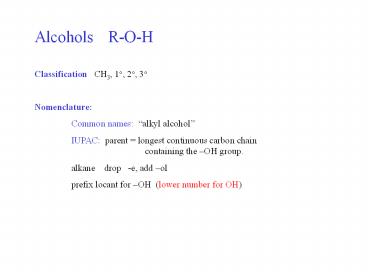
Alcohols R-O-H Classification CH3, 1o, 2o,
3o Nomenclature Common names alkyl
alcohol IUPAC parent longest continuous
carbon chain containing the OH
group. alkane drop -e, add ol prefix
locant for OH (lower number for OH)
2
CH3 CH3 CH3CHCH2CHCH3 C
H3CCH3 OH
OH 4-methyl-2-pentanol tert-
butyl alcohol 2-methyl-2-propanol
2o 3o
CH3 HO-CHCH2CH3 CH3CH2CH2-OH sec-butyl
alcohol n-propyl alcohol 2-butanol
1-propanol 2o 1o
3
Physical properties of alcohols polar
hydrogen bonding relatively higher mp/bp water
insoluble! (except for alcohols of three
carbons or less) CH3CH2CH2CH2CH2CH2CH2CH2CH2CH2-
OH hydrophobic hydrophilic
4
Oldest known organic synthesis fermentation Sug
ar yeast ? ethyl alcohol
CO2 Grape juice gt wine Barley gt
beer Honey gt mead Rice gt sake 5-11
ethanol
5
Alcohols, synthesis 1. 2. 3. 4. Hydrolysis of
alkyl halides (CH3 or 1o) 5. 6. 7. 8.
6
R-H R-X R-OH
Acids Bases Active metals Oxidation Reduction Halo
gens
7
- Alcohols, reactions
- R--OH
- With HX
- With PX3
- (later)
- RO--H
- As acids
- Ester formation
- Oxidation
8
1. Reaction of alcohols with HX (1 synthesis
of RX) R-OH HX ?
R-X H2O a) HX HI gt HBr gt HCl b)
ROH 3o gt 2o gt CH3 gt 1o c) May be acid
catalyzed d) Rearrangements are possible except
with most 1o alcohols.
9
CH3CH2CH2CH2-OH NaBr, H2SO4, heat ?
CH3CH2CH2CH2-Br n-butyl alcohol
n-butyl bromide 1-butanol
1-bromobutane CH3
CH3 CH3C-OH HCl ?
CH3C-Cl (room temperature) CH3
CH3 tert-butyl
alcohol tert-butyl chloride 2-methyl-2-propanol 2
-chloro-2-methylpropane CH3CH2-OH HI,
H, heat ? CH3CH2-I ethyl alcohol
ethyl iodide ethanol iodoethane
10
Mechanism? CH3-OH and most 1o alcohols react
with HX via SN2 mechanism 3o and 2o react with
HX via SN1 mechanism ?Both mechanisms include an
additional, first step, protonation of the
alcohol oxygen R-OH H ?
R-OH2 oxonium ion
11
Whenever an oxygen containing compound is placed
into an acidic solution, the oxygen will be
protonated, forming an oxonium ion.
12
Mechanism for reaction of an alcohol with
HX CH3OH or 1o alcohols
13
Mechanism for reaction of an alcohol with HX 2o
or 3o alcohols
14
May be catalyzed by acid. SN2 rate k
ROH2 X- SN1 rate k ROH2 Acid
protonates the -OH, converting it into a better
leaving group (H2O), increasing the concentration
of the oxonium ion, and increasing the rate of
the reaction.
15
Rearrangements are possible (except with most 1o
alcohols) CH3
CH3 CH3CHCHCH3
HBr ? CH3CCH2CH3
OH
Br
? ? Br- CH3
CH3 1,2-H CH3
CH3CHCHCH3 ? CH3CHCHCH3
? CH3CCH2CH3 OH2
2o
carbocation 3o carbocation
16
(No Transcript)
17
Most 1o? If large steric requirement
CH3
CH3 CH3CCH2-OH HBr
? CH3CCH2CH3 CH3
Br neopentyl alcohol
2-bromo-2-methylbutane ? ?
CH3 CH3
CH3 CH3CCH2-OH2 ? CH3CCH2
? CH3CCH2CH3 CH3
CH3
1o carbocation
3o carbocation
1,2-CH3
18
- With PX3
- ROH PX3 ?
RX - PX3 PCl3, PBr3, P I2
- No rearrangements
- ROH CH3 gt 1o gt 2o
- CH3
CH3 - CH3CCH2-OH PBr3 ?
CH3CCH2-Br - CH3
CH3 - neopentyl alcohol
2,2-dimethyl-1-bromopropane
?
19
- Dehydration
- (later)
20
- As acids.
- With active metals
- ROH Na ? RONa ½ H2 ?
- With bases
- ROH NaOH ? NR!
- CH4 lt NH3 lt ROH lt H2O lt HF
21
CH3CH2OH NaOH ? H2O
CH3CH2ONa WA WB
SA SB CH3CH2OH
CH3MgBr ? CH4
MgBr(OCH2CH3) SA SB
WA
WB CH3OH NaNH2 ? NH3
CH3ONa SA SB
WA WB
22
- Ester formation.
- CH3CH2-OH CH3CO2H, H ?
CH3CO2CH2CH3 H2O - CH3CH2-OH CH3COCl ?
CH3CO2CH2CH3 HCl - CH3-OH CH3SO2Cl ? CH3SO3CH3
HCl - Esters are alkyl salts of acids.
23
(No Transcript)
24
(No Transcript)
25
(No Transcript)
26
(No Transcript)
27
oxidation states of carbon
- oxidation ? CH4 CH3OH
CH2O HCO2H CO2 -4
-2 0
2 4
? reduction -
28
- Oxidation
- Oxidizing agents KMnO4, K2Cr2O7, CrO3, NaOCl,
etc. - Primary alcohols
- CH3CH2CH2-OH KMnO4, etc. ?
CH3CH2CO2H -
carboxylic acid - Secondary alcohols
- OH
O - CH3CH2CHCH3 K2Cr2O7, etc. ?
CH3CH2CCH3 -
ketone - Teriary alcohols
- no reaction.
29
Primary alcohols ONLY can be oxidized to
aldehydes CH3CH2CH2-OH C5H5NHCrO3Cl ?
CH3CH2CHO pyridinium chlorochromate (PCC)
aldehyde
or CH3CH2CH2-OH
K2Cr2O7, special conditions ?
30
Alcohols, synthesis 1. 2. 3. 4. Hydrolysis of
alkyl halides (CH3 or 1o) 5. 6. 7. 8.
31
- Alcohols, reactions
- R--OH
- With HX
- With PX3
- (later)
- RO--H
- As acids
- Ester formation
- Oxidation
Recommended

