

Theory of Control of Matter on the Atomic Scale PowerPoint PPT Presentation
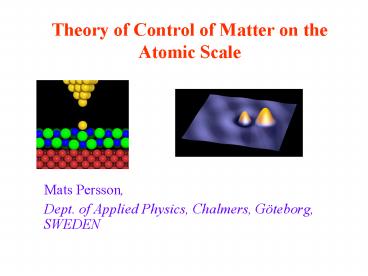
Title: Theory of Control of Matter on the Atomic Scale
1
Theory of Control of Matter on the Atomic Scale
- Mats Persson,
- Dept. of Applied Physics, Chalmers, Göteborg,
SWEDEN
2
Introduction and Outline
- The ultimate limit of engineering materials
involves control of matter on the atomic scale
imaging, characterization and manipulation by
scanning tunneling microscope (STM) - Example of molecular device (nanomachine)
- To fully exploit these unique capabilities of the
STM one needs theory and modelling - STM images
- Vibrational inelastic tunneling
- Charge control of adatoms
3
Example of Molecular Nanomachine Three-Input
Sorter
Function by molecular cascades of 512 CO
molecules on Cu(111)
Heinrich et al., Science 298, 1381 (2002)
4
Scanning Tunneling MicroscopeControl of Matter
on the Atomic Scale
The Three Pillars
Imaging (1983)
Characterization (1998)
Manipulation (1990)
From analysis and synthesis of ensembles of atoms
to single atoms paradigm shift in (surface)
science
5
Elastic and Inelastic Electron Tunneling
Vibrations Stipe, Rezaei, Ho, (1998)
Binnig Rohrer, (1983)
6
Theoretical and Computational Challenges
- Calculation of geometric and electronic structure
of several hundreds of atoms in low symmetry
configurations with useful accuracy and
predictive power density functional theory
calculations - Theory and modelling of elastic and inelastic
electron tunneling
7
Density Functional Theory
- The total energy, Etot, of the electrons and all
ground state - properties determined by the electron density
n(r) by minimizing - All complicated exchange and correlation effects
hidden in EXCn - Development of good approximations in the 90s for
EXCn with useful accuracy and predictive power
Generalized gradient approx.
Walter Kohn 1964, Nobel prize in Chemistry, 1998
8
Density Functional Calculations
- Numerical solution of non-linear Kohn-Sham
equations obtained from minimization of E0n - Efficient algorithms and methods developed in the
90s so that large systems can be handled - e.g. Plane wave basis set, FFT, and super cell
geometry - Iterative diagonalisation methods for lowest
lying states - Effective valence-ion core potentials
- Exponential development of computer power
9
First Pillar
Characterization
Imaging
Manipulation
10
Example STM images of O2/Ag(110)
(CO-functionalized tip)
What kind of information is contained in the STM
image ?
__________________________________________________
__________________________________________________
__ Hahn, Lee, and Ho, Phys. Rev. Lett. 85, 1914
(2000)
11
Theory STM and LDOS images
Tersoff-Hamann approx. (1983) (Bardeen approx.
spherical wave)
Local density of one-electron states
One-electron approximation (Kohn-Sham states) for
LDOS
(In principle, excited state property)
12
Density functional theory calculations
Iterative solution of a NxNk non-linear
Schrödinger (Kohn-Sham) equations for 2N valence
electrons in a planewave basis set of size Npw in
a super cell geometry sampled by Nk Typical
size 100 atoms, N 500, Npw 20,000 and Nk 5
gives about 5x10⁷ degrees of freedom
- Total energy, force and electronic structure
calculations - Geometric optimization
- Energitics Barriers, .
- Vibrational frequencies
- One-electron (Kohn-Sham) wave functions
13
LDOS vs. STM images O2/Ag(110)
Protrusions derive from an anti-bonding molecular
state and not from the nuclear positions
14
Second Pillar
Characterization
Imaging
Manipulation
- Electron Spectroscopy by Elastic Tunneling
- Vibrational Spectroscopy and Microscopy by
Inelastic Electron Tunneling
15
Inelastic Electron Tunneling from an Ordered CO
Structure on Cu(111)
STM image
Vibrational Microscopy
Vibrational Spectroscopy
________________________________ Heinrich,
Lutz, Gupta Eigler, Science 298, 138 (2002)
16
Generalized Tersoff-Hamann Approx. for IET
Going beyond the Born-Oppenheimer approx.
Fermi exclusion principle in final states and
intermediate states results in a threshold at
bias V hW/e for both elastic and
inelastic tunneling
17
IET-LDOS intensities
IET signal
Broadened by temperature (Fermi level smearing),
modulation voltage, and vibrational lifetime
Spatially dependent parameters
__________________________________________________
______________________________________ Lorente
Persson, Phys. Rev. Lett. 85, 2997 (2000)
18
Density Functional Calculations
PW-PAW-GGA (VASP)
19
IET intensities
ND Not detected (a) IETS data (b) IRAS data
Explains why only two vibrational modes (FTFR)
are strong and observed
__________________________________________________
__________ I mode dipole excited not fully
included in the theory
20
Third Pillar
- Direct tip-surface interaction either by electric
field or chemical interactions - Bond making and breaking by IET
- Charge control by IET
21
First Controlled Atomic Manipulation
- Xe atoms adsorbed on Ni(110) at 4K
- Xe adatoms dragged by direct tip surface
interaction around in a controlled manner
_____________________________________________ Eig
lerSchweizer, Nature 344 524 (1990)
22
Single Molecule Chemistry O2 on Pt(111)
I0.80.2
--- Expts. - - Theory
I1.80.2
I2.90.2
Inelastic electron tunneling mechanism
__________________________________________________
____________________ Stipe, Rezaei, Ho, Gao,
Lundqvist Persson, Phys. Rev. Lett. 97, 4410
(1997)
23
Charge State Control of Single Gold Adatoms
Single Au atom on an insulating NaCl bilayer
supported by a Cu surface
__________________________________________________
____________________ Repp, Meyer, Olsson,
Persson, Science 305, 493 (2004)
24
Manipulation of Au adatom by a Voltage/Current
Pulse
- Shape of STM image changed reversibly by voltage
pulse and tunneling current - Manipulated adatom scatter interface state with
no bound states and is repelled by positive
sample bias gt - Negatively Charged !?
- Both states are stable and have different
diffusion coefficients
Au atom on NaCl bilayer supported by a Cu(111)
surface
25
Physical Origin of Charge Bistability ?
Density functional theory calculations Au atom
on a NaCl bilayer supported by a Cu(100) surface
(177 atoms)
Original Au state
- Nearly half-filled 6s resonance
- LDOS image in qualitative but not quantitative
agreement with STM image
__________________________________________________
Broadening artificial and not resolved in the
calculation
26
Manipulated Au state
- Fully occupied 6s resonance
- Large ionic relaxations key mechanism behind
stabilization of negative Au ion - LDOS image in quantitative agreement with STM
image
__________________________________________________
Broadening artificial and not resolved in the
calculation
27
Origin of large ionic relaxations ?
Alkali-halides such as NaCl and also other polar
materials have a large ionic polarizability
e0-e?
- So NaCl is not unique !
- Is the Au atom unique ?
28
Mechanism behind charge state control ?
Dz is the tip-retraction distance to keep a
switching rate 1/s
- Yield saturates at 1.4V bias
- Simple estimate of tunneling current suggests a
saturation yield of order unity one switching
event per tunneling electron !!
Tunneling electron attachment to a negative Au
ion resonance a 1.4 eV !
29
Nature of the negative Au ion resonance ?
- Negative ion resonances poorly described by the
unoccupied Kohn-Sham states of the neutral
adatom. - poor mans description U coulomb interaction
term
- Negative ion resonance at 1.1 eV derives from Au
atom affinity level, which is unusually large - STM image in quantitative agreement
30
Concluding Remarks
- The fiction of controlling matter at the atomic
scale is becoming a reality -- molecular devices
(nanomachines) for catalysis, sensors, computing,
etc - Theory play an important role in developing new
concepts and physical understanding through
large scale computer simulations and simple
modeling - STM images
- Single molecule vibrational spectroscopy by
inelastic electron tunneling - Charge state control
31
Acknowledgments
Theory Nicolas Lorente, U. de Paul Sabatier,
Toulouse Fredrik Olsson and Sami Paavilainen,
Chalmers/GU Experiments Wilson Ho, UC
Irvine Jascha Repp and Gerhard Meyer IBM
Zurich Funding
32
Simulated IET Spectrum of FR mode
geh g Modulation 1mVRMS and T 5K
_________________ A. Heinrich (private
communication)
Recommended

