

Interdependence, Resilience and Sustainability of Infrastructure Systems for Biofuel Development PowerPoint PPT Presentation
1 / 15
Title: Interdependence, Resilience and Sustainability of Infrastructure Systems for Biofuel Development
1
Interdependence, Resilience and Sustainability of
Infrastructure Systems for Biofuel Development
PI Ximing Cai Co-PIs Yanfeng Ouyang, Madhu
Khanna, Gregory McIsaac, Atul Jain, SPs Steven
Eckhoff, Sivapalan Murugesu, Imad Al-Qadi,
Stephen Gasteyer University of Illinois at
Urbana-Champaign Michigan State University
2
Introduction
Goal To develop innovative engineering
guidelines for the expansion and operation of
interdependent infrastructure systems that
sustainably support the emerging
bio-economy. Premises The emerging bio-economy
will increase the interdependencies among
infrastructure systems and interactions among
engineered infrastructures, social communities
and the natural environment, which makes it
critical to address infrastructure resilience and
sustainability within a broad socioeconomic
context.
3
Introduction
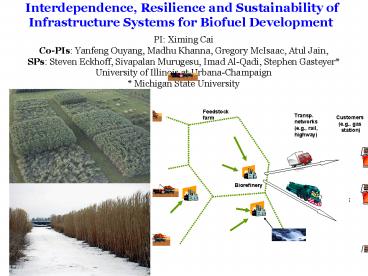
Infrastructure interdependence
4
Key Questions to Address
Introduction
- To achieve the biofuel goals, are strategic
changes in water supply, transportation system
and feedstock production required? - How will environmental regulations, climate
control policies and technology advances affect
infrastructure needs? - How will the time horizons used for biofuel and
engineering planning affect engineering system
resilience and sustainability? - To what extent is there a divergence between the
privately profitable and the socially optimal
design? - What mix of knowledge, resources and social
networks will enable social resiliency
(decision-making capacity and adaptability) at
the community, regional, state and national
level?
5
Introduction
- Adventures!?
- An engineering system bigger than engineering
and a holistic approach to address
infrastructural interdependencies and
environmental and socio-economic impacts
underlying a socio-technical framework - A team of engineers, natural scientists and
social scientists trees or forest? - Engineering vs. policy OR engineering and
policy in the context of the biofuel debate? - Extend operations research from human controlled
engineering systems (e.g., manufacture systems)
to large-scale coupled human-nature systems
6
Key Methodology
Framework for assessing infrastructure
sustainability, a three-dimensional framework,
composing economic efficiency, environmental
preservation, and social development
7
Key Methodology
Conceptual development A probability
representation
Perturbation (DS) Probability
Interdependency
Resilience
8
Key Methodology
Modeling framework for integrated system
simulation and decision making.
9
Key Methodology
- Bottleneck infrastructure
- Perturbation propagation
10
Implications for engineering infrastructure
distribution?
Miscanthus yield (tons/ha)
Switchgrass yield (tons/ha)
11
Spatial distribution of Miscanthus yield in
Illinois (supported by data from field trials at
the three locations)
12
(No Transcript)
13
Implications for technology choices? Farmgate
Costs of Production of Cellulosic Feedstocks in
Illinois
14
Implications for the environment?
Life Cycle GHG Emissions
7.54
3.64
2.09
0.92
GHG emission reduction relative to
gasoline Corn 52 Corn stover
88 Miscanthus 89 Switchgrass 71
15
Summary Implications for engineering?
- Critical engineering infrastructures such as
water supply and transportation, as a system of
systems, will be required to support the biofuel
industry - Infrastructure interdependence will be enhanced
by the energy food resource environment
nexus - Infrastructural resilience and sustainability
issues are beyond engineering and should be
addressed within a broad socioeconomic context by
an interdisciplinary approach - Great challenges are posed for engineering
researchers to communicate with researchers in
other fields
Recommended

