

Secure Routing in Wireless Sensor Networks: Attacks and Countermeasures PowerPoint PPT Presentation
1 / 1
Title: Secure Routing in Wireless Sensor Networks: Attacks and Countermeasures
1
Secure Routing in Wireless Sensor Networks
Attacks and Countermeasures
Chris Karlof and David Wagner NEST
Retreat Winter 2003 UC-Berkeley
Attacks
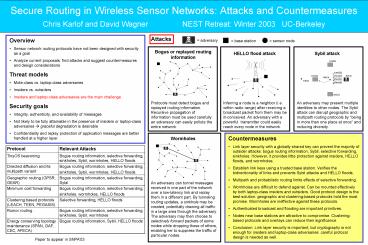
- Overview
- Sensor network routing protocols have not been
designed with security as a goal - Analyze current proposals find attacks and
suggest countermeasures and design considerations - Threat models
- Mote-class vs. laptop-class adversaries
- Insiders vs. outsiders
- Insiders and laptop-class adversaries are the
main challenge - Security goals
- Integrity, authenticity, and availability of
messages - Not likely to be fully attainable in the presence
of insiders or laptop-class adversaries ?
graceful degradation is desirable - Confidentiality and replay protection of
application messages are better handled at a
higher layer
- Countermeasures
- Link layer security with a globally shared key
can prevent the majority of outsider attacks
bogus routing information, Sybil, selective
forwarding, sinkholes. However, it provides
little protection against insiders, HELLO floods,
and wormholes. - Establish link keys using a trusted base station.
Verifies the bidirectionality of links and
prevents Sybil attacks and HELLO floods. - Multipath and probabilistic routing limits
effects of selective forwarding. - Wormholes are difficult to defend against. Can be
mounted effectively by both laptop-class insiders
and outsiders. Good protocol design is the best
solution geographic and clustering-based
protocols hold the most promise. Wormholes are
ineffective against these protocols. - Authenticated broadcast and flooding are
important primitives. - Nodes near base stations are attractive to
compromise. Clustering-based protocols and
overlays can reduce their significance. - Conclusion Link layer security is important, but
cryptography is not enough for insiders and
laptop-class adversaries careful protocol design
is needed as well.
Wormholes
An adversary can tunnel messages received in one
part of the network over a low-latency link and
replay them in a different part. By tunneling
routing updates, a sinkhole may be created,
potentially drawing all traffic in a large area
through the adversary. The adversary may then
choose to selectively forward packets of some
nodes while dropping those of others, enabling
her to suppress the traffic of particular nodes.
Paper to appear in SNPA03
Recommended

