

Morphology and PerformanceBased Assessment of Stream Restoration PowerPoint PPT Presentation
1 / 74
Title: Morphology and PerformanceBased Assessment of Stream Restoration
1
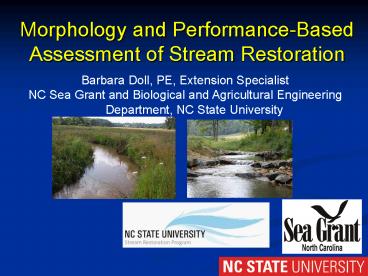
Morphology and Performance-Based Assessment of
Stream Restoration
Barbara Doll, PE, Extension Specialist NC Sea
Grant and Biological and Agricultural Engineering
Department, NC State University
2
Stream Restoration Expenditures
- Nationally gt 1 billion (Bernhardt et al., 2007)
- NC EEP - 1,000,000 feet x ave. cost 260/ft
260 million (Jeff Jurek, NC EEP) - NC CWMTF - No current tally, allocate 33
million annually to restoration projects
3
Why Evaluate Stream Restoration Projects?
- Compliance with mitigation rules
- Lack of post-construction monitoring nationwide
- Evaluate ecological recovery
- Evaluate project effectiveness
- Adaptive management
- Optimize future efforts
- Public acceptance
- Secure future funding
4
Current NC Mitigation Monitoring Requirements
- Channel Geometry longitudinal profile and
cross-sections including the floodplain - Vegetation
- Substrate Pebble Count
- Macroinvertebrate (rarely)
5
Riffle
Run
Pool
Glide
Max Pool
6
(No Transcript)
7
(No Transcript)
8
Bed Material (Substrate) Silt/Clay lt 0.062
mm Sand 0.062 2 mm Gravel 2 64 mm Cobble
64 256 mm Boulder 256 2048 mm
9
Substrate CharacterizationPebble Count
10
Stability Assessment
- http//www.epa.gov/warsss/index.htm
11
Vertical StabilityDegradation/Aggradation
- Bank Height Ratio
- Entrenchment Ratio
12
Bankfull Discharge
- The flow that fills the active channel and begins
to spread onto the floodplain - Represents the break between channel processes
and floodplain processes - For a channel in equilibrium, assumed to equal
the effective discharge
- Bankfull stage is identified in the field
- Return Period typically between 1 and 2 years
13
Bankfull Indicators
- Top of streambank
- Break in slope on streambank
- Top of point bar
- Note Pay attention to flat sandy depositional
surfaces
Bankfull
Bankfull
14
Bank Height Ratio
BHR Dmax tob / Dmax
Dmax tob Max Depth from top of low bank to
thalweg
Dmax Max Depth from bankfull stage to thalweg
Bankfull
Dmax tob
Dmax
15
BHR 5.3 / 2.5 2.1
Top of Bank
Bankfull
16
Entrenchment Ratio
ER Wfpa / Wbkf
Wfpa Width of Flood Prone Area measured at the
elevation twice bankfull max depth above thalweg
Wbkf Width of Bankfull Channel
Wfpa
Bankfull
2 x dmax above thalweg
dmax
Wbkf
17
(No Transcript)
18
Lateral Stability
- Meander Width Ratio
- Bank Erosion (BEHI)
19
Meander Width Ratio
MWR Wblt / Wbkf
Wblt Belt Width
Wbkf Bankfull Width of Riffle Cross-Section
Wbkf
Wblt
20
Bank ErosionMonitoring
21
Bank Erosion Hazard Index (BEHI)
22
(No Transcript)
23
Rapid Stream Assessment for NC CWMTF
- Evaluate project status
- Determine if project goals were met
- Identify specific common problems
- Provide recommendations to improve future
projects
24
Stream Rapid Assessment Phase I, Summer 2006
- 18 stream restoration projects selected for review
25
Variability in the data
- 5 Ecoregions
- Land Cover 5 urban, 13 rural projects
- Project Age 1-7 years
- Enhancement to full restoration (dimension,
pattern profile) - Some projects had repairs
26
Mechanics of Stream Evaluation
- Rapid Assessment - approximately 2-3 hours per
project - Four teams of two-people
- Physical
- Vegetation
- Bug
- Rover
27
Stream Assessment Protocol
B. Bank and Riparian Habitat
D. Condition and Function of Structures
C. Aquatic Insects
A. Channel Condition
28
A. Channel Condition Evaluations
- A1- Bedform
- A2 - Substrate
- A3 - Cover and Refuge
29
A1. Bedform
- Evaluate location, design and biological function
of major channel geomorphic units (riffles,
pools, runs, and structure related habitat) and
additional channel geomorphic units (CGUs).
- Pocket Water
- Plunge Pools
- Cascades
- Edgewater
- Lateral Scour Pool
- Step Pool
- Rapids
- Bedrock Sheet
- Backwater Pool
30
A2. Dominant Substrate Material
- Pebble counts are conducted at two riffles
- -D50
- -D84
- - lt 2mm
31
A3. Cover and Refuge
- Cover type (leaf packs, macrophytes, woody
debris, overhanging vegetation, etc) - Overall instream cover
32
B. Bank and Riparian Habitat Conditions
- B1. Streambank Stability Assessment (Modified
BEHI) - B2. Health and Condition of the Riparian
Vegetation - B3. Floodplain and Floodplain Soils
33
B1. Streambank Stability Assessment
- Streambank stability - modified BEHI (Rosgen)
- Bank Height / Bankfull Height
- Root Depth / Bank Height
- Root Density
- Bank Angle
- Surface Protection
- Near Bank Stress
34
B2. Health Condition of the Riparian
Vegetation
- Structural Complexity and Species Diversity
- Planted Trees/Shrubs/Livestakes
- Natural Tree and Shrub Regeneration
- Invasive Exotic Species
- Streambank Root Mass
35
B3. Floodplain and Floodplain Soils
- Six floodplain characteristics (7 in urban
streams) - Floodplain connection
- Vegetated buffer width
- Floodplain habitat
- Floodplain encroachment
- Soil characteristics and rooting medium
- Percent exposed or bare ground
- Stormwater outfall quality (urban projects only)
36
C. Aquatic Insect Community
- Aquatic insects collected upstream and within the
project - Abundant taxa in common
- EPT abundance
- Number of indicator taxa
- shredders and predators
37
D. Instream Structure Evaluation
- Structure Condition
- Structure Function
38
Cross Vane Functions
- Bank protection
- Flow Concentration (pool formation)
- Grade control
- Habitat enhancement
39
Rootwads
- Bank Protection
- Habitat
40
Results
- Most common project goals are reducing streambank
erosion and establishing floodplain connection - Most projects met the intended goals
- Some observed problems
- Poor riparian vegetation
- Aquatic insects are colonizing the new features
however, complete recovery hasnt yet occurred - Sedimentation from upstream sources
- Streambank erosion in critical areas
- Some structure failures due to poor construction
41
Results Summed scored for all sites
42
Riparian Vegetation
- Many projects have healthy growing riparian
buffers - Problems related to
- Poor soil conditions
- Mowing
- Invasive exotic plants
43
Urban projects have lower riparian vegetation
quality than rural projects
Urban Projects
44
Newer projects have slightly higher riparian
vegetation quality than older projects
45
Aquatic Insects
- Most streams are developing an aquatic insect
fauna - Aquatic fauna potentially inhibited by
- Upstream water quality impacts (e.g. stormwater)
- Excessive sedimentation
- Poor riffle/pool bedform
46
Urban projects have lower macroinvertebrate
quality than rural projects
Urban Projects
47
Older projects have higher macroinvertebrate
quality than newer projects
48
Stream Stability
- Many projects have stable dimension, pattern, and
profile - Problems related to
- Structure failure
- Excessive sedimentation
- Streambank erosion
49
Channel stability is not related to watershed
land use (rural vs. urban)
Urban Projects
50
Channel stability is not correlated with age of
project
51
- Successful Structures
- Properly designed and constructed
- Small elevation drop
- Sealed to prevent piping
- Riffles constructed to maintain length
52
- Structure Failures
- Rocks or logs not placed properly
- Piping under or through rocks or logs
- Excess scour
53
Conclusions
- Most projects are meeting goals of stabilizing
channels and creating accessible floodplains - Poor riffle/pool bedform observed at many sites
due to both design and implementation
(potentially leading to poor aquatic insect
populations) - Ecological recovery (habitat and benthic
macroinvertebrate communities) may require many
years - Recolonization of the riparian area is critical
for ecological recovery - Water quality improvement depends on watershed
factors including stormwater, sedimentation and
point sources - Long-term intensive monitoring is necessary to
evaluate ecological success
54
Systematic Performance Index
- Rapid visual assessment of stream physical
condition (form and function) - Channel bedform
- Channel pattern
- Floodplain connection
- In-stream habitat features
- Sediment transport
- Streambank Condition
- Streambank vegetation
55
Objectives
- Establish the range of morphologic structure and
function for high quality reference streams - Determine if stream restoration projects exhibit
morphologic form and function that is comparable
to reference streams. - Determine if watershed, landscape or design
parameters influence the morphologic form and
function of streams.
56
High-quality reference streams serve as design
templates
57
Determine Restoration Potential
Reference Reaches
Restored Streams
Performance Index Range
Disturbed Channels
58
NC EEP Reference Reach Study
Map courtesy of Brian Lowther
59
- Channel Bedform
- Riffles
- Steps
- Pools
60
Consider location and quality of bedform features
61
Channel Pattern
62
In-Stream Habitat
Bedrock, Boulders or Boulder Clusters
Large Woody Debris
63
In-Stream Habitat
Stable Undercut Banks
Fine Roots
64
In-Stream Habitat
Leaf Packs
65
Sediment Transport
66
Streambank Condition
67
Streambank Vegetation
68
Floodplain Connection
69
(No Transcript)
70
Preliminary Results
71
(No Transcript)
72
Is the Performance Index a consistent method for
evaluating the morphological condition of stream
restoration projects?
73
(No Transcript)
74
What factors best predict the performance of a
stream restoration project?
- Watershed drainage area size, impervious,
landuse/landcover - Landscape valley type, valley slope, substrate
composition - Restoration design parameters Dimensionless
Ratios, Sinuosity, Slope, Stream Type
75
Watershed Assessment
76
Detailed GIS Analysis of Land Use/Land Cover
77
Future Work
- Visit 70 additional stream restoration projects
- Visit 16 disturbed/unstable streams
- Collect site and design data from EEP, CWMTF and
project designers - GIS analysis of all watersheds
- Statistical analyses to determine which variables
best relate to the Performance Index scores
Recommended

