

An autonomous multisensor probe for taking measurements under glaciers PowerPoint PPT Presentation
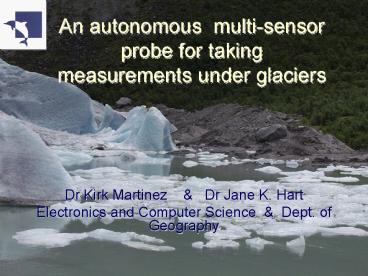
Title: An autonomous multisensor probe for taking measurements under glaciers
1
An autonomous multi-sensor probe for taking
measurements under glaciers
- Dr Kirk Martinez Dr Jane K. Hart
- Electronics and Computer Science Dept. of
Geography
2
Advisors
- Prof. Harvey Rutt
- Dr Joe Stefanov
- Workshop Ken Frampton
- PIC Tim Forcer
3
A Subglacial ProbeAn autonomous multi-sensor
probe for taking measurements under glaciers
- Introduction
- Current Research Methods
- Subglacial Probe
- Site details
- Radar details of ice/sediment
- Probe details
- Revised Timetable and Conclusion
4
Introduction
- Current day Global Warming represents one of
major changes to our social and environmental
well being - One key element of climate change is the response
of glaciers - sea level change, and changes to
the thermohaline circulation in the North
Atlantic - Vital to understand behaviour of the subglacial
bed
5
Subglacial Deformation
- Movement in sediment can comprise 90 of glacier
motion - Requires high pore water pressures
6
Current research methods
- Geophysical techniques (seismic and radar) are
mostly static and of low resolution - In situ process studies
7
Ground Penetrating Radar
Ground Penetrating Radar, example from
Breidamerkurjokull
8
In situ process studies
- Sediment strength (ploughmeter)
- Sediment deformation (tiltmeter)
- Sediment velocity (dragspools)
9
SedimentStrength
- Ploughmeter
10
Ploughmeter
Variations in sediment strength - typical viscous
model for sediment behaviour
Example from Vestari- Hagafellsjokull, Iceland
11
Amount of deformation
- Tilt cells
12
Tiltmeter
-8cm
Variations in tilt
-15cm
Example from Vestari- Hagafellsjokull, Iceland
13
Amount of deformation/sliding
- Drag Spools
14
Summary
- Current techniques useful, but because they are
tethered they do not behave in a natural manner
15
Subglacial Probe
- Smart sensor pebbles tracked by radio
16
Site details
- Briksdalsbreen in Norway
- Advanced 400m since 1988 over silty clay (lake
bed) - Average July surface velocity 1996-2000 was 0.33
m/day - basal velocity normally 70 of surface so
predicted velocity 0.23 m/day - Expected deforming bed thickness
- 0.2 - 0. 3m
- Expected ice thickness at drill site 100m
17
Properties of ice/sediment
- dielectric constant of ice
- ?? 3.17 ??? 0.003
- frozen sediments ?? 3.8
- dry sediments ?? 4.4
- DC conductivity 10-5 to 10-6 S m-1
18
Probe Details
- Sediment strength
- Sediment deformation
- Sediment velocity
- Sediment temperature
- Holes will be drilled by hot water drill
- Probes will be inserted at 5 sites
19
Sediment Strength
- Stress gauges in probe
ICE
Probe
SEDIMENT
20
Sediment Deformation (rotation)
- 10 degree accuracy sufficient
- 2 tilt cells
ICE
Probe
SEDIMENT
21
Velocity(position)
- 10-50cm accuracy in position
- Transponder
ICE
Probe
SEDIMENT
22
Temperature and Pressure
- 1 2 C accuracy sufficient
- Thermistor and Pressure sensor
ICE
Probe
SEDIMENT
23
Basic Design
Base Station
DGPS Ground station
Ice
Sediment
24
Movement in a year
Base Station
13m
DGPS Ground station
Ice
10m
7m
3m
Sediment
25
Probes
- Hard oval case probably potting-filled
- PIC microprocessor RAM
- Data Transmitter radar transponder
- A/D and amplifiers
- Powerful batteries
- Sensors tilt, temp. pressure,
- May measure hourly, transmit and sleep
26
Radio calculations
- Velocity in ice 0.16 m/ns
- 1.8GHz wavelength 0.167 m
- ? 4 ? Im(v?) / ? 0.063 m-1
- Attenuation e - ? L
- For L 100m Attenuation 27 dBm
- ie within range
27
Probe Case
- Made of strong milled material
- two halves
- Use join area for antennae
- Padded interior
28
Base Station
- Computer with larger storage
- Large power supply (lead-acid gell plus Solar
top-up) - DGPS for position relative to ground station
- Receiver for Probe data
- GSM/Satellite phone connection home
- Position radar antennas to track probes
29
Ground Station
- DGPS base station to locate base station on
glacier
30
Power estimate
- 400mA for 2s every hour is 2AH/year
- Lithium AA batteries reach 2-3 AH
- Estimate 6 batteries for 7V approx.
- Can reduce on/off ratio if necessary
31
Testing
- Mechanical testing of case
- Telemetry testing
- Sensor testing/calibration
- Accelerated power drain testing at -5oC
- Traditional instruments will also be inserted in
glacier for comparison
32
Timetable
33
Conclusions
- Probe allows
- less invasive monitoring of the subglacial
- more natural mimicking of clast behaviour
- Technical solution is feasible
- This will be the first instrument of its kind for
earth observations
Recommended

