

Effect of Intake Nozzle Design on a Banki Turbine PowerPoint PPT Presentation
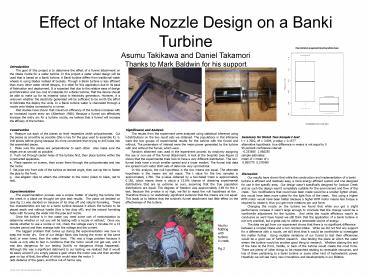
1 / 1
Title: Effect of Intake Nozzle Design on a Banki Turbine
1
Effect of Intake Nozzle Design on a Banki
Turbine Asumu Takikawa and Daniel Takamori Thanks
to Mark Baldwin for his support
Introduction The goal of this project is to
determine the effect of a funnel attachment on
the intake nozzle for a water turbine. In this
project a water wheel design will be used that is
based on a Banki turbine. A Banki turbine differs
from traditional water wheels in using blades
instead of buckets. Though a Banki turbine is
less efficient than many other water wheel
designs, it is ideal for this application due to
its ease of fabrication and deployment. It is
expected that due to the relative ease of design
and fabrication and low cost of materials for a
Banki turbine, that the device should be able to
make up for its material value in electricity
generation. However, it is unknown whether the
electricity generated will be sufficient to be
worth the effort to fabricate the deploy the
units. In a Banki turbine water is channeled
through a nozzle onto blades connected to a
runner. Past studies have shown that maximum
efficiency of the turbine increases with an
increased nozzle entry arc (Albertson 1988).
Because a funnel can effectively increase the
entry arc for a turbine nozzle, we believe that a
funnel will increase the efficacy of the turbine.
Construction a. Measure out each of the pieces
on their respective width polycarbonate. Cut the
pieces as smoothly as possible (this is key for
the glue used to assemble it). b. Drill pieces
before gluing because it's more convenient than
trying to drill holes into the assembled
pieces. c. Make sure the pieces are
perpendicular to each other. Also make sure the
edges are as smooth as possible. d. Push rod
through center holes of the turbine first, then
place turbine within the constructed
apparatus. e. Place spacers on screws, then
screw them through the polycarbonate and into the
motor. f. Set pipe into front side of the
turbine at desired angle, then use zip ties to
fasten the pipe to the front. g. Use alligator
clips to attach the voltmeter to the motor (black
to black, red to red). Experimentation The
experimentation process was a simple matter of
placing the turbine into the creek in a place we
thought we give best results. The place we
decided on (see fig 2.) was decided on because of
its drop off and natural funneling. These two
characteristics are key to a banki turbine
because it allows the turbine to be placed easily
and without hassle (this is the drop off), and
the natural funneling helps with focusing the
water into the pipe and nozzle. Once the turbine
is in the water you need some sort of
randomization to determine whether or not you
will be testing with a nozzle or without. Once
you decide whether to use a nozzle or not, check
the voltage every 5 minutes for a 15 minutes
period and then average both the voltage and the
current. The biggest problem that comes up
during the experimentation was how to keep the
motor dry. One of our design flaws was having
the motor at the same level, or even lower, than
the water level. This was a huge problem because
it made us only able to test in conditions that
the motor would not get wet, and it was also
dangerous for our testing (luckily no dangerous
things happened). Although this was a
significant detriment to our testing, we realized
that it would be easily solved if you simply
placed a gear where the motor was and then
another gear on top of that, the effect of which
would raise the motor 3 radii distance of the
gears, and thus out of harms way.
Significance and Analysis The results from the
experiment were analyzed using statistical
inference using t-distributions on the two result
sets we obtained. The populations in this
inference were the two groups of experimental
results for the turbine with the funnel and
without. The parameters of interest were the mean
power generated by the turbine with and without
the funnel, which were . Random allotment was
used in the experiment process by randomly
assigning the use or non-use of the funnel
attachment. A look at the boxplots (see Figure 2)
shows that the experimental trials look to have a
very different distribution. The non-funnel
trials have a much smaller spread and a lower
median. The funnel trial data are spread much
wider. Both sets of data look very symmetrical.
In this analysis, the null hypothesis is the
two means are equal. The alternate hypothesis is
the means are not equal. The t value for the two
samples is approximately 1.768. The p-value
obtained by a two-tailed t-test is approximately
0.158, which means there is about a 15.8 chance
of obtaining experimental distributions that are
as extreme as ours, assuming that the true
population distributions are equal. The degrees
of freedom was approximately 3.69 for the t-test.
Because this p-value is so high, we fail to
reject the null hypothesis at the . Therefore
there is no statistically significant evidence
that the means are not equal. This leads us to
believe that the turbine's funnel attachment had
little effect on the effectiveness of the turbine.
Summary for Welch Two Sample t-test t 1.7682,
df 3.694, p-value 0.1577 alternative
hypothesis true difference in means is not equal
to 0 95 percent confidence interval -0.253685
1.068255 sample estimates mean of x mean of y
0.985775 0.578490
Discussion Our results have shown that while the
construction and implementation of a banki
turbine is efficient and relatively easy, a more
energy efficient system and one designed for use
in the specific area. Our design wasn't
specifically designed for Jackson Creek and as
such the design wasn't completely suitable for
the environment and flow of the creek. Two
modifications that could have been made would be
a smaller lighter wheel, this would have been
more suited for the light flow of the creek.
Also using a higher RPM motor would have been
better because a higher RPM motor means less
torque is required to rotate it, thus you get
more rotations per unit force. Changing the
nozzle on the turbine we found that while you got
a slight performance increase it wasn't large
enough to conclude that the change would be a
worthwhile adjustment for the turbine. And while
the nozzle efficiency wasn't as conclusive as
we'd have hoped we still think that the
application of a banki turbine is not only
practical, but a great way to utilize a renewable
source of energy. The data we got from our
experiment shows that there is no significant
difference between a nozzled intake and a
non-nozzled intake. While we did not find any
support for a difference with a nozzle, we still
think that it would be worthwhile to investigate
the matter further. Using multiple variations of
our funnel to test their efficiencies would be a
good use of further research. Also testing the
place at which the water enters the turbine would
be another good thing to research. Whether
placing the end of the tube at the front, middle,
or back of the turbine would create the most
force. There are plenty of other things to be
researched relating to renewable resources, and
lots of them pertaining to a banki turbine or
some other kind of hydroelectric power.
Hopefully we will see many new innovations and
developments in our lifetime.
Asumu fiddling with turbine in creek
Fig 2
Revised June 01, 2006. banki-turbine-2006-poster.
ppt
Recommended

