

HSBC Director of Low Carbon Innovation: Energy Science Director: PowerPoint PPT Presentation
1 / 47
Title: HSBC Director of Low Carbon Innovation: Energy Science Director:
1
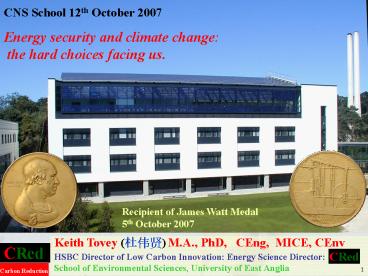
CNS School 12th October 2007 Energy security and
climate change the hard choices facing us.
Recipient of James Watt Medal 5th October 2007
Keith Tovey (???) M.A., PhD, CEng, MICE, CEnv
HSBC Director of Low Carbon
Innovation Energy Science Director School of
Environmental Sciences, University of East Anglia
CRed
2
(No Transcript)
3
Latest Temperature Data from GISS 10/09/2007
4
Is Global Warming man made?
Prediction Natural only good match until 1960
Prediction Anthropogenic only Not a good match
between 1920 and 1970
- Predictions include
- Greenhouse Gas emissions
- Sulphates and ozone
- Solar and volcanic activity
Prediction Natural and Anthropogenic Generally a
good match
Source Hadley Centre, The Met.Office
5
Increasing Occurrence of Drought
Increasing Occurrence of Flood
Change in precipitation 1961-2001
Source Tim Osborne, CRU
Total summer precipitation
Total winter precipitation
6
Consequence of 1m rise
Consequence of 6m rise
(Source Prof. Bill McGuire, University College
London)
Norwich City would be playing water polo!
7
Climate ChangeArctic meltdown 1979 - 2003
- Summer ice coverage of Arctic Polar Region
- Nasa satellite imagery
- 20 reduction in 24 years
Source Nasa http//www.nasa.gov/centers/goddard/n
ews/topstory/2003/1023esuice.html
8
Options for Electricity Generation in 2020 -
Non-Renewable Methods
Nuclear New Build assumes one new station is
completed each year after 2018.
9
Options for Electricity Generation in 2020 -
Renewable
10
Options for Electricity Generation in 2020 -
Renewable
Area required to supply 5 of UK electricity
needs 300 sq km But energy needed to make PV
takes up to 8 years to pay back in UK.
11
Options for Electricity Generation in 2020 -
Renewable
- Transport Fuels
- Biodiesel?
- Bioethanol?
- Compressed gas from
- methane from waste.
But Land Area required is very large - the area
of Norfolk and Suffolk would be needed to
generated just over 5 of UK electricity needs.
12
Options for Electricity Generation in 2020 -
Renewable
13
Options for Electricity Generation in 2020 -
Renewable
14
Options for Electricity Generation in 2020 -
Renewable
Output 78 000 GWh per annum Sufficient for 13500
house in Orkney Save 40000 tonnes of CO2
15
Options for Electricity Generation in 2020 -
Renewable
16
Solar Energy - The BroadSol Project
Solar Collectors installed 27th January 2004
Annual Solar Gain 910 kWh
17
It is all very well for South East, but what
about the North?
House on Westray, Orkney exploiting passive solar
energy from end of February
House in Lerwick, Shetland Isles with Solar
Panels - less than 15,000 people live north of
this in UK!
18
Our Choices They are difficult Energy Security
There is a looming capacity shortfall Even with a
full deployment of renewables. A 10 reduction in
demand per house will see a rise of 7 in total
demand - Increased population decreased
household size
- Opted Out Coal Stations can only run for 20 000
hours more and must close by 2015 - New Nuclear assumes completing 1 new nuclear
station each year beyond 2018 - New Coal assumes completing 1 new coal station
each year beyond 2018
19
Our Choices They are difficult
- Do we want to exploit available renewables i.e
onshore/offshore wind and biomass.
Photovoltaics, tidal, wave are not options for
next 20 years. - If our answer is NO
- Do we want to see a renewal of nuclear power
- Are we happy with this and the
other attendant risks?
- If our answer is NO
- Do we want to return to using coal?
- then carbon dioxide emissions will rise
significantly - unless we can develop carbon sequestration and
apply it to ALL our - COAL fired power stations within 10
years - unlikely.
If our answer to coal is NO Do we want to leave
things are they are and see continued
exploitation of gas for both heating and
electricity generation? gtgtgtgtgtgt
20
Our Choices They are difficult
- If our answer is YES
- By 2020
- we will be dependent on around 70 of our
heating and electricity from GAS - imported from countries like Russia, Iran,
Iraq, Libya, Algeria - Are we happy with this prospect? gtgtgtgtgtgt
If not We need even more substantial cuts in
energy use. Or are we prepared to sacrifice our
future to effects of Global Warming by using
coal? - the North Norfolk Coal Field? Aylsham
Colliery, North Walsham Pit?
Do we wish to reconsider our stance on
renewables? Inaction or delays in decision making
will lead us down the GAS option route and all
the attendant Security issues that raises.
21
Historic and Future Demand for Electricity
Business as usual
Energy Efficient Future ?
Number of households will rise by 17.5 by 2025
and consumption per household must fall by this
amount just to remain static
22
Electricity Options for the Future
Energy Efficiency consumption capped at 420
TWh by 2010 But 68 growth in gas demand
(compared to 2002) Business as Usual 257
increase in gas consumption ( compared to 2002)
The Gas Scenario Assumes all new non-renewable
generation is from gas. Replacements for ageing
plant Additions to deal with demand
changes Assumes 10.4 renewables by 2010
25 renewables by 2025
23
Alternative Electricity Options for the Future
- 25 Renewables by 2025
- 20000 MW Wind
- 16000 MW Other Renewables inc. Tidal, hydro,
biomass etc.
Energy Efficiency Scenario Other Options Some
New Nuclear needed by 2025 if CO2 levels are to
fall significantly and excessive gas demand is to
be avoided
Business as Usual Scenario New Nuclear is
required even to reduce back to 1990 levels
24
Decision Time for you
- In groups for next 5 minutes discuss the
following - How should we generate electricity in the period
up to 2030? - Beyond 2030?
- How important is Energy Security?
- What is important to ensure Energy Security?
- What are your reactions to wind turbines?
25
(No Transcript)
26
Wind Turbines are Incredibly Inefficient
Efficiency the ratio of the USEFUL work to
the total energy available (or expended) Oxford
English Dictionary
Modern Wind Turbines convert 40 42 of
available energy in the wind Modern Coal Fired
Power Stations achieve 38 Sizewell B achieves
32 A car engine achieve 20 - 25 at best
Compared to many other energy devices, Wind
Turbines are Very Efficient
27
Is Efficiency being confused with Capacity
Factor?
- The Capacity Factor is a measure of how much use
is made of an appliance compared to the amount
that could be achieved at rated output over a
year. - Wind Turbines have a Capacity Factor of 22 for
first generation turbines in the East to 30 for
the latest generation machines. Capacity
factors are higher in the West and as much as 40
or more in places in Scotland. Even in East
Anglia, capacity factors of 50 are achieved in
some months. - A capacity factor of 30 does not mean it is only
working for 30 of the time. It means that it
could be working at 30 of output for 100 of the
time, 100 of output for 30 of time, or any
combination between. The fact the turbine is
working does not mean that it is at its rated
output. - Large coal and nuclear stations are off line for
up to 50 days at a time loosing equivalent
output of 700 turbines. - A car driven 10000 miles has a capacity factor
about 4. - A washing machine used 5 times a week has a
capacity factor of 3.
28
Some Myths about Wind Energy
- What happens when the wind does not blow?.
- Large Coal /Nuclear Stations trip/ have failures
and these cause a loss of power within a matter
of minutes. - In terms of short term variations wind is more
reliable.
- Wind Turbines kill birds.
- Evidence suggesta that a few birds are killed
typically 3 per installed MW per year except in a
few locations. In many cases it is much less - Oldest wind farm in UK on Burgar Hill has an
RSPB reserve right next to it. - Currently UK has around 1700 MW wind turbines
installed perhaps 5000 birds killed a year - Estimates of 1 million killed each year by
vehicles
29
On average each person in UK causes the emission
of 9 tonnes of CO2 each year.
How many people know what 9 tonnes of CO2 looks
like?
5 hot air balloons per person per year. Around 4
million in the Diocese of Norwich. In the
developing world, the average is under 1 balloon
per person Is this Fair?
"Nobody made a greater mistake than he who did
nothing because he thought he could do only a
little." Edmund Burke (1727 1797)
30
Raising Awareness
- A tumble dryer uses 4 times as much energy as a
washing machine. Using it 5 times a week will
cost over 100 a year just for this appliance
alone and emit over half a tonne of CO2.
- 10 gms of carbon dioxide has an equivalent volume
of 1 party balloon.
- A Mobile Phone charger up to 20 kWh per year
- 1000 balloons each year. 10 kg CO2
- Standby on electrical appliances
- 60 kWh a year - 4000 balloons.
- Filling up with petrol (38 for a full tank
40 litres) - --------- 90 kg of CO2 (5 of
one hot air balloon)
How far does one have to drive in a small family
car (e.g. 1400 cc Toyota Corolla) to emit as much
carbon dioxide as heating an old persons room for
1 hour?
1.6 miles
31
Saving Energy A Practical Guide Ways to Reduce
Your Carbon Footprint
Micro Wind
32
The Behavioural Dimension
- Household size has little impact on electricity
consumption. - Consumption varies by up to a factor of 9 for any
given household size. - Allowing for Income still shows a range of 6 or
more. - Education/Awareness is important
33
Transport
- Car 5 door Toyota Yaris
- Real performance is best at 50 mph. Saves up
to 15 in fuel consumption cf 70 mph.
- Driver behaviour trials at Banham Poultry
- Driver behaviour affects performance
- Driver 2 uses 13.8 more fuel
34
Historic Trends Freight Transport on Roads
- Distance each tonne has travelled has increased
by - 223 since 1960
- 20 since 1990
- Is this increase in movement of freight conducive
to optimum economic growth, energy security, and
carbon reduction?
35
Electricity Statistics
Each house in Norwich consumes, 3727 kWh per
year. Broadland 5057 kWh
Breckland 5612 kWh North Norfolk
5668 kWh South Norfolk 5797 kWh Kings
Lynn and 5908 kWh Great
5144 kWh West Norfolk
Yarmouth A wind farm the size of Scroby
Sands can supply twice domestic demand of Norwich
or 66 on average. (or 22 of total demand)
Saves 70 000 to 75 000 tonnes of carbon dioxide
a year or 40 000 hot air balloons each
year. The alternatives Persuade 30 000 motorists
never to drive the car again Or 300 000 motorists
to drive 1000 miles less each year. Widespread
deployment of small scale renewables, and energy
conservation.
36
Involve the local Community
- The residents on the island of Burray (Orkney)
campaigned for a wind turbine. - On average they are more than self-sufficient in
electricity needs and indeed are a net exporter
of electricity. - Many of the Islanders bought shares in the
project and are now reaping the reward. - Orkney is hoping to be a zero net emitter of
carbon dioxide by 2015.
37
Involve the local Community
Even better things are happening on the Island of
Westray.
The Parish Kirk, and Community Centre are heated
by heat Pumps partly powered by Wind Turbines
Waste cooking oil from other islands is processed
into biodiesel for farm and other
vehicles. Ethanol used in process is obtained
from fermentation of harvested sea weed
38
Hard Choices
- What can we as individuals do?
- What can we do collectively as a Community?
- Visit the CRed WEB Site
- Sign a pledge to
- combat global warming
- help secure a sustainable environment for our
children - help reduce the adverse impacts of Global
Warming - help secure energy supplies for the future
- saving energy
- Adopting technical solutions
- Promoting Awareness
- Promoting appropriate renewable energy
www.cred-uk.org
39
Decision Time for you
- In groups for next 5 minutes discuss the
following - What could you pledge to do at home?
- What could CNS Pledge to do?
40
Conclusions
- Global Warming will affect us all - in next few
decades - Energy Security will become increasingly
important. Inaction over making difficult
decisions now will make Energy Insecurity more
likely in future. - Move towards energy conservation and LOCAL
generation of energy and small changes to
behaviour. - It is as much about the individuals response
to use of energy as any technical measures the
Government may take. - Wind (and possibly biomass) are the only real
alternatives for renewable generation in next 5
10 years. - Otherwise Nuclear???
- Even if we are not convinced about Global Warming
Energy Security issues will shortly start to
affect us.
41
Conclusions
- Need to act now otherwise we might have to make
choice of whether we drive 1.6 miles or heat an
old persons room
Are you up to the Challenge? Will you make a
pledge?
"If you do not change direction, you may end up
where you are heading."
Lao Tzu (604-531 BC) Chinese Artist and Taoist
philosopher
42
Animation Courtesy of Rob Hannington
43
(No Transcript)
44
(No Transcript)
45
Latest Temperature Data from GISS 10/09/2007
These represent temperatures for US only
46
Wind Turbines are Incredibly Inefficient
Efficiency the ratio of the USEFUL work to
the total energy available (or expended) Oxford
English Dictionary
Modern Wind Turbines convert 40 42 of
available energy in the wind Modern Coal Fired
Power Stations achieve 38 Sizewell B achieves
32 A car engine achieve 20 - 25 at best
Compared to many other energy devices, Wind
Turbines are Very Efficient
47
Is Efficiency being confused with Capacity
Factor?
- The Capacity Factor is a measure of how much use
is made of an appliance compared to the amount
that could be achieved at rated output over a
year. - Wind Turbines have a Capacity Factor of 22 for
first generation turbines in the East to 30 for
the latest generation machines. Capacity
factors are higher in the West and as much as 40
or more in places in Scotland. Even in East
Anglia, capacity factors of 50 are achieved in
some months. - A capacity factor of 30 does not mean it is only
working for 30 of the time. It means that it
could be working at 30 of output for 100 of the
time, 100 of output for 30 of time, or any
combination between. The fact the turbine is
working does not mean that it is at its rated
output. - Large coal and nuclear stations are off line for
up to 50 days at a time loosing equivalent
output of 700 turbines. - A car driven 10000 miles has a capacity factor
about 4. - A washing machine used 5 times a week has a
capacity factor of 3.
Recommended

