

ECs in the United States: Understanding Their Occurrence, Fate and Effects PowerPoint PPT Presentation
1 / 26
Title: ECs in the United States: Understanding Their Occurrence, Fate and Effects
1
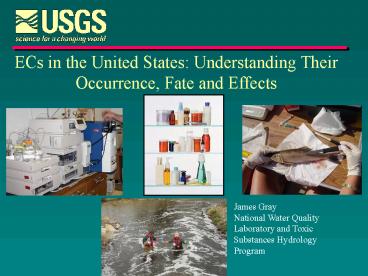
ECs in the United States Understanding Their
Occurrence, Fate and Effects
James Gray National Water Quality Laboratory and
Toxic Substances Hydrology Program
2
Acknowledgements
Dana Kolpin, Iowa City IA dwkolpin_at_usgs.gov Ed
Furlong, Denver COLarry Barber, Boulder CO Mike
Meyer, Lawrence KS Pat Phillips, Troy NY Keith
Loftin, Lawrence KS Joe Duris, Lansing MI Paul
Bradley, Columbia SC
James Gray, Boulder CO Sheridan Haack, Lansing
MI Kymm Barnes, Iowa City IA Mark Burkhardt,
Denver CO Mike Focazio, Reston VA Dave Alvarez,
Columbia MO Vicki Blazer, Kearneysville WV Lisa
Fogarty, Lansing MI Frank Chapelle, Columbia SC
Center expertise (e.g. Kathy Lee, Doug
Schnoebelen, Paul Stackelberg, Tracy Yager, Jason
Vogel)
Emerging Contaminant Project toxics.usgs.gov/regi
onal/emc/
Plus more.
3
Emerging Contaminants
- Several Names Pharmaceutical and Personal Care
Products (PPCPs), Organic Wastewater
Contaminants (OWCs), Emerging Pollutants of
Concern (EPOCs) - New chemicals produced to offer improvements in
industry, agriculture, medicine,and common
conveniences. - New reasons for concern for existing
contaminants. - New capabilities enabling improved examination
of contaminants.
4
EC Project Source-to-Receptor Research
http//toxics.usgs.gov/regional/emc/
Methods Development
Sources Pathways
Environmental Occurrence
Transport and Fate
Receptors (Eco exposure and effects)
gt130 pubs since 98
5
Sources and Source Pathways
To effectively minimize environmental
contamination, it is necessary to understand
potential contaminant origins and pathways to the
environment.
6
Human and Animal Sources
- Human
- Wastewater treatment plants
- Combined sewer overflows
- Onsite septic systems
- Industrial Discharge
- Landfills
- Water Reuse
- Animal
- Waste lagoons, etc.
- Land application
- Processing plants
- Aquaculture
7
Occurrence
The first step in the road to understanding the
fate of a contaminant is determining if
contamination is actually taking place.
- Which compounds enter the environment?
- How frequently do they occur?
- At what concentrations do they occur?
- In what mixtures?
8
gt1500 Sites gt400 Streams gt1,000 Wells gt75 WWTPs
Preliminary, in preparation
9
WWTP Study - 2002
10 WWTP Settings upstream effluent 1st
downstream 2nd downstream 2 Background settings
EST, 2005, v. 39, n. 14, p. 5157-5169
10
Most Frequently Detected Compounds
78 of 110 ECs detected
Cotinine (92.5) Caffeine (70.0) Cholesterol
(90.0) DEET (70.0) Carbamazepine (82.5)
Tributylphosate (70.0) Tonalide (80.0)
Ethanol,2-b,p (70.0) Tri(dcp)phosphate (77.5)
Benzophenone (67.5) Tri(2-ce)phosphate (75.0)
Diltiazem (67.5) 3,4-dcp isocyanate (72.5)
NPEO2 (62.5) b-sitosterol (72.5) NPEO1
(62.5) Codeine (72.5) Triclosan (62.5) Ethyl
citrate (72.5) 3b-coprostanol
(60.0) Sulfamethoxazole (72.5) Trimethoprim
(60.0)
11
WWTP StudySummary Results
12
Plants Vary In Ability To Reduce ECs
13
Transport and Fate
In order to minimize ecologic effects, it is
essential to understand how a contaminant moves
and is altered in the environment.
(Barber and others, 1995)
14
WERF Project Overview
- Evaluate the fate of known estrogenic compounds
and total estrogenic activity in solids derived
from wastewater treatment and through commonly
used sludge and solids treatment processes. - 2 Phases
- Phase I Full Scale Plants
- Phase II Bench Pilot Scale Studies
- Chemical Bioassay Measurements
15
In-stream Study of ECs
Fourmile Creek (IA)
Boulder Creek (CO)
- - Effluent dominated systems (WWTP discharge)
- Background data denote multiple ECs present
- Relatively small basin sizes
- Basic understanding of the flow system
- Controls present above WWTPs
16
Hydrologic Mixing
37 Effluent
2.89 m3/s
1.84 m3/s
2.41 m3/s
Boulder Creek (9/3/03)
1.61 m3/s
1.84 m3/s
3.7 km
7.5 km
5.1 km
-0.1 km
9.7 km
Effluent 0.93 m3/s
Tributary 0.09 m3/s
0 km
Ditch 0.16 m3/s
Ditch 0.20 m3/s
Ditch 0.88 m3/s
82 Effluent
Fourmile Creek (8/5/03)
0.03 m3/s
0.18 m3/s
0.17 m3/s
0.16 m3/s
0.16 m3/s
-0.1 km
10.6 km
8.4 km
2.9 km
0.4 km
Effluent 0.14 m3/s
Tributary 0.07 m3/s
0 km
17
Time of Travel
Dye Injection
Leading Edge
Peak
Trailing Edge
18
Estrogenicity of Boulder Effluent and Boulder
Creek
Fall 2003 Spring 2005
19
Receptor Effects
- Contaminant uptake
- Endocrine Disruption
- Antibiotic Resistance
- Pathogens
Our ability to measure contaminants currently
exceeds our understanding of their environmental
effects.
20
Evidence of Reproductive Disruption in Boulder
Creek white suckers
1. Sex Ratio Skewed toward females at
downstream sites 14 MF
21
Evidence of Reproductive Disruption in Boulder
Creek white suckers
1. Sex Ratio Skewed toward females at
downstream sites 14 MF
2. Intersex only at downstream sites.
(1 in 10)
22
Evidence of Reproductive Disruption in Boulder
Creek white suckers
1. Sex Ratio Skewed toward females at
downstream sites 14 MF
2. Intersex only at downstream sites.
(1 in 10)
3. Vitellogenin An estrogen-dependent female
yolk protein is elevated in downstream males.
(Woodling et al., submitted 2005 Vajda et al.,
in prep)
23
Mobile Exposure Laboratory (MEL)
- in situ (captures true variability in water
chemistry) - Photo-period and temperature controlled
24
Linking Chemistry and Biology
- What do we know for sure?
- Downstream of Boulder WWTP
- Hormones/NPs elevated
- Levels cause ED elsewhere
- Relatively persistent downstream
- White suckers show signs of ED
- No direct causative link
25
Linking Chemistry and Biology
HYPOTHESIS The differences in sexual development
of white suck- ers observed above and below the
Boulder WWTP are the result of exposure to
chemical constituents of the effluent.
26
EC Project Source-to-Receptor Research
http//toxics.usgs.gov/regional/emc/
Methods Development
Sources Pathways
Environmental Occurrence
Transport and Fate
Receptors (Eco exposure and effects)
gt130 pubs since 98
Recommended

