

South Bay Salt Pond Restoration Challenges to Ecological Restoration PowerPoint PPT Presentation
1 / 26
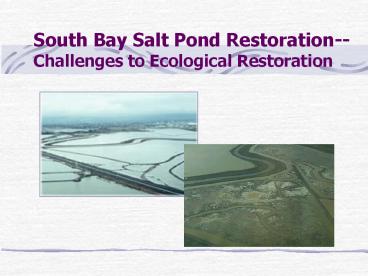
Title: South Bay Salt Pond Restoration Challenges to Ecological Restoration
1
South Bay Salt Pond Restoration-- Challenges to
Ecological Restoration
2
Topics Covered in this Talk
- Goals of the Project Scientific Input
- Restore to What?
- Key Habitats in the Restoration Plan
- Constraints on Restoration Success
- Some Key Questions
- Moving forward in the face of
- Uncertainty
3
Goals of the Restoration Project
- Restore and enhance a mix of wetland habitats
- Provide for flood management
- Provide for public access and recreational
opportunities
4
Scientific Direction is Needed
- To identify ecologically meaningful restoration
goals - To identify and evaluate uncertainties,
constraints and complications - To identify ways to reach ecological restoration
goals in light of these challenges
5
Restore to What? What is the Goal?
- Native, indigenous ecosystem as a goal
- Improving ecological functioning as a goal
- Historical view helps guide restoration goals
- Current conditions guide restoration goals
6
San Francisco BayHabitats ca. 1800 (SFEI
EcoAtlas Project)
7
Our Urbanized Estuary
- Oakland Harbor
- Carquinez Straights
8
Conversion to Salt Ponds
9
(No Transcript)
10
A Mix of Habitats
11
for a Diversity of Species
12
Habitat Mix
- Restore Vegetated Tidal Salt Marsh
- Manage Ponds of Various Salinities
- Maintain Ecological Functions of Mudflat and
Slough Habitats outside Ponds - How do we restore tidal salt marsh and manage
salt ponds while maintaining the ecological
support provided by habitats outside the ponds?
13
Three Conceptual Models
- Tidal Salt Marsh
- Managed Pond
- Landscape Level
- bay, mudflats,
- sloughs
14
Factors that Limit Full Ecological Restoration
- Scientific Constraints Data on sediment loads,
sea-level rise - Technical Constraints Engineering limitations
- Human Impacts Adjacent land uses, flooding,
mosquitoes - Regulatory Requirements Water quality, species
- Economic Constraints Costs of different actions
15
Scientific Constraints
- Missing data on current conditions critical to
restoration of the target habitat - Lack of data on short-term ecological processes
(acting immediately after restoration actions
initiated) - Inability to predict long-term ecological
processes (acting long after restoration is
initiated)
16
Goals of Restoration Science
- Identify the conditions and processes most
important to successful restoration - Collect data on essential conditions
- and processes, where possible
- Estimate range of uncertainty
- produced by not having
- all necessary data
17
Sediment Loads Invasive Species
Sea-level Rise Pond Elevations Pollutant
Effects Landscape Change
Tidal Marsh Restoration Actions, Conditions,
Constraints
Collect Data
Collect Data
Adaptive Management
Restoration Actions
Current Conditions
Short-term Conditions
Long-term Conditions
18
Potential Constraints on Successful Salt Marsh
Restoration
- Levee heights/adjacent land uses
- Inadequate sediment supplies
- Sea-level rise
- Non-native invasive species
- Pollutant impacts
- Importance of particular ponds
19
Potential Constraints on Pond Management
- Ability to maintain salinities at suitable levels
for target species - Ability to maintain levees and structures
- Smell associated with algal decay
- Importance of particular ponds for tidal marsh
restoration
20
Potential Impacts of Restoration on South Bay
Waters, Mudflats, Sloughs
- Localized salinity changes due to pond water
release - Regional loss of mudflat due to sediment sinks in
ponds being restored to salt marsh - Local loss of slough habitat from scour due to
changes in water circulation
21
Some Key Questions
- Sediments
- To what extent is the suspended sediment supply
adequate for restoration? - How might sediment needs of
- restoring pond affect sloughs
- and mudflats in the Bay?
22
Some Key Questions
- Non-native Species
- Can we prevent non-native,
- species, esp. Spartina
- alterniflora and predators,
- from dominating restored
- marshes?
- What ecological effects are
- likely from particular non-native species?
- Are there design alternatives, e.g., levee
design, breach location, etc., that can be
incorporated to prevent the access of non-native
species into restored wetlands?
23
Some Key Questions
- Habitats and Species
- What ecosystem functions are
- provided by the existing habitats
- and habitats planned for
- restoration?
- Can remaining ponds be
- managed to increase their
- shorebird and waterfowl
- carrying capacity?
- What physical factors drive the conversion of one
habitat type to another? Are there any critical
factors that may limit ecosystem development
24
Some Key Questions
- Pollutants
- To what extent might restoration activities
release contaminants, especially mercury? - What are the ecological effects of released
contaminants? - What is the potential for nuisance algal blooms
in future managed ponds?
25
Dealing with Uncertainty
- Analyze existing data
- Collect additional data in the short-term
- Model ecological processes
- Assess uncertainty (modeling, stats)
- Conduct long-term monitoring
- Conduct new research
26
Moving Forward with Restoration
- Use the best existing data
- Collect more data during planning
- Implement the most scientifically-sound plan
- Use adaptive management to learn improve
Recommended

