

Working with your supervisor Strategies for working with PowerPoint PPT Presentation
1 / 26
Title: Working with your supervisor Strategies for working with
1
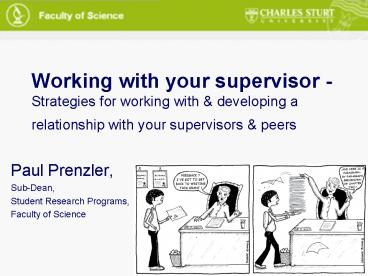
Working with your supervisor - Strategies for
working with developing a relationship with
your supervisors peers
- Paul Prenzler,
- Sub-Dean,
- Student Research Programs,
- Faculty of Science
2
Session Outline
- Not rocket science
- Basic common sense
- Usually a very smooth and positive interaction
- For the candidate
- For the supervisor
3
Session Outline
- Getting to know your supervisors
- Getting the project and team started
- Working together for 4 years (and beyond)
- Writing and Publishing
- Where to get help if you need it.
4
Misconceptions about supervision
I was so wrong in making these assumptions.
My second supervisor provided the straw for me
to clutch on to so I didnt sink in a pool of
self-doubt.
I now know what supervisors are for.
http//www.FIRST.edu.au The Balancing Act, from
Coralie McCormack and Barbara Pamphilon.
5
Getting to know your supervisors
- who has known their supervisor 6 months?
- 1 year?
- more than 1 year?
- need to establish and maintain a good working
relationship - how?
1. All supervisors are different
involvement in project
rarely seen
everyday
6
Getting to know your supervisors
1. All supervisors are different
2. Understand expectations
- Degree of direction (appropriate to
project/topic/candidate) - Ethical behaviour
- Safe environment personal respect
- Some ground rules / mutual expectations
(establish early)
3. Be prepared to negotiate
- the relationship will change with time (esp.
degree of direction) - eventually you will become the expert
7
The Supervisor Student Alignment Tool Kit (G.
Gurr, CSU)
http//www.first.edu.au/members/relationships/alig
nment/index.html
Maggie (initially)
X
Possible conflict
Autonomy generation
Possible neglect
Appropriate support
- use this if you feel there may be a mismatch
between your needs and the level of supervision
youre experiencing.
8
Getting the project and team started
- frequency of meetings (weekly, fortnightly etc.)
- preparation for meeting (what do I want to
achieve advice, reporting, alerting resource
needs etc) - who attends (all supervisors every time, other
arrangements) - record keeping (minutes)
- rights and responsibilities (yours and
supervisors) - publishing journal articles whos going to do
what, who are the authors
- communication skills, working with people,
working in a team - all generic skills
9
Intellectual property
- Fundamentally candidate owns what they create
- Commercial in confidence
- Publication embargo
- Frequently founded on the work/data generated of
others - Consider formal agreement to establish what
others bring to project and who shares interests
in the outcomes
10
Discussion Rights and Responsibilities
- Expectations
- What should you expect from a supervisor?
- What should a supervisor expect of you?
11
What should a supervisor expect of you?
- stick to agreed deadlines
- turn up on time to meetings
- be prepared for meetings
- take notes
- carry out agreed actions
- inform as soon as a situation becomes
intractable - demonstrate increasing confidence to chart own
course - listen
- resource issues
- speak up when other issues make progress
difficult - abide by OHS and Ethics regulations
- respect technical and admin. staff
- work harmoniously with others in group esp. with
shared facilities
12
Responsibilities of Supervisors (from Academic
Regulations)
2.3.3 Duties of the Supervisory
Team 2.3.3.1 Duties of the Principal
Supervisor The Principal Supervisor is
accountable to the Faculty Sub-Dean for advising
and monitoring the progress of a candidate and
leading the supervisory team. The Principal
Supervisor has final responsibility for the
decisions made by the supervisory team.
b) facilitating the operation of the
supervisory team to ensure support for the
candidate by encouraging all supervisors to be
actively involved in supporting the candidates
research endeavours. Where this does not occur,
the Principal Supervisor shall consult with the
Sub-Dean c) monitoring carefully the
performance of the candidate relative to the
standard required for the program, and advising
that inadequate progress or work below the
standard generally expected is brought to the
candidates attention d) ensuring that no
research data are collected until the necessary
approval is obtained from the relevant University
and/or other ethics committees where the research
deals with human or animal subjects
13
Working together for 4 years (and beyond)
- is the team functioning?
- do I need to meet less frequently (or more)?
- conference opportunities, publishing
opportunities - own the project
- it will be unique because you are involved
- but...listen to advice
- your supervisors have got their PhDs therefore
have something to offer
14
Problem Solving
- Researchers are independent thinkers and problem
solvers - Researchers are allowed to be independent
thinkers and problem solvers - Resources
- Collaborators in the field
- The postgraduate body in your department
- The postgraduate Interact community
- Librarians
- Laboratory staff / technicians
- Independent vs Isolated
- university Latin universitas magistrorum et
scholarium - community of teachers and scholars
15
If it arises
- Problem resolution
- Dont let problems fester
- Tackle them face to face / phone to phone first
- Only involve others if you cannot resolve
- Rarely
- Dispute resolution processes
- Change of supervisor
16
Writing and Publishing
- Start early, work continuously
- Establish ground rules
- Small regular slices
- Whose work is it?
- Guidance and direction vs take-over
- Learn citation software before you start, and use
it
17
Where to get help if you need it
- your supervisors
- other staff
- peers (a research environment is a resource
use it) - the Sub-Dean in your Faculty
- other resources
18
Resources
19
Resources
20
fIRST (http//www.csu.edu.au/research/policy/staff
only/resources_supervisors.htm) password
protected
Managing the relationships between supervisors
and candidates This section examines various
aspects of the supervisor candidate relationships
from various points of views. Balancing the
supervisor-candidate relationship Stories from
three full-time candidates, three part-time
candidates, and three supervisors explore the
balance of the supervisor-candidate relationship.
The initial stories were developed from a
research project investigating women academics
experiences of balancing work, study and
life... Aligning views of candidature Supervisors
and their candidates often assume that they are
'on the same wavelength' when, in fact, at times
they have very different perceptions of the same
events. The candidate-supervisor alignment tool
allows the candidate and supervisor independently
to express their view of current candidate needs
and supervisor style... Candidate perceptions of
research supervision candidates and supervisors
sometimes have different conceptions of
supervision. One may give a higher priority to an
element of supervision that the other thinks is
relatively unimportant. In this tool, candidate
and supervisor independently fill in parallel
questionnaires... Productive working
relationships Building productive working
relationships helps research candidates and their
supervisors begin discussions about key
supervision issues....
21
Thank you
- Thank you for your attention
- Any questions?
22
Acknowledgements Prof. Patrick Ball, previous
Sub-Dean Graduate Studies
https//itl.usyd.edu.au/synergy/article.cfm?articl
eID27
http//blogs.warwick.ac.uk/janedouglas/entry/its_n
ot_rocket
http//www.unisa.edu.au/resgrad/suprole.asp
http//www.myspace.com/the_elusive_pimpernel
http//www.deloitte.com/dtt/article/0,1002,cid253
D96133,00.html
http//www.cartoonstock.com/directory/s/scruples_g
ifts.asp
http//www.siestasands.com/map___directions
http//www.osuokc.edu/rights/
http//www.sillydogs.net/teamwork/40/
http//www.nytimes.com/2006/05/28/business/yourmon
ey/28advi.html
http//fullproofministry.blogspot.com/2008/04/team
work.html
http//www.stus.com/stus-cartoon.php?nameAlternat
iveDisputeResolutioncartooncla192a
http//wwwiaim.ira.uka.de/users/rogalla/mittelbau/
calvin.html
http//en.wikipedia.org/wiki/University
23
2.3.3.1 Duties of the Principal Supervisor The
Principal Supervisor is accountable to the
Faculty Sub-Dean for advising and monitoring the
progress of a candidate and leading the
supervisory team. The Principal Supervisor has
final responsibility for the decisions made by
the supervisory team. Responsibilities of a
Principal Supervisor include a) negotiating
roles with co-supervisors, in conjunction with
the candidate, at the commencement of the
candidature b) facilitating the operation of the
supervisory team to ensure support for the
candidate by encouraging all supervisors to be
actively involved in supporting the candidates
research endeavours. Where this does not occur,
the Principal Supervisor shall consult with the
Sub-Dean c) monitoring carefully the
performance of the candidate relative to the
standard required for the program, and advising
that inadequate progress or work below the
standard generally expected is brought to the
candidates attention d) ensuring that no
research data are collected until the necessary
approval is obtained from the relevant University
and/or other ethics committees where the research
deals with human or animal subjects e) advising
the Faculty Sub-Dean when problems are occurring
with regard to issues of academic misconduct
24
f) at the time of submission, either certifying
that the thesis or portfolio is properly
presented, conforms to the Regulations and is,
therefore, prima facie, worthy of examination, or
providing reasons why he/she believes the thesis
or portfolio is not ready for examination (see
clauses 2.4.4.1 and 2.4.5 below
respectively) g) at any time during
candidature, bringing to the attention of the
Centre for Research and Graduate Training issues
of intellectual property rights and/or commercial
or other confidentiality matters which relate to
the content of the thesis or portfolio h) advisi
ng the Board, through the relevant Faculty
Research and Higher Degrees Committee and/or the
Faculty Sub-Dean, of the names and credentials of
suitable examiners j) ensuring the candidate
has accurate information about any planned, long
leave (or retirement) during the candidature and,
in consultation with the Faculty Sub-Dean for
Graduate Training and the Dean, making
arrangements to provide for supervision during
absences (see clause 2.3.2.3 above) k) contribut
ing to the development of co-supervisory skills
in academic staff inexperienced in
co-supervision.
25
2.3.3.2 Duties of Each Member of the Supervisory
Team Responsibilities of the Supervisory Team
include a) suggesting ways that the candidate
can make the most effective use of time. This
will involve discussing the nature of research
with the candidate and the standard expected for
particular degrees, the choice of the research
topic, the planning of the research program, and
the availability of library resources in the
field and bibliographical and technical
assistance b) maintaining close and regular
contact with the candidate and establishing at
the beginning the basis on which contact will be
made. This will facilitate the supervisory role
in advising the candidate on the rate of
progress, and ensuring that a reasonable
timetable is set to permit the degree to be
completed in the appropriate time c) requiring
written or other work from the candidate on a
pre-arranged and agreed schedule so that progress
can be assessed at regular intervals d) monitori
ng carefully the performance of the candidate
relative to the standard required for the degree,
and ensuring that inadequate progress or work
below the standard generally expected is brought
to the candidate's attention. The team should
help with developing solutions to problems as
they are identified
26
e) ensuring that the research work and the
production of all categories of examinable work
are the candidate's own work and ensuring that
where the candidate receives substantial
assistance that such assistance is acknowledged
in the examinable work and does not conflict
with the requirement that the intellectual
content of the research and examinable work is
that of the candidate f) commenting on the
content and the drafts of the examinable work
prior to submission g) fulfilling other
obligations imposed by the University regarding
postgraduate supervision.
Recommended

