

Interplanetary Propagation of Ions From Impulsive Solar Flares: ACEULEIS Data PowerPoint PPT Presentation
Title: Interplanetary Propagation of Ions From Impulsive Solar Flares: ACEULEIS Data
1
Interplanetary Propagation of Ions From Impulsive
Solar Flares ACE/ULEIS Data
- Impulsive solar particle events have a
composition unlike any other sample of
accelerated matter in the heliosphere the
isotope 3He is enhanced by a factor of 100 to
1000 over its abundance in the Sun, and heavy
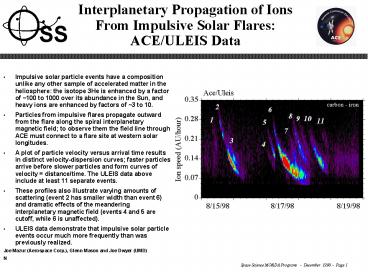
ions are enhanced by factors of 3 to 10. - Particles from impulsive flares propagate outward
from the flare along the spiral interplanetary
magnetic field to observe them the field line
through ACE must connect to a flare site at
western solar longitudes. - A plot of particle velocity versus arrival time
results in distinct velocity-dispersion curves
faster particles arrive before slower particles
and form curves of velocity distance/time. The
ULEIS data above include at least 11 separate
events. - These profiles also illustrate varying amounts of
scattering (event 2 has smaller width than event
6) and dramatic effects of the meandering
interplanetary magnetic field (events 4 and 5 are
cutoff, while 6 is unaffected). - ULEIS data demonstrate that impulsive solar
particle events occur much more frequently than
was previously realized. - Joe Mazur (Aerospace Corp.), Glenn Mason and Joe
Dwyer (UMD) - N
2
Solar Wind Isotopes in the May 3, 1998 CME
ACE/SWIMS Data
- Solar energetic particles (SEPs) in gradual
events are accelerated at a shock driven by a
coronal mass ejection (CME) moving through the
corona into the interplanetary medium. - The actual source of the accelerated material is
a subject of controversy possibilities include
ambient coronal material, CME material, and solar
wind. SEPs are sometimes enriched in heavy
isotopes such as 22Ne and 26Mg to date there are
no reports of whether CME material is enriched in
heavy isotopes. - The figure shows SWIMS/ACE isotope data from the
May, 3, 1998 CME - preliminary analysis of the Mg
isotopes reveals very little or no enhancement of
the heavier isotopes, 25Mg and 26Mg, with respect
to the main isotope, 24Mg. - As solar maximum approaches it should be possible
to relate the isotopic composition of SEPs to
that of additional possible seed populations
observed at solar wind energies. - R.F. Wimmer-Schweingruber, U. of Bern,
Switzerland - N
3
SAMPEX Data Complement ACE data
- SAMPEX instruments have measured the ionization
states of solar flare accelerated iron nuclei by
using the geomagnetic field as a magnetic
spectrometer - The ionization states are important for
understanding the origin and acceleration of the
particles. - Usually the ionization state is interpreted as
indicative of the temperature of the original
plasma - Charge states of 18 indicate temperatures of
7,000,000 K, while the lower charge states
indicate temperatures of lt2,000,000 K (see
figure) - In the Nov. 1997 event, large element and isotope
abundance anomalies (fractionation) were observed
on ACE the ionization states are critically
important for interpreting these data - This event showed an increase in ionization state
from low to high energies-- this has not been
seen before - These data give information about the source
plasma temperatures and the acceleration
processes, and are critical for understanding
abundances observed on ACE
from Mazur, Mason, Looper, Leske Mewaldt,
Geophys. Res. Letters, 1998, in press
Recommended

