

A Preliminary Structural Model for the Blue Mountain Geothermal Field, Nevada PowerPoint PPT Presentation
1 / 18
Title: A Preliminary Structural Model for the Blue Mountain Geothermal Field, Nevada
1
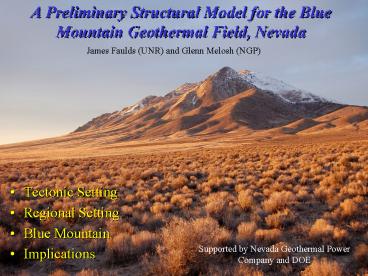
A Preliminary Structural Model for the Blue
Mountain Geothermal Field, Nevada
James Faulds (UNR) and Glenn Melosh (NGP)
- Tectonic Setting
- Regional Setting
- Blue Mountain
- Implications
Supported by Nevada Geothermal Power Company and
DOE
2
(No Transcript)
3
Geothermal Fields Why Clustered in Northern
Great Basin?
Blackwell and Richards, 2004
- High heat flow through much of western U.S.
- Not higher in northern Great Basin
- Concentrated in NW Great Basin
- NE of northern Walker Lane
- Several NE-trending belts
4
Why is Nevada in Hot Water?
- Dextral shear in Walker Lane transferred to WNW
extension in NW Great Basin - Accentuates Basin-Range extension, enhancing deep
circulation of fluids - Generates major transtensional domain in northern
Great Basin - Geothermal belts Loci of strain transfer
5
Exploration Challenges
- Hot dry wells
- Overturn in down-hole temperature gradients
- Wet cool wells
- Better characterization and conceptual models are
critical
Blue Mt., Nevada, USA
Germancek, Turkey
Desert Peak, Nevada, USA
6
Methods
- Detailed mapping and reconnaissance
- Structural analysis
- Gravity surveys
- Studies of surficial geothermal features
- Shallow temperature surveys
- Geochemical analyses
- GIS compilation
7
Structural Controls
Gerlach
Desert Peak
- Most not on major range-front faults
- Majority on less conspicuous normal faults
- Most common occurrences
- Discrete steps in fault zones
- Intersecting faults
- Overlapping fault zones
- Terminating, horse-tailing faults (some
range-front faults) - Small pull aparts within or at ends of
strike-slip faults
Astor Pass
8
Blue Mountain Geothermal Field
- Blind system West flank of Blue Mountain
- No surface hot springs
- Discovered due to mineral exploration in
hydrothermally altered area - Exploration by Nevada Geothermal Power
- 40 megawatt plant under construction
9
Geologic Setting
- Miocene volcanic strata overlying Mesozoic
metamorphic-plutonic basement - NE of Walker Lane in actively extending region
- Gently to moderately east-tilted fault blocks
(10-40o) - Mainly systems of normal faults
- Major E-W to WNW extension begins 12 to 8
MaContinues to present
N
10
Blue Mountain Fault Block
- Small isolated block 8 km long
- Tilted 20-40o east
- Bounded by
- NNE fault
- WNW fault
- Merge at geothermal field
- Quaternary offset
- 1 km of relief
- Questions?
- Fault kinematics
- Controls on geothermal fluids
11
Productive Wells
- Productive wells all along western apex of Blue
Mountain - Productive depths (inner wells) from 600 to
1,070 m - High flow rates
- Temperatures to 184-213oC
- Step out well to west
- gt 210oC at 1,730 m
- Intersecting moderate to steep W-dipping fault
zone (55-60o)
12
Fault Kinematics
- SW side dextral-normal
- Offset drainages (Szybinski, 2007)
- Small right steps
- Quaternary offset
- Normal component dominant?
- NW side sinistral-normal
- Small left steps
- Quaternary offset
- Normal component dominant
- Geothermal activity at intersection
- Multiple young scarps
- Complex intersection
SW flank - View NW
SW flank - View NE
13
Fault Kinematics
- SW side right-lateral-normal
- Offset drainages
- Small right steps
- Quaternary offset
- Normal component dominant?
- NW side left-lateral-normal
- Small left steps
- Quaternary offset
- Normal component dominant
- Geothermal activity at intersection
- Multiple young scarps
- Complex intersection
Western Apex
NW flank - View NE
14
Basement Fabric
- Triassic metasedimentary rocks
- NE- to ENE-striking, NW dipping fabric
- N-striking fabric to south gives way to ENE
fabric to north - As orientation of basement fabric changes, so
does strike of major faults
15
Conceptual Model
- Basement fabric affecting normal fault
orientation - Induces adjustments or steps
- Produces complex fault intersections and focused
dilational zone
16
Dilatant Zone Closely-Spaced Faults
- Entire NNE fault zone dilational
- Fault intersection at apex
- Dilational
- Dense fracturing
- Natural pathway for deep circulation
- Moderately to steeply W-plunging reservoir
17
Implications
- Blue Mountain more complex than many other
geothermal fields - Not a simple step over or termination in a
normal fault zone - Slightly different setting than previously
described - Most common occurrences
- Discrete steps in fault zones
- Intersecting faults
- Overlapping fault zones
- Terminating, horse-tailing faults (some
range-front faults) - Small pull aparts within or at ends of
strike-slip faults - Complex dilatant fault intersection
18
Conclusions
- Geothermal system controlled by a complex fault
intersection - Multiple strands connect two oblique-slip normal
faults - Dilatant zone with high fracture density
- Induced by strong basement fabric
- Major NNE normal faults skewed to ENE trends
- Adjustments produce fault intersections
- Exploration strategies
- Steps in range fronts and less conspicuous normal
faults - Interbasinal highs
- Ranges of low, discontinuous ridges
- Lateral terminations of ranges
- Ends of Walker Lane strike-slip faults
- Apex of small isolated fault blocks
Recommended

