

Background Information for the Pumping Lemma for ContextFree Languages PowerPoint PPT Presentation
1 / 16
Title: Background Information for the Pumping Lemma for ContextFree Languages
1
Background Information for the Pumping Lemma for
Context-Free Languages
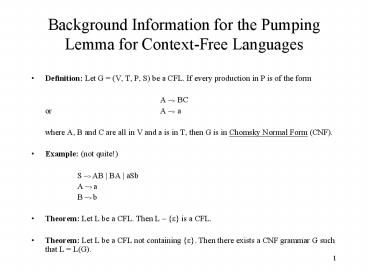
- Definition Let G (V, T, P, S) be a CFL. If
every production in P is of the form - A BC
- or A a
- where A, B and C are all in V and a is in T,
then G is in Chomsky Normal Form (CNF). - Example (not quite!)
- S AB BA aSb
- A a
- B b
- Theorem Let L be a CFL. Then L e is a CFL.
- Theorem Let L be a CFL not containing e. Then
there exists a CNF grammar G such that L L(G).
2
- Definition Let T be a tree. Then the height of
T, denoted h(T), is defined as follows - If T consists of a single vertex then h(T) 0
- If T consists of a root r and subtrees T1, T2,
Tk, then h(T) maxih(Ti) 1 - Lemma Let G be a CFG in CNF. In addition, let w
be a string of terminals where Aw and w has a
derivation tree T. If T has height h(T)?1, then
w ? 2h(T)-1. - Proof By induction on h(T) (exercise).
- Corollary Let G be a CFG in CNF, and let w be a
string in L(G). If w ? 2k, where k ? 0, then
any derivation tree for w using G has height at
least k1. - Proof Follows from the lemma.
3
Pumping Lemmafor Context-Free Languages
- Lemma
- Let G (V, T, P, S) be a CFG in CNF, and let n
2V. If z is a string in L(G) and z ? n,
then there exist strings u, v, w, x and y in T
such that zuvwxy and - vx ? 1 (i.e., v x ? 1)
- vwx ? n
- uviwxiy is in L(G), for all i ? 0
4
- Proof
- Since z ? n 2k, where k V, it follows
from the corollary that any derivation tree for z
has height at least k1. - By definition such a tree contains a path of
length at least k1. - Consider the longest such path in the tree
- S
- t
- yield of T is z
- Such a path has
- Length ? k1 (i.e., number of edges in the path
is ? k1)
5
- Since there are only k non-terminals in the
grammar, and since k1 appear on this long path,
it follows that some non-terminal (and perhaps
many) appears at least twice on this path. - Consider the first non-terminal that is repeated,
when traversing the path from the leaf to the
root. - S
- Second occurrence of
non-terminal A - A First occurrence
- A
- t
- This path, and the non-terminal A will be used
to break up the string z.
6
- Generic Description
- S
- A
- A
- u y
- Example
- S
- E F
- C D A F
- c d G G f
7
- Cut out the subtree rooted at A
- S
- A
- u y S uAy (1)
- Example
- S
- E F
- C D A F
- c d f S cdAf
8
- Consider the subtree rooted at A
- A A
- G G
- A
- F A g
- v x
- f a
- Cut out the subtree rooted at the first
occurrence of A - A A
- G G
- A
- F A g
- v x f
9
- Consider the smallest subtree rooted at A
- A A
- a
- w
- A w (3) A a
- Collectively (1), (2) and (3) give us
- S uAy (1)
- uvAxy (2)
- uvwxy (3)
- z since zuvwxy
10
- In addition, (2) also tells us
- S uAy (1)
- uvAxy (2)
- uv2Ax2y (2)
- uv2wx2y (3)
- More generally
- S uviwxiy for all i1
- And also
- S uAy (1)
- uwy (3)
- Hence
11
- Consider the statement of the Pumping Lemma
- What is n?
- n 2k, where k is the number of non-terminals
in the grammar. - Why is v x ? 1?
- A
- A
- v w x
- Since the height of this subtree is ? 2, the
first production is A-V1V2. Since no
non-terminal derives the empty string (in CNF),
either V1 or V2 must derive a non-empty v or x.
More specifically, if w is generated by V1, then
x contains at least one symbol, and if w is
generated by V2, then v contains at least one
symbol.
12
- Why is vwx ? n?
- Observations
- The repeated variable was the first repeated
variable on the path from the bottom, and
therefore (by the pigeon-hole principle) the path
from the leaf to the second occurrence of the
non-terminal has length at most k1. - Since the path was the largest in the entire
tree, this path is the longest in the subtree
rooted at the second occurrence of the
non-terminal. Therefore the subtree has height
?k1. From the lemma, the yield of the subtree
has length ? 2kn. - A
- A
- v w x
13
Closure Propertiesfor Context-Free Languages
- Theorem The CFLs are closed with respect to the
union, concatenation and Kleene star operations. - Proof (details left as an exercise) Let L1 and
L2 be CFLs. By definition there exist CFGs G1 and
G2 such that L1 L(G1) and L2 L(G2). - For union, show how to construct a grammar G3
such that L(G3) L(G1) U L(G2). - For concatenation, show how to construct a
grammar G3 such that L(G3) L(G1)L(G2). - For Kleene star, show how to construct a grammar
G3 such that L(G3) L(G1).
14
- Theorem The CFLs are not closed with respect to
intersection. - Proof (counter example) Let
- L1 aibicj i,j ? 1
- and
- L2 aibjcj i,j ? 1
- Note that both of the above languages are CFLs.
If the CFLs were closed with respect to
intersection then - would have to be a CFL. But this is equal to
- aibici i ? 0
15
- Lemma Let L1 and L2 be subsets of S. Then
. - Theorem The CFLs are not closed with respect to
complementation. - Proof (by contradiction) Suppose that the CFLs
were closed with respect to complementation, and
let L1 and L2 be CFLs. Then - would be a CFL
- would be a CFL
- would be a CFL
- would be a CFL
- But by the lemma
-
a contradiction.
16
- Theorem Let L be a CFL and let R be a regular
language. Then is a CFL. - Proof (exercise sort of)
- Question Is regular?
- Answer Not always. Let L aibi i 0 and R
aibj i,j 0, then
which is not regular.
Recommended

