

FIELD METHODS Strategy for Monitoring Postfire Rehabilitation Treatments PowerPoint PPT Presentation
1 / 36
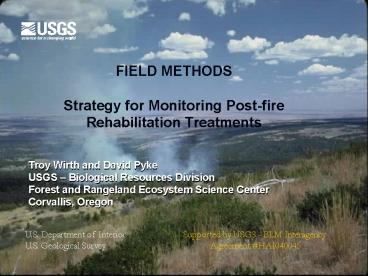
Title: FIELD METHODS Strategy for Monitoring Postfire Rehabilitation Treatments
1
FIELD METHODSStrategy for Monitoring Post-fire
Rehabilitation Treatments
- Troy Wirth and David Pyke
- USGS Biological Resources Division
- Forest and Rangeland Ecosystem Science Center
- Corvallis, Oregon
U.S. Department of Interior U.S. Geological Survey
Supported by USGS - BLM Interagency Agreement
HAI040045
2
Field Methods
Plot design Three transects radiating from a
central point. Measurements made along each
transect and averaged for a plot total.
- Photo points
- Line Point Intercept (Cover)
- Basal Gap
- Density
- Belt Transect
- Quadrats
- Paper data sheets or rangeland monitoring database
3
Photo Points
- Photos taken from center stake at standard height
(1.5 m) - Qualitative documentation of site conditions
- May show change that is indicated by quantitative
data
4
Plot establishment
- General Information
- GPS Location Information
- Soil / ecological site Verification
- Disturbance/Management history
- Species Lists
- Additional Plot Information
5
(No Transcript)
6
Vertical and Horizontal slope shape descriptions
7
(No Transcript)
8
(No Transcript)
9
(No Transcript)
10
(No Transcript)
11
(No Transcript)
12
(No Transcript)
13
Plot EstablishmentPage 2
- Recent weather
- Recent disturbance
- Wildlife use
- Management history
- Map
14
Additional Plot InformationComments
- Species present but not encountered during
quantitative techniques - Search for rare species if a concern in the area
- Evidence of drill rows
- General impression of the site (lots of
seedlings, few seedlings etc.) - Other information that would help interpretation
of seeding success.
15
Line-Point Intercept
- Measures canopy, basal, and bare ground cover
- Total cover (vegetation surface cover)
positively correlated with soil and site
stability and hydrologic function - Basal and canopy cover are sensitive indicators
of biotic integrity - Rangeland Health Indicators
16
Line-Point Intercept
- Drop a pin flag at a 90 angle at the specified
meter mark - Record the first species that intercepts the pin
in the top canopy column (If no plant is
intercepted, record NONE in top canopy) - Record additional species that intercept the pin
(record each species only once) - Record litter (L or W)
- Record perennial plant bases or soil surface in
soil surface column.
17
Line-Point Intercept
- Perennial plant bases are important because they
hold the soil surface throughout the year. - Soil surface codes Rock (R), Bedrock (BR), Duff
(D), Moss (M), LC (Lichen Crust), and Soil (S) - Standing dead is recorded as that species dead
material must be on soil surface to be litter
18
(No Transcript)
19
Line-Point Intercept
- Number of points taken per transect can be
adjusted depending on the variability of the
community (minimum of 50) - The line-point intercept procedure is designed to
estimate the cover of dominant species, not
species diversity or richness - Richness is combination of species on LPI and
searching for additional species
20
Line Point Intercept Data Form
21
Basal Gap Intercept
- Measurement of gaps gt20 cm between perennial
plant bases along a transect (typically 50 m) - Look straight down at the tape and use a stiff
pin to project a line vertically to the ground. - Record the beginning and end of each gap between
perennial plant bases longer than 20 cm. - Count only live plant bases
22
Basal Gap Intercept
- Correlated with soil and site stability,
hydrologic function, and biotic integrity - Large gaps increase the potential for erosion
- Detects increasing/decreasing number of large
gaps - Sensitive to spatial pattern (aggregation or
patches) of vegetation - Successful seedings should show decreasing
percentage of large gaps
23
Basal Gap Intercept
From Herrick et al. 2005a
24
Basal Gap Intercept
25
Basal Gap InterceptForm
26
Plant DensityBelt Transect
- Walk along transect with a PVC pipe and record
plants occurring underneath - Use for larger, less abundant plants
27
Belt Transect
- Measures density of larger and less common plants
(Class B and C shrubs) - Adjustable belt width to increase sampling
efficiency dependent on the number of plants
From Herrick et al. 2005a, based on Tazik et al.
1992
28
Plant DensityQuadrats
- Place quadrats at specified intervals along each
transect to estimate density of seedlings and
common herbaceous species (generally 1x1 meter
quadrats) - Track size classes of individuals (A, B, C)
- Separate into seeded and non-seeded plants if
possible - Define rules for dealing with rhizomatous species
or other species that are difficult to count
29
Plant Density Quadrats
- Count number of individuals of all seeded
species and other species of interest
- Count stems of rhizomatous species
- Questionable situations - follow a consistent
set of guidelines
30
Cheatgrass follows the drill rows, search here
for seedlings
31
Shrink-swell breaks plants apart - difficult to
locate drill rows
32
Rhizomatous plants and seeded plants present.
How do you decide which is which?
33
Plant DensityAnalysis
- Analyze data to isolate the effect of the seeding
depending on your situation - Comparing parameter to quantitative objective
- Treatment vs. control (direct)
- Treatment vs. control (change)
- Seeded vs. unseeded or group if unable to tell
the difference - Group lifeforms (seeded perennial grasses) etc.
34
Plant DensityAnalysis
- Treatment
- Density
- N 5
- X 5.3 plants/m2
- S 1.8 plants/m2
- Control
- Density
- N 5
- X 2.5 plants/m2
- S 0.7 plants/m2
Objective is difference of 2 plants/m2 (alpha
0.1)
35
(No Transcript)
36
Reporting
Recommended

