

Vacuumsystem design for the largescale cryogenic gravitational wave telescope PowerPoint PPT Presentation
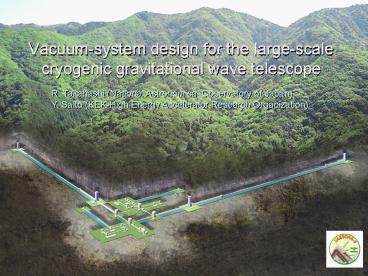
1 / 14
Title: Vacuumsystem design for the largescale cryogenic gravitational wave telescope
1
Vacuum-system design for the large-scale
cryogenic gravitational wave telescope
R. Takahashi (National Astronomical Observatory
of Japan) Y. Saito (KEK-High Energy Accelerator
Research Organization)
2
Gravitational waves
Wave propagating gravitational field predicted
by general relativity theory of A. Einstein
Big Bang
10-43s
Inflation 10-35s
Binary neutron star coalescence Binary black hole
coalescence Super Nova Pulsar
CMB 300,000yr
Present
Background radiation Cosmic string
3
Gravitational wave detectionusing Michelson
interferometer
Gravitational wave is a transverse wave,
propagates at the speed of light
Mirror
Fabry-Perot Cavity (3km)
Mirror
Beam Splitter
Mirror
Fabry-Perot Cavity (3km)
Mirror
- Gravitational wave
- Strain of space-time
- Optical length fluctuation
- Fringe variation
Photo Detector
High Power Laser (150W)
4
LCGT(Large-scale Cryogenic Gravitational-wave
Telescope) Project
- Detectable for binary neutron star coalescence at
240Mpc - 3-km baseline
- Underground of Kamioka mine
- Cryogenic mirrors
- Based on results of TAMA300 CLIO
(CLIO 100-m cryogenic GW detector in Kamioka)
5
Requirement for vacuum system
LCGT requires UHV tubes so as to reduce
scattering-effects due to residual gas
molecules. Aimed sensitivity in LCGT dx110-20
m/Hz1/2 _at_100Hz Aimed pressure 210-7 Pa Residual
gas noise (H2O) 110-21 m/Hz1/2 Safety margin 10
- Verification of residual gas effects in TAMA300
- Observed noise (dx2) was proportional to
pressure. This result is proving the theory.
(R. Takahashi, Y. Saito, et al. JVST A20,
1237-1241, 2002)
6
Vacuum-system design
Pumping unit
Beam tube (1mfx3km) 2 Chamber 13 Pumping unit
67
7
Beam tube
- SS304L/SS316 is among the most available.
- The electro-chemical buffing (ECB) method is
advantageous for large-scale applications,
because of process without large coating system. - ECB method was successfully applied to the
TAMA300 system (the order of 10-7Pa without
baking). - The surface of Ti, once oxidized, becomes
chemically passive and stable. - Heating at 200Co in a vacuum or in an inert gas
is the most effective method for outgas reduction
(thickness of the processed layer of 10nm,
amorphous). - Expensive.
- Outgassing rate at 50 hour
- SS316L-ECB/baked 1x10⁻⁸Pa m3 s-1 m-2
- Ti-10nm thick oxidized 5x10⁻⁹Pa m3 s-1 m-2
(Y. Saito, J-PARK Vacuum Group Vacuum 73,
181-186, 2004)
8
Chamber
Type A SAS cryogenic mirror suspension Type
B SAS mirror suspension Type C1 C2 stack
mirror suspension
A
B
SAS in TAMA300
C1
Cryostat
9
Scattered light noise
- The light scattered from the arm cavity mirrors
will make multiple reflections from the inside
wall. - The scattered light back onto the mirrors causes
phase noise on the interferometer output beam. - A lot of baffles are put inside the tubes to
block the scattered light in large scale
interferometers like LIGO and VIRGO.
10
Baffle arrangement in LCGT
- The main interferometer and the suspension point
interferometer use a common beam tube. - Mirrors are put with an offset of 0.2m from the
tube center. - a) Symmetrical configuration
- Baffles should be placed at predicted reflection
points. - b) Asymmetrical configuration
- A reflection point is separated. ?Concept of
effective baffle number
a
b
11
Effective baffle number
- Scattered light with large reflection number may
clear the baffle. - Since merely h and d are meaningful, it doesnt
matter whether the shape of baffles is spiral or
circular. - Each baffle blocks the scattered light partially.
- Total N baffles work effectively.
Length of tube L Radius of tube R Height of
baffle h Interval of baffle d
tube wall
baffle
12
Effects of baffles
Parameters in LCGT Length of tube 2700m Diameter
of tube 1m Diameter of mirror 0.25m Radius of
curvature 4050m Height of baffle 5cm Interval of
baffle 11m Offset of mirror 0.2m Seismic motion
_at_30Hz 10-11m/Hz1/2 Effective baffle number 24.5
Estimated scattered light noise as a function of
N.
Aimed displacement sensitivity of LCGT 6x10-20
m/Hz1/2 _at_30Hz Scattered light noise without
baffle 3x10-21 m/Hz1/2 (margin 20) Scattered
light noise with baffles 4x10-22 m/Hz1/2
(margin 150)
13
Baffle design
- Diamond-Like Carbon (DLC) Coatings
- Very small outgassing rate
- Smooth surface (Ra20nm)
- Reflectivity of 5 at the minimum for the laser
beam (l1064nm)
Baffle used in TAMA300
s-polarization ? p-polarization
(R. Takahashi, Y Saito, et al. Vacuum 73,
145-148, 2004)
Out-gassing of various black surface
Optical properties
14
Summary
- LCGT requires UHV tubes which the laser beams
pass through. - Two 3-km vacuum tubes are kept in 10-7Pa of
vacuum pressure so as to reduce
scattering-effects due to residual gas molecules. - The stainless-steel material with ECB is the most
available for use as long tubes of 1m in
diameter. - To reduce noises due to scattered light from the
surface of tubes, a lot of baffles with DLC
coatings are inserted into the tubes.
Recommended

