

starter activity PowerPoint PPT Presentation
1 / 32
Title: starter activity
1
? starter activity
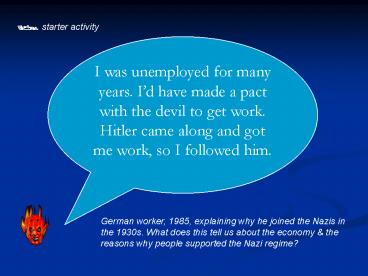
I was unemployed for many years. Id have made a
pact with the devil to get work. Hitler came
along and got me work, so I followed him.
German worker, 1985, explaining why he joined the
Nazis in the 1930s. What does this tell us about
the economy the reasons why people supported
the Nazi regime?
2
How successful was Nazi economic policy?
- To what extent was Nazi economic policy
ideologically driven?
3
? Your task
- Read Hite Hinton, p. 212 and list Hitler and
the Nazis war aims.
4
Hitlers war aims
- Tackle problems of Depression
- Restore Germany to full employment
- Rebuild Germanys military prepare for future
war, Wehwirtschaft - Greater self-sufficiency, autarky
- Win support of Mittelstand
- Corporativist govt.
How many of Hitlers aims are represented in this
1930s propaganda poster?
5
? Your task
- Read p. 216 and list the methods used by the
Nazis to stimulate economic recovery
6
Methods
- Job creation
- Increased public expenditure investment
- Tax concessions employment incentives
- Trade unions dissolved formation of DAF (May
1933) - RAD
- Conscription
Incentives for young families. Were there any
links to other areas of Nazi policy?
7
Schact
- Hjalmar Schact appointed president of Reichsbank
(March 1933) Economic Minister (1934) - Deficit financing (Mefo bills)
- End of reparations (1932)
- Suspension of debt repayments
Study the biography of Schact on p.217 and list
the reasons for his success.
8
New Plan
- Balance of trade deficit redressed with New Plan
(1934) - Bilateral trade agreements, e.g. with Balkan
states where products raw materials were
bartered rather than bought or sold - Increased economic influence over regions, e.g.
Austria, Czechoslovakia Balkans
9
? Your task
- Study source 12.19. List the points Hitler
claims contributed to Germanys success. Now
imagine you are a critic of the regime. Write a
brief counter speech refuting these claims
10
What was the Four-Year Plan?
- Goering and the Nazi economy, 1936-9
11
- Study the biography of Goering on p.221 and list
the reasons why he was so successful within the
Nazi regime. What were his failings?
12
Hermann Goering (1893-1946)
- WWI ace fighter pilot
- 1922 joined NSDAP, wounded during Munich Putsch,
1 of 3 original NSDAP ministers in Jan 1933,
involved in N of the Long K - 1935 C-inC Luftwaffe
- 1936 Plenipotentiary for 4 Y Plans
- 1946 Nuremberg trials, committed suicide,
cremated at Dachau
How was Goerings lifestyle another example of
Nazi hypocrisy?
13
- Read p. 218 and list the reasons for the
Four-Year Plan
14
Why was the Four-Year Plan introduced?
- Hitler impatient with Schachts caution
- 4 September 1936, Goering put in charge of
Four-Year Plan - Priority given to rearmament autarky
- Office of the Four-Year Plan issued regulations
controlling foreign exchange, labour, raw
materials and prices
Hermann Goering Commissioner Plenipotentiary for
the Four-Year Plan, 1936
15
- Create a scales chart to evaluate the successes
and failures of the Plan
16
Success or failure of Four-Year Plan
- Aims of autarky were to increase production of
key commodities, e.g. iron food - Develop ersatz products, e.g. using coal to
produce oil - By 1939 Germany still dependent on foreign
imports for 1/3 of raw materials - Expansionism replaced autarky
Hitler Goering, eye-up chemical products to be
used for ersatz production
17
How significant was the drive for rearmament?
- Example of radicalisation in the Nazi regime
- Guns or butter debate
- Tim Mason - Hitler hindered by need to supply
both needs - Richard Overy - periods of economic development
(1933-6, public works, economic revival and
1936-9, rearmament)
What other examples of govt. policies becoming
radicalised can you think of?
18
How were major areas of the economy organised
during the Third Reich?
- Hite/Hinton, p.224
19
Agriculture
- Government measures to reduce high food prices
debts - Attention focussed on large estates rather than
smallholders - Production from agriculture overall fell
20
Industry
- Industry brought under state supervision
(Reichsgruppe for Industry) - State controlled resources, but industry remained
largely privately owned - 300,000 small businesses went bankrupt 1933-1945
21
Transport
- Massive investment (3.8 billion RM p.a. by 1938)
- Confusion and overlap, e.g. with investment and
administration of railways
22
Foreign trade
- Schachts bilateral trade agreements replaced by
policy of autarky - Foreign conquests made up lack in domestic
production
23
?
- Study p.224-6 and work out what the numbers refer
to on the slip of paper your teacher gives you.
24
Who benefited most from the Nazi economy?
25
? Your task
- Read Hite/Hinton, p.227-235
- Complete the table, p.227 shown below
26
?
- Which social group came off worst under the
Nazis. Make a case for your original group. - Write a short judgement paragraph explaining
which group you think benefited most from the
regime and which suffered the most as well.
27
? Your homework task
- Read p.232 and write definitions of the following
Nazi organisations - DAF
- Kraft durch Freude
- Schönheit der Arbeit
- Trustees of Labour
- Councils of Trust
- RAD
- NSBO
28
- DAF German Labour Front, estd. May 1933, headed
by Robert, replaced independent TUs, membership
reached 22 million by 1939 - Kraft durch Freude Strength through Joy,
created by DAF, subsidised holidays leisure
activities, 1938 10m took KdF holidays - Schönheit der Arbeit Beauty of Work,
improving working conditions - Trustees of Labour estd. 1933, officials
responsible to Minister for Labour,
responsibilities included pay conditions - Councils of Trust estd. 1934, subordinate to
Trustees of Labour, workers councils looking at
conditions - RAD 1935 compulsory labour introd for all men
(19-25), 1939 extended to women, public works
schemes or agriculture - NSBO Nazi workers organisation, estd. In
1920s, superseded by DAF
29
Was Nazi economic policy ideological?
- Hite / Hinton, p.236-7
30
Ideology
- Support given to the Mittelstand
- Wehrwirtschaft (defence economy) preparing
Germany psychologically as well as militarily
economically for war - Autarky (economic self-sufficiency)
- State control of key industries businesses
- Racism, eg. Aryanisaion of businesses
31
Economic policy
- Investment in infrastructure, e.g. autobahns
- Deficit financing, e.g. Mefo Bills
- Public works schemes to stimulate the economy
- State economic controls, e.g. Reich Food Estate
Reich Economic Chamber - Reich Entailed Farm Law Law for Protection of
Retail Trade - Ersatz production
32
? Your task
- Write a short judgement explaining whether or
not you think Nazi economic policy was
ideological.
Recommended

