

The Fermi Gamma-ray Space Telescope Bright Source List PowerPoint PPT Presentation
1 / 13
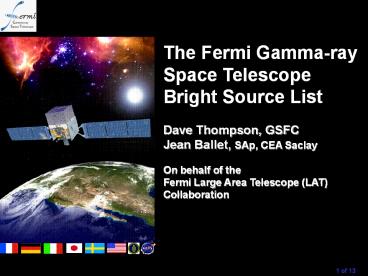
Title: The Fermi Gamma-ray Space Telescope Bright Source List
1
The Fermi Gamma-ray Space Telescope Bright
Source List Dave Thompson, GSFC Jean Ballet,
SAp, CEA Saclay On behalf of the Fermi Large
Area Telescope (LAT) Collaboration
2
The LAT Bright Source List
- During the early part of the Fermi mission, the
Large Area Telescope (LAT) team is optimizing
calibrations, analysis methods, and background
subtraction techniques. - The brightest sources seen by LAT are less
influenced by these ongoing improvements than are
weaker sources.
- Releasing information about the brightest sources
early has two principal goals - Provide opportunities for multiwavelength studies
of these sources - Facilitate proposals for the second cycle of
Fermi Guest Investigator proposals, due on March
6.
- The release date for the bright source list is
February 6. - This list is a first step toward the first LAT
catalog, due in the Fall of this year.
3
Exposure map
- Data used are the first three months of all-sky
scanning data, Aug. - Oct. 2008. Total live time
is 7.53 Ms - Scanning scheme makes exposure map very uniform
(SAA creates North-South asymmetry)
PRELIMINARY
Ms
Equivalent on-axis observing time, Galactic
coordinates
4
Constructing the LAT Bright Source List
- 2.8 M events above 100 MeV with current cuts
- Maximum likelihood analysis was used to determine
source significance, fluxes in two energy bands,
locations, and variability information, all of
which is included in the list. - Only sources with confidence level greater than
10 ? over 3 months were retained for the bright
source list.
- The resulting bright source list is not a full
catalog - Not complete - many more sources at lower
significance - Not flux limited - cut is on confidence level
- Not uniform - sources near the Galactic plane
must be brighter because of the strong diffuse
background. - No detailed energy spectral information.
5
Sensitivity map
- Structure is mostly that of the interstellar
medium - Below 10-7 ph/cm2/s over most of the
extragalactic sky
10-7 ph/cm2/s
2 1.5 1 0.5
PRELIMINARY
Flux gt 100 MeV required to reach 10 s for average
E-2.2 spectrum
6
205 Preliminary LAT Bright Sources
Map above 300 MeV
Crosses mark source locations, in Galactic
coordinates
7
Source localization
- Conservative error radii adjusted on known
associations - Conservative 0.04 absolute limit based on bright
pulsars
PRELIMINARY
8
Source variability
- Build light curves of all sources on one-week
time scale - Pulsars are stable within 3
- Bright blazars are very clearly variable
PRELIMINARY
AO 0235164 blazar
Geminga pulsar
Not at same scale!
9
Source variability 2
- Many blazars are too faint (even at TS gt 100) to
be detected as variable even if they were - Many fewer variable sources in the plane
PRELIMINARY
10
205 Preliminary LAT Bright Sources Census of
Associations (not Identifications)
11
Source association
- Mostly AGN outside the Galactic plane
- Not that many unassociated outside the plane
Red - steeper spectra Blue - harder spectra
PRELIMINARY
12
Source association 2
- Most associated sources in the Galaxy are pulsars
- Many unassociated sources in the inner regions of
the Galaxy
PRELIMINARY
13
205 Preliminary LAT Bright Sources Conclusions
- EGRET on the Compton Observatory found only 31
sources above 10 ? in its lifetime. - Typical 95 error radius is less than 10 arcmin.
For the brightest sources, it is less than 3
arcmin. Improvements are expected. - About 1/3 of the sources show definite evidence
of variability.
- 29 pulsars in the list are identified by
gamma-ray pulsations. - Over half the sources are associated positionally
with blazars. Some of these are firmly
identified as blazars by correlated
multiwavelength variability. - 37 sources have no obvious associations with
known gamma-ray emitting types of astrophysical
objects.
Recommended

