

FINANCIAL RATIOS PowerPoint PPT Presentation
1 / 11
Title: FINANCIAL RATIOS
1
FINANCIAL RATIOS
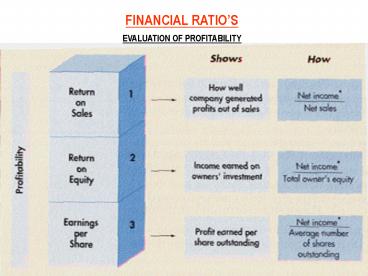
EVALUATION OF PROFITABILITY
2
EVALUATION OF PROFITABILITY
Profit marginNet Income / Net sales
- Also known as Return on Sales
- Net income is taken after taxes
- Measure of Net Income a company makes per unit of
sales
Asset Turnover Net Sales / Average total assets
- Measure of how efficient a company is using
assets to produce sales
3
EVALUATION OF PROFITABILITY
Return on Assets Net Income / Average total
assets
To measure how much income a company makes for
each of Asset
Return on Equity Net Income / Average
stockholders equity
- Also known as Return on Investment
- Measure of the income earned on owners investment
4
EVALUATION OF LIQUIDITY
5
EVALUATION OF LIQUIDITY
Working Capital Current Assets- Current
Liabilities
- A Measure of liquidity
- Represents current assets remaining after payment
of all current liabilities - The dollar value of Working capital can be
misleading since it may include value of slow
moving inventory. Inventory that cannot be used
to clear a companys short term debt. - The value of Working Capital does not consider
the size of the company.
Caution
6
EVALUATION OF LIQUIDITY
Current Ratio Current Assets/current
Liabilities
- Measure of a firms short term liquidity
- Compares the current debt owed with the current
assets available to pay the debt
Quick Ratio (Cash Marketable SecuritiesAccounts
Receivable)/Current Liabilities
- The Acid test ratio
- Good indicator of firms ability to pay creditors
since inventories are not included
7
EVALUATION OF ACTIVITY
8
EVALUATION OF ACTIVITY
Average Days sales uncollected 365 days /
receivable turnover
- Measure of how many days on average a company has
to wait for Accounts
Receivable to turn to cash
Inventory TurnoverCost of goods sold/Average
inventory
- Measure of how fast a company can convert its
inventories into sales - Quicker the better
- Inventory sitting on shelves implies holding
costs - Risk of inventory becoming obsolete
9
EVALUATION OF ACTIVITY
Receivable TurnoverNet Sales / Average Accounts
Receivable
- Measure of frequency with which a company turns
its accounts receivables to cash - Measure of a companys Credit and Collection
policies - Who qualifies for credit and who does not
- How long customers are given to pay their bills
- How aggressive is the company in collecting its
debts - If ratio is increasing need to determine whether
company doing better job of collection or Sales
going up - If ratio is going down need to determine whether
company lagging in sales or collection efforts
are failing
Caution
10
EVALUATION OF LEVERAGE
11
EVALUATION OF LEVERAGE
Debt to Equity Total liabilities / Total
Stockholders Equity
- Extent to which a business is financed by debt as
opposed to invested capital (Stockholders Equity) - From lenders stand point the lower the ratio
safer the company- since company has less
existing debt - May also imply low growth rate - company may be
financing its growth by using excess cash flow
from operations
Debt to Total Assets Total liabilities / Total
Assets
- Measure of firms ability to carry long term debt
- As a rule of thumb amount of debt should not
exceed 50 of the value of assets
Recommended

