

Satellitebased inversion of NOx emissions using the adjoint of CMAQ PowerPoint PPT Presentation
1 / 19
Title: Satellitebased inversion of NOx emissions using the adjoint of CMAQ
1
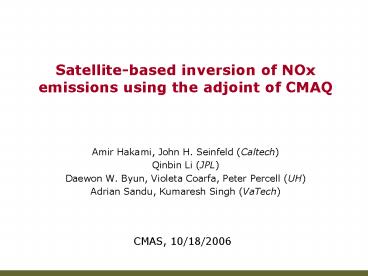
Satellite-based inversion of NOx emissions using
the adjoint of CMAQ
- Amir Hakami, John H. Seinfeld (Caltech)
- Qinbin Li (JPL)
- Daewon W. Byun, Violeta Coarfa, Peter Percell
(UH) - Adrian Sandu, Kumaresh Singh (VaTech)
CMAS, 10/18/2006
2
Inverse Modeling and adjoint analysis
- Inverse modeling is our primary approach for
reducing model prediction uncertainties. - Among all model parameters, emission
uncertainties play the most significant role. - Inverse modeling requires sensitivity
information. When a large number of model
parameters are inverted, adjoint sensitivity
analysis provides an efficient tool. - Variational methods have been widely used in
meteorology and oceanography. - 4D-Var applications in atmospheric modeling is
receiving increasing attention. - Adjoint analysis has been recently implemented in
CMAQ.
3
4D-Var formulation
- Cost function is defined as
- The first part of the cost function is a measure
of distance (mismatch) between the model
predictions and observations. The second term
penalizes deviations from background (a-priori)
estimates. - The weight factor is used to assign proper
emphasis on the observations. - Gradients of the cost function with respect to
the control variables, - , are calculated during backward
calculations. - The cost function is minimized iteratively using
a quasi-Newton optimization algorithm (LBFGS).
4
4D-Var formulation (II)
- Instead of adjusting absolute emissions, optimal
emission scaling factors are found. Normalized
gradients are used in the optimization - Cost function is re-defined as
- By using scaling factors, relative changes are
compared at various locations. Also,
zero-emission cells will not be assigned
emissions as a result of optimization.
5
Application
- CMAQ-ADJ with CB-IV chemical mechanism.
- 3-day simulation (6/20/2005-6/22/2005).
- 36 km horizontal resolution (45x46), 23 vertical
layers. - 3-D time-independent, emission scaling factors
(47610 control variables). - Independent background error covariance matrix
with 100 uncertainty. - Time-dependent boundary conditions from GEOS-Chem
global model (ozone, NO, NO2, PAN, HNO3). - SCIAMACHY tropospheric NO2 column densities used
as observations.
6
4d-Var test
- Inversion with pseudo-observations (identical
twin experiment) where the true answer is known. - After 15 iterations scaling factors are
approximately recovered. - Not a realistic case, as abundance of (pseudo-)
observations helps the assimilation.
7
SCIAMACHY NO2 tropospheric columns
- One overpass per day during 3-day period.
- Observational time rounded to closest advection
time.
8
Mapping CMAQ to SCIAMACHY grid
- CMAQ grid cells are interpolated horizontally and
vertically to produce concentrations that
correspond to SCAIMACHY averaging kernel. - Adjoint of mapping operators is used in forcing
term propagation in backward calculations.
9
Model Predictions vs. SCIAMACHY retrievals
10
Adjoints
- Adjoint variables indicate regions of influence
on the cost function. - NO2 is generally considered a short-lived
species. As a result other investigators have
corrected the mismatch in model predictions by
adjusting (only) the local emissions. This
assumption appears to be an oversimplification,
particularly at finer scales.
11
Cost function reduction
12
Assimilated results Day I
After
SCIA
Before
13
Assimilated results Day II
14
Assimilated results Day III
After
Before
SCIA
15
Scaling factors
16
Independent verification (day IV)
After
Before
SCIA
17
Conclusions
- Adjoint analysis provides an efficient tool for
fine scale inversion of chemically active species
and their precursors emissions. - In general, CMAQ underestimates SCIAMACHY
retrievals, leading to significantly scaled-up
emissions. - For column density assimilation, inclusion of
lightning emissions seems necessary. - Even though emissions scaling factors are mostly
local to the retrievals, the effect of emissions
carry-over into the following day can be sizable. - Emissions scaling results in improved model
prediction, even for days that were not included
in the inversion.
18
Future work
- Inclusion of lightning emissions.
- Addition of other parameters to the control
variables. Boundary conditions can also be
scaled. - Addition of ground-level observations of NO2.
- Multi-pollutant assimilation.
19
Acknowledgements
- This work was supported by funding from
- NSF-ITR
- JPL
Recommended

