

D Forward Proton Detector Andrew Brandt UTA PowerPoint PPT Presentation
Title: D Forward Proton Detector Andrew Brandt UTA
1
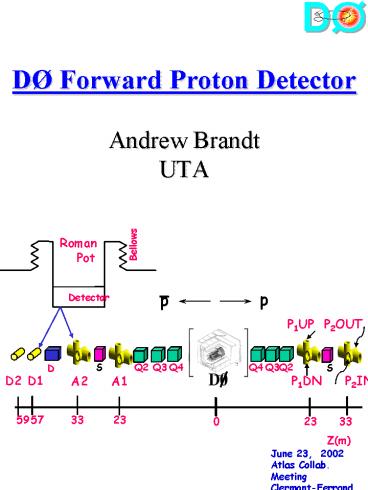
DØ Forward Proton Detector Andrew BrandtUTA
June 23, 2002 Atlas Collab. Meeting Clermont-Ferr
and
2
Diffraction Thesis Topics Soft Diffraction and
Elastic Scattering Inclusive Single
Diffraction Elastic scattering (t
dependence) Total Cross Section
Centauro Search
Inclusive double pomeron Search
for glueballs/exotics Hard
Diffraction Diffractive jet
Diffractive b,c
Diffractive W/Z
Diffractive photon
Diffractive top Diffractive Higgs
Other hard diffractive topics
Double Pomeron jets Other
Hard Double Pomeron topics Rapidity
Gaps Central gapsjets
Gap tags vs. proton tags
Double pomeron with
gaps
lt100 events in Run I, gt1000 tagged events in Run
II
3
Data Taking
- No special conditions required
- Read out Roman Pot detectors for all events
- (cant miss )
- A few dedicated global triggers for diffractive
- jets, double pomeron, and elastic events
- Use fiber tracker trigger board -- select
- x , t ranges at L1, readout DØ standard
- Reject fakes from multiple interactions
- (Ex. SD dijet) using L0 timing, silicon
- tracker, longitudinal momentum conservation,
- and scintillation timing
- Obtain large samples (for 1 fb-1)
- 1K diffractive W bosons
- 3K hard double pomeron
- 500K diffractive dijets
with minimal impact on standard DØ
physics program
4
Acceptance
x
Quadrupole ( p or )
450 400 350 280 200
MX(GeV)
Geometric (f) Acceptance
x
Dipole ( only)
GeV2
450 400 350 280 200
MX(GeV)
GeV2
Dipole acceptance better at low t, large
x Cross section dominated by low t
x 0 0.02 0.04 1.4 1.4 1.3 2
35 95
5
Roman Pot Castle Design
Worm gear assembly
50 l/s ion pump
Detector
Beam
Step motor
- Constructed from 316L Stainless Steel
- Parts are degreased and vacuum degassed
- Plan to achieve 10-11 Torr
- Use Fermilab style controls
- Bakeout castle, then insert fiber detectors
6
Roman Pot Arm Assembly
Detector is inserted into cylinder until it
reaches thin window
Threaded Cylinder
Motor
Bellows
Flange connecting to vacuum vessel
Thin window and flange assembly
7
Girder Reconfiguration
Bypass
BEFORE
Sep
Sep
Sep
Sep Girder
Tunnel Floor
Pit Floor
Run I Girder Configuration
AFTER
Bypass
Sep
Sep
Sep
Pot
Pot
Sep Girder
Pit Floor
Hole in Floor
Run II Girder Configuration
8
Castle Status
- All 6 castles with 18 Roman pots comprising the
FPD were constructed in Brazil, installed in the
Tevatron in fall of 2000, and have been
functioning as designed.
Quadrupole castle A2 installed in the beam line.
9
Detector Setup
Six planes (u,u,x,x,v,v) of 800 mm
scintillating fibers () planes offset by
2/3 fiber
20 channels/plane(U,V)() 16 channels/plane(X,X)
112 channels/detector 18 detectors 2016 total
channels 4 fibers/channel 8064 fibers 1 250 mm
LMB fiber/channel 8 LMB fibers / bundle 252 LMB
bundles 80 mm theoretical resolution
4 fiber bundle fits well the pixel size of H6568
16 Ch. MAPMT (Multi- Anode Photomultiplier
Tube) 7 PMTs/detector 16 250 mm fibers each PMT
10
Detector Assembly
At the University of Texas, Arlington (UTA),
scintillating and optical fibers were spliced
and inserted into the detector frames.
11
Detectors in Cartridges
The plastic frames containing the clear fibers
are attached to the cartridge bottom.
The cartridge bottom containing the detector is
installed in the Roman pot and then the cartridge
top with PMTs is attached.
12
Tunnel and Detector Status
- All 18 cartridges have been assembled, 10 are
installed in - tunnel (8 with full detectors 2 with trigger
scint). The 10 - instrumented pots (Phase I) are ups, downs, and
dipoles. - Cables and tunnel electronics (low voltage,
amp/shapers, etc.) - installed and operational for full 18 pot
(Phase II) setup. - 9 more detectors are complete except for final
polishing, last 3 - (2 spares) will be finished this summer.
13
Veto Counters
In the October 2001 shutdown four veto counters
(designed at UTA, built at Fermilab) each of
which cover 5.2 lt ? lt 5.9 were installed
between DØ and the first low beta quadrupole
(Q4), about 6 m from the interaction point. The
counters, two each on the outgoing proton and
anti-proton arms, can be used in Diffractive
triggering (veto proton remnant).
14
Pot Motion
Pot motion is controlled by an FPD shifter in the
DØ Control Room via a Python program that uses
the DØ online system to send commands to the step
motors in the tunnel.
15
Stand-alone DAQ
- Due to delays in DØ trigger electronics, we have
maintained our stand-alone DAQ first used in the
- fall 2000 engineering run.
- We build the trigger with NIM logic using signals
given by our trigger PMTs, veto counters, DØ
clock, and the luminosity monitor. - If the event satisfies the trigger requirements,
the CAMAC module will process the signal given
by the MAPMTs. - With this configuration we can read the fiber
information of only two detectors (currently PD
spectrometer is read out), although all the
trigger scintillators are available for
triggering. - An elastic trigger is formed from coincidences of
- the PUAD spectrometers combined with halo vetoes
(early time hits) and vetoes on LM and Veto
counters.
16
FPD Control Room
17
Elastic ? Distribution (raw)
Require clean events with 0 or 1 hit per plane
for initial studies
??p/p should peak at 0 for elastic events!!
18
Data Elastic x,y Correlations
PD1x vs. PD2x (mm)
Good correlation between x1,x2 and y1,y2 in data
but shifted from MC expectation (3 mm in x and 1
mm in y)
PD1y vs. PD2y (mm)
19
Elastic ?,t (calibrated)
Calibrated ? now peaks at 0
Minimum t about 1.0 Gev2
? peak reasonably Gaussian, still 2x ideal MC
resolution
20
Proton ID
- The Proton ID group led by Gilvan Alves and
Sergio Novaes has made substantial progress in
many software areas - Track reconstruction
- Monte Carlo
- Unpacking
- Single Interaction Tool
- Alignment
- Database
Regular Proton-ID meetings are held off-week
Thursdays 11-1230 in Black Hole using VRVS
21
Goals for 2002
- Early summer
- Installation of full readout chain for one
spectrometer - Late summer/fall
- Installation of readout chain for Phase I
- 10 detectors 5 spectrometers
- FPD data acquisition integrated into DØ
- Elastic Diffractive dN/dt and ?-distribution
- September
- FPD triggers in DØ global list
- December
- First Diffractive jets data analysis shown at
QCD meeting
22
Lessons Learned
- Bigger project than you (I) might think
- more manpower, time, cost, CABLES
- Using other peoples electronics is risky
- Need a budget and some level of priority
- (beyond the baseline syndrome)
- Early integration is essential
- Good contacts in the Accelerator Division
- are crucial
- Halo not well-understood
- Elastics or alignment, redundancy needed
- Splicing fibers is painful
23
FPD Summary
- FPD will be a completely integrated
sub-detector - of the DØ detector which will help maximize
- Run II physics potential
- Hard diffraction exists, but not
well-understood - -- large data samples and precise
measurements - needed
- Large and L at Tevatron necessary
for - these measurements
- Combination of quadrupole and dipole
- spectrometers gives ability to tag both ps
and p s - over large kinematic range, allows alignment,
- understanding of backgrounds
- Tremendous progress in installation and
- commissioning, emphasis switches to
- trigger, software, operations, and data
analysis
24
NIKHEF Window
- Used finite element analysis to model different
window options - Built three types of pots and studied deflection
with pressurized helium. - 150 micron foil with elliptical cutout gives
excellent results
25
Measurements Using the FPD
- Observation of hard diffractive processes.
- Measure cross sections
- dominated by angular
dispersion - 15 error for
(resolutions - given for dipole spectrometer).
- Measure kinematical variables with sensitivity
- to pomeron structure ( h, ET, )
- Use Monte Carlo to compare to different
- pomeron structures and derive pomeron
structure. - Combine different processes to extract quark
- and gluon content.
26
Dipole Region
Quadrupole Region
(Arbitrary Scale)
27
(No Transcript)
28
Pot Motion Safeguards
- The software is reliable and has been tested
extensively. It has many safeguards to protect
against accidental insertion of the pots into the
beam. - The drivers are disabled with a switch in the
Control Room when the pots are not being moved. - The pots are hooked to an emergency line
which bypasses the software to send the pots back
to the home position in case of emergency (tested
but not used).
29
Pot Insertion Monitor
Effect of the pot motion on the proton and
antiproton losses at DØ and CDF is monitored
using ACNET.
Current agreement with Beams Division and
CDF requires that the effect on halo rates is
less than 20.
Recommended

