

The PALS PREK ASSESSMENT: Make it work harder for you PowerPoint PPT Presentation
1 / 49
Title: The PALS PREK ASSESSMENT: Make it work harder for you
1
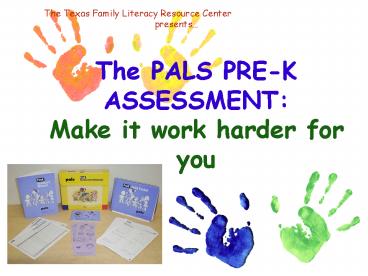
The PALS PRE-K ASSESSMENT Make it work harder
for you
The Texas Family Literacy Resource Center
presents
2
Objectives
- Understand why to assess at the early preschool
level - Identify and understand the benefits of
implementing the entire assessment - Review the procedures for administering the
assessment - Understand how to administer each part of the
assessment - Discuss and identify supporting activities
3
Phonological Awareness Literacy Screening
- A tool that measures young childrens
understanding of emergent literacy fundamentals - A direct method of matching early literacy
instruction to specific literacy needs - A way to recognize those children who are
relatively behind in their emergent literacy
development
4
CURRENTLY
- Even Start programs are only required to
administer the Section II, Alphabet Knowledge
Section of PALS PreK.
5
As stated by Beth Thompson
- Now that you are familiar with the
- instrument, you may be ready to have it work
- harder for you. It can be difficult to obtain
- specific information to help your teachers
- form instruction that meets the specific
- needs of each child. PALS Pre-K is a tool
- that can provide your EC teachers with
- information they can use as a basis for
- instruction. Such information can also be
- incorporated into parenting education and
- ILA.
6
So why administer the whole assessment?
- To identify general degree of literacy
development for the children in your class - Guide classroom instruction
- identify specific areas that may need increased
attention - For the class
- For individual students
- Identify children at risk for future reading
difficulties - Integrate info. obtained into
parenting ed and ILA
7
Parts of Assessment
- Section I Name Writing
- Section II Alphabet Knowledge
- Part A Upper-Case Alphabet Recognition
- Part B Lower-Case Alphabet Recognition
- Part C Letter Sounds
- Section III Beginning Sound Awareness
- Section IV Print and Word Awareness
- Section V Rhyme Awareness
- Section VI Nursery Rhyme Awareness
8
Name Writing why is it important?
- Highly correlated with letter recognition, print
knowledge, and concept of word - Practice with name writing allows child to see
that a group of letters can refer to people - and objects
- Reading and writing are interrelated develop
concurrently
9
Why is alphabet recognition important?
- Early literacy research suggests that accurate,
rapid naming of the letters of the alphabet is
the single best predictor of early reading
achievement. - An essential tool in connecting print and speech
- Alphabet knowledge is currently viewed as one of
the most accurate identifiers of a young childs
later risk for reading difficulties
10
Elements of Phonological Awareness why are they
important?
- These three areas of the PALS Pre-K are basic
parts of phonological awareness - Beginning Sound Awareness
- Rhyme Awareness
- Nursery Rhyme Awareness
- Awareness of speech at the individual sound level
is essential to learn sounds and match speech to
print.
11
Print and Word Awareness why is it important?
- Familiarity with books is an important precursor
to learning to read - Children need to know that
- stories and other texts are written left to right
- spaces between words matter
- and there is a one-to-one correspondence between
the words on a page and the words the reader says
12
The Building Blocks of Literacy
Concepts Of Print How to use books print
Alphabet Knowledge The shapes sounds of letters
Phonological Awareness The sounds of spoken
language
Oral Language Talking listening
13
Sequence of PALS Pre-K Tasks
- Can be administered in suggested order or in
order most convenient for teacher - Suggested order for entire assessment
- I. Name Writing
- II. Alphabet Knowledge
- III. Beginning Sound Awareness
- IV. Print and Word Awareness
- V. Rhyme Awareness
- VI. Nursery Rhyme Awareness
- Do not administer III. And V. consecutively
(in order to avoid confusion)
14
Administration Scoring
- Time Required
- No time limit
- Usually 20-25 minutes
- Administration Management
- Recommend administered by classroom teacher
- If each section done separately, entire
assessment should be completed in two weeks
15
MODIFICATIONS
- PreK Bilingual Program be aware if child is in
PreK Bilingual - Assessment administered in English
- Response in English expected if child responds
in another language they are still displaying
letter recognition - Differentiate correct responses in English and
those in another language on Summary Sheet for
scoring later
16
WHO GETS TESTED?
- Programs complete assessment of all Even Start
children who were four by September 1st,
regardless of which partner provides direct early
childhood instruction. - http//www.curriculumassociates.com/brigance/Age_C
alc/BRIGANCE_Age_Calculator.htm - Use Sept. 1st
as testing date - Assess every four-year old in your Even Start
families, even if they are receiving early
childhood education in district PreK, Head Start
or from some other Even Start collaborator.
17
Important Dates to watch for
- Pre-test by Sept. 14
- Post-test on May 1-16
- In order to have the full impact of EC facilitate
the post-test score - Pre-test as early as you can and Post-test as
late as you can
18
Assessment Procedures Before the Assessment
- Familiarize yourself with contents of the
instrument and manual watch the video - Complete name/date on form
- Set up the testing area
- Quiet location
- All materials needed are available and ready to
use - Minimize interruptions
19
Assessment Procedures During the Assessment
- Introduce the task right before you ask the child
to complete it - Administer practice items (more than once if
needed) - Monitor child carefully offer encouragement
- If task too difficult and child frustrated stop
administration indicate task discontinued on
form - Score each item See next slide!
20
Assessment Procedures DURING Assessment contd.
- IMPORTANT!!
- Score each item --
- indicate whether responses were in English,
Spanish, another language, or combo on Child
Summary Sheet - Will need that info. for data reporting purposes!!
21
Section I Name Writing
- Administration notes
- Ask child to write their name
- Ask child to draw a picture of themselves
- Instructions
- What to say
- Where - Child Summary Sheet (back page)
- Scoring
- Minimum score 0, Maximum Score 7
- Dont score the drawing
- Name writing video clip
22
Section II Alphabet Knowledge
- Part A Upper-Case Alphabet Recognition
- Administration Notes
- Show one row or one letter at a time
- Ask child to touch the letters or you can point
to letters - Instructions
- Tell child to put his/her finger on the first
letter at the top of the page - Say(see script in teachers manual pg. 15)
- Scoring
- Score responses on Child Summary Sheet enter
total number of correct responses in score box. - Self-corrections are counted as correct answers.
- Must score 16 or more to continue to Part B.
- Alphabet Recognition video clip
23
Part B Lower-Case Alphabet Recognition
- Administered only if scored 16 or more in
upper-case - Instructions
- Tell child to put his/her finger on the first
letter at the top of the page - Say(see script pg. 16)
- Scoring
- Score responses on Child Summary Sheet enter
total number of correct responses in score box. - Self-corrections are counted as correct answers.
24
Part C Letter Sounds
- Administered only if scored 9 or more in
lower-case letters - Instructions
- Say(see script on pg. 17)
- Note Pronunciation Guide (not looking for long
vowel sound) - Scoring
- Mark slash through incorrect answers
- Count correct answers
- Enter score in score box
- Letter Sounds video
25
Reminder Pals PreK Process
26
Section III Beginning Sound Awareness
- Administration Notes
- Goal for child to produce a beginning sound
- Task can be used as a teaching exercise whether
responds correctly or not tell child what
correct answer was as you sort the picture cards - Instructions
- Show picture of target word ? child repeats word
? ask child to produce first sound - (teacher sorts cards)
- Practice items can be repeated
- Administer assessment script (pg. 19)
- If letter given refocus to sound
27
Beginning Sound Awareness, contd.
- Scoring
- Score first oral response correct response can
either be letter sound or the letter name (sound
preferred) - Count or and enter number of correct
responses in score box - Beginning Sound Awareness video clip
28
Section IV Print and Word Awareness
- Administration Notes
- While reading book ask questions in script
- Familiarize yourself with the ten items in the
task - Script pg. 24
- Scoring
- Enter or on scoring sheet
- Enter number of correct answers in score box
- Video clip
29
Section V Rhyme Awareness
- Administration Notes
- Do practice items use as teaching exercise
(give correct answer only here) - Child can say the word or point to picture
- If child says another word that rhymes redirect
to choose from pictures on page - Instructions
- Guide through practice items
- Administer test (repeat directions at any time)
30
Rhyme Awareness, contd.
- Scoring
- Enter or on scoring sheet
- Enter number of correct answers in score box
- Video clip
31
Section VI Nursery Rhyme Awareness
- Administration Notes
- Nursery rhymes read aloud and child gives missing
word - Practice items only time practice together
- Instructions
- Do practice items
- Administer assessment
- If child doesnt say missing word after 5 seconds
provide the correct word and go to the next
item.
32
Nursery Rhyme Awareness, contd.
- Scoring
- Use or to score answers
- Count correct answers and record in score box
- Video clip
33
FAQS
- Can I administer the assessment or instructions
in Spanish? - No, the test is to be administered in English.
- What if the child responds to letter names with
letter sounds? Is it correct? - No, if the child gives the sound only, redirect
them to provide the letter NAME. If they give
both the sound and the correct letter name it
is correct.
34
FAQs, cont.
- What if the child responds to letter names and/or
sounds in Spanish or other language? - Yes, if they respond correctly in Spanish or
other language for letter name or sound it is
correct. It is still letter recognition. - If a child is frustrated by PALS, may I stop
administration? - If a child is clearly frustrated by a task, you
may open up the task. - For example, a child who struggles with alphabet
recognition may be shown the entire alphabet
recognition sheet and asked to identify any known
letters.
35
Assessment Procedures After the Assessment
- Enter data into TFLRC data collection spreadsheet
- Refer to Chapter Three in Teachers Manual re
interpreting results - Browse PreK activities on PALS website and/or
Chapter 4 of Teachers Manual for supporting
activities - Look for supporting activities TFLRC will be
providing some in the future
36
Teachers ManualChapter 3, Page 34
37
Data Submission Procedures
- Spreadsheets will be posted on TFLRC website
- Data transferred from child summary sheets to
spreadsheet - E-mail (preferred) or fax spreadsheets to TFLRC
38
Example of Report
- Data Sheet Demo
39
What the reports do
40
Now What?!
41
Now
- Use the PALS Pre-K results and data to guide and
plan your literacy curriculum!
42
Linking assessment with the curriculum
- When developing a curriculum, it is important to
identify the goals one has for childrens
learning - Assessment information is a starting point for
curriculum development - The use of assessments (especially ongoing)
provides the tools to re-align the curriculum
43
ACTIVITY
- Teacher Checklist of Literacy Practices
- This checklist presents different activities
that - help to foster literacy development in
pre-school children. - Use the checklist to evaluate your own literacy
practices by checking what you already do. - List a couple of supporting activities you use in
the classroom on the activity sheet. - 2. Look at unchecked boxes for additional ideas.
- List a couple of ideas for supporting activities
you can use in the classroom on the activity
sheet. - To look at checklist online
- http//pals.virginia.edu/PALS-Instruments/PreK_NYC
U_CheckList.pdf
44
Supporting Activities
- PALS PreK website
- http//pals.virginia.edu/PALSInstruments/PALS-PreK
.asp - Activities, lesson plans, parents corner
- Colorín Colorad?
- http//www.colorincolorado.org/educators/questions
/earlylit - A bilingual site for families and educators of
English Language Learners - Get Ready to Read!
- http//www.getreadytoread.org/content/view/69/321/
- Free, downloadable resources for the Get Ready to
Read! Skill-building activity cards
(English/Spanish) - TFLRC website
- Comingfollow up information on
- supporting activities
45
Spring, 2008
TFLRC will present a Parenting Education
Initiative in Feb. May at 4 locations.
Home Visiting Initiative Spring 07
46
Whats it all about?
- Well tie PALS PreK, Home Inventory and Parent Ed
together with lots of great resources and
strategies. - Be sure to budget for and make plans to attend
this initiative. - Well get back to you with more
- details so be on the lookout!
47
Evaluation
- Complete your evaluation sheet and
- Fax to Gloria Rodriguez at (512) 245-8151
48
Thanks for
- Attending the first TFLRC professional
development web conference!!!
49
References Resources
- http//pals.virginia.edu/PALSInstruments/PALS-PreK
.asp - http//reading.org/downloads/52nd_conv_handouts/m_
invernizzi.doc - Ivernizzi, M. Using PALS Data to Plan
Multi-tiered Intervention in Virginia.
Retrieved July 10, 2007 from http//pals.virginia
.edu. - Justice, L.M., Pence, K., Bowles, R., Wiggins,
A. (2006). An investigation of four hypotheses
concerning the order by which 4-year-old
children learn the alphabet letters. Retrieved
July 6, 2007 from httpwww.sciencedirect.com. - PALS and Reading First. Retrieved July 10, 2007
from http//pals.virginia.edu/Reading-First/PALS_
- and_Reading_First.pdf .
Recommended

