

CSSE374 Iteration 3: More Object Design with GoF Patterns PowerPoint PPT Presentation
1 / 16
Title: CSSE374 Iteration 3: More Object Design with GoF Patterns
1
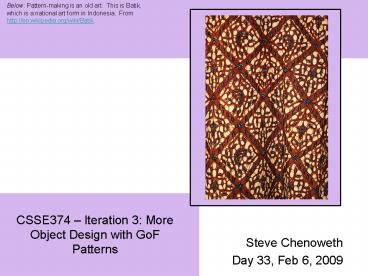
Below Pattern-making is an old art. This is
Batik, which is a national art form in Indonesia.
From http//en.wikipedia.org/wiki/Batik.
CSSE374 Iteration 3 More Object Design with
GoF Patterns
Steve Chenoweth Day 33, Feb 6, 2009
2
Today coming up
- Today
- More Object Des with GoF patterns (Ch 36) ?
- Revisit what you think you can deliver in P6?
- Monday, Feb 9
- HW 8 applying these ideas to your project
- Persistence frameworks (Ch 37)
- Tuesday, Feb 10
- UML deployment components (Ch 38)
- Thursday, Feb 12
- P6 due!
- Documenting archs (Ch 39)
- Friday, Feb 13
- P6A Turn in doc describing lessons learned from
project - More on iterative agile (Ch 40)
3
More Object Des with GoF patterns
- This is not all the GoF patterns. ?
- Big application focus in this Ch is error
handling. - In NextGen POS
- Failover to a local service when a remote service
fails - Local caching
- Support for third-party POS devices, such as
different scanners - Handling credit, debit, and check payments
- Note the overall idea that designing these things
has been deferred to Iteration 3!
Ch 36
4
Heres the whole GoF list
- Creational Patterns
- Abstract Factory
- Builder
- Factory Method
- Prototype
- Singleton
- Structural Patterns
- Adapter
- Bridge
- Composite
- Decorator
- Facade
- Flyweight
- Proxy
- Behavioral Patterns
- Chain of Responsibility
- Command
- Interpreter
- Iterator
- Mediator
- Memento
- Observer
- State
- Strategy
- Template Method
- Visitor
Ones we did / will do are in red.
5
NextGen POS Error Handling
- Typical tough situation remote service failure
how to avoid closing the store! - E.g., were using a remote product database, and
the connection is interrupted. - Similarly for tax calculation, inventory, credit
- What would you do to prevent these situations
from being catastrophic? (Quiz question 1)
6
Lets analyze the books solution
- The ServicesFactory will always return an adapter
to a local product information service. - The local products adapter is not really an
adapter to another component. It will itself
implement the responsibilities of the local
service. - The local service is initiated to a reference to
a second adapter to the true remote product
service. - If the local service finds the data in its cache,
it returns it otherwise, it forwards the request
to the adapter for the external service. - The local cache is actually 2 levels in-memory
and on-disk.
7
Adapters for product information
How would you handle the stale cache problem?
(Quiz question 2)
8
Advantages / disadv of local cache
- Faster performance
- Backup for remote failure
- May not agree (stale cache problem)
- Local is likely to be incomplete
- Note that these are quality attribute decisions!
9
This is a GoF Proxy
- Pattern Proxy
- Context/Problem Direct access to a real object
is not desired or possible. - Solution Add a level of indirection with a
surrogate proxy object that implements the same
interface as the subject object, and has
responsibility for controlling or enhancing
access to it.
10
Error guidelines / patterns
- Exceptions are especially appropriate when
dealing with resource failures (disk, memory,
network, database, etc.) - Pattern Convert Exceptions (Exception
Abstraction) - Within a subsystem, avoid emitting lower level
exceptions. Convert into ones meaningful at the
subsystem level. It wraps the lower-level one
and adds higher-level info.
11
Error guidelines / patterns, cntd
- Pattern Name the problem, not the thrower
- Assign a name to an exception that describes why
the exception is being thrown, not the exception.
This makes it easier for the programmer to
understand what to do about it, and lets you
group similar exceptions by rationale. - Pattern Centralized error logging
- Use a Singleton-accessed central error logging
object and report all exceptions to it. In a
distributed system, each local singleton will
collaborate with a central error logger.
12
Error guidelines / patterns, cntd
- Pattern Error Dialog
- Use a standard Singleton-accessed
application-independent non-UI object to notify
users of errors. - It wraps one or more UI dialog objects (suchas
a GUI modal dialog, text console, sound beeper,
or speech generator) and delegates the
notification of the error to the UI objects. - Thus, output could go to both a GUI dialog and to
a speech generator. - It will also report the exception to the
centralized error logger.
13
Error Handling in UML
14
Abstract Factory
- Weve already discussed factories which
create objects for us, when the main user of
those would be too complex by including this. - Abstract factory adds one more level of
indirection you might do the object creations
in different ways, depending upon some variables. - Java creates different GUI objects depending on
what O/S it is operating under. - In NextGen POS, how to use the software for
different hardware, for IBM versus NCR POS
terminals.
15
Abstract Factory, cntd
- Context / Problem How to create families of
related classes that implement a common
interface? E.g., - cashDrawer JavaPOSDevicesFactory.getInstance().g
etNewCashDrawer() - returns a cashDrawer for the right class (IBM vs
NCR), depending on how you want it done. - Solution Define a factory interface (the
abstract factory). Define a concrete factory
class for each family of things to create.
Optionally, define a true abstract class that
implements the factory interface and provides
common services to the concrete factories that
extend it.
16
Abstract Factory, cntd
Recommended

