

The Story of Wavelets Theory and Engineering Applications PowerPoint PPT Presentation
1 / 14
Title: The Story of Wavelets Theory and Engineering Applications
1
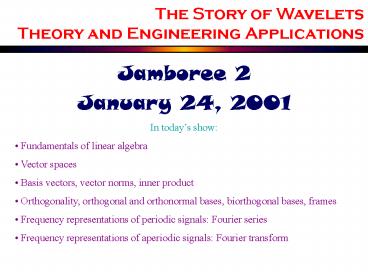
The Story of WaveletsTheory and Engineering
Applications
Jamboree 2 January 24, 2001
- In todays show
- Fundamentals of linear algebra
- Vector spaces
- Basis vectors, vector norms, inner product
- Orthogonality, orthogonal and orthonormal bases,
biorthogonal bases, frames - Frequency representations of periodic signals
Fourier series - Frequency representations of aperiodic signals
Fourier transform
2
Vector Spaces
- Definition and properties A complex (real)
vector space V is a set of elements u, v, etc.
called vectors, with two arithmetic operations
defined on these elements - Addition
- Scalar multiplication
- Vector spaces have the following properties
- Commutativity
- Associativity
- Distributivity
- Zero vector
- Negative vector
3
Vector Subspace
- A subset W of a vector space V is called a
subspace of V, as long as W itself is a vector
space under the addition and scalar
multiplication operations defined on V. - Note that the definitions of addition and scalar
multiplication do not specify the nature of
vectors and / or the operations. As long as the
properties are satisfied, anything can be a
vector and any operation can be substituted for
addition and scalar multiplication. - For example Let humans be vectors, reproduction
be the addition operation and putting on a
clothing be the scalar multiplication. Is this a
valid vector space? Why / why not?
4
Linear Combination
- A linear combination of vectors is another vector
defined as - where are scalar coefficients.
- A collection of vectors are linearly dependent,
if any one of them can be written as a linear
combination of others with at least one non-zero
scalar. Otherwise, they are linearly independent.
5
Span
- If Sv1,v2,,vn is a set of vectors in vector
space V, then the subspace W which consists of
all linear combinations of these vectors in S is
called the space spanned by Sv1,v2,,vn. Or,
we say, v1,v2,,vn span W.
6
Basis Vectors
- A basis of V is a collection of linearly
independent vectors such that any vector v in V
can be written as a linear combination of these
basis vectors. That if Bu1,u2,,un is a basis
for V, than any v in V can be written as - The alpha coefficients are unique for each v.
Note that basis vectors span V. - The number of vectors in a basis defines the
dimension of the vector space V
7
Vector Norms
- A norm on a vector space V is a mapping which
assigns a length (norm) , to each v
with the following properties - is real and positive.
- 0 if and only if v0
- For discrete sequences the lp norm is defined as
- For continuous functions, Lp norm is
8
Inner Product
- An inner product on a vector space is a mapping
which assigns a complex (real) number ltv,wgt to
each pair v,w in V, such that
9
Inner Products for Standard Norms
- For discrete sequences on lp norm, Euclidean
inner product - For continuous functions on Lp norm
10
Orthogonality
- Two vectors v,w are orthogonal (perpendicular) if
ltv,wgt0 - If, furthermore, they both have the length 1,
i.e., - Then these vectors are orthonormal.
- A collection of vectors v1,v2,,vn are
orthonormal, if they are pair wise orthogonal and
all have length 1, i.e.,
11
Orthonormal Bases
- Recall if v1,v2,,vn constitutes a basis for
V, than any vector (function) in V can be written
as - However, ?j may be difficult to compute. If vj
form an orthonormal basis, this difficulty is
eliminated, since then - Thus if vj is a set of orthonormal basis for V,
than any w in V can be written as
12
Orthogonal Projections
- If W is a finite dimensional subspace of V, then
every vector u in V can be expressed in exactly
one way as sum of two perpendicular vectors
uw1w2, where w1is in W, and w2 is in the
orthogonal complement of W. Then, w1 is called
the orthogonal projection, Pwu of u on W. - Let W be a finite dimensional subspace of a
vector space V with the Euclidean inner product.
If v1,,vn is an orthonormal basis for W, and u
is in V, then
13
Biorthogonal bases
- Sometimes, orthonormal bases are not available. A
generalization is the concept of biorthogonal
bases , which are actually a pair of bases. - If vj and wj are both basis vectors
themselves for V, satisfy - then any u in V can be written as
- Biorthogonal bases are not numerically as
stable as orthonormal bases, are they are just as
easy to work with.
14
Frames
- Sometimes, biorthogonal bases are not available
either. We still would like to be able to
represent any vector in V as a linear combination
of some other (simpler) vectors / functions,
while giving up orthogonality and even linear
independence - A sequence of vectors vj is called a frame with
frame bounds A and B, if for any vector u in V - If AB, the frame is said to be tight. If
removing an element from the frame makes it no
longer a frame, thenthe original frame is said to
be exact. - Any vector u can then be written as a linear
combination of frame vectors. However, the
coefficients are no longer unique, vectors are no
longer independent, and hence the frame does not
constitute a basis. Only exact frames are bases.
Recommended

