

Motivation PowerPoint PPT Presentation
1 / 24
Title: Motivation
1
Motivation
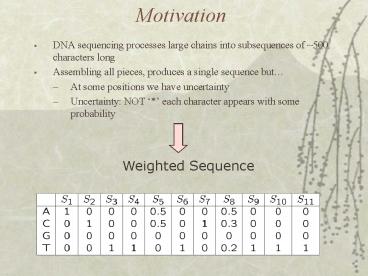
- DNA sequencing processes large chains into
subsequences of 500 characters long - Assembling all pieces, produces a single sequence
but - At some positions we have uncertainty
- Uncertainty NOT each character appears with
some probability
Weighted Sequence
2
Definitions
- Word w a sequence of zero or more characters
from an alphabet S. - w w1w2wn or w1..n
- Subword u wi..ip-1. If i1, u is a prefix.
If ip-1 n, u is a suffix. - Repeat At least two equal subwords u
3
Definitions (contd)
- Repetition At least two consecutive equal
subwords - u1 wi..ip-1 u2 wip..i2p-1
- Example w abaabab
- abaaba
- aa
- abab
- Cover u A repeated subword that covers the
entire sequence (allowing catenations and
overlaps)
4
Weighted words
- Weighted word w w1w2wn.
- wi(s1, pi(s1)), (s2, pi(s2)),...
- s?S and
- Example
- S A, C, G, T
- Q Which subwords occur with probability ? 1/4?
- A ACTTATCATTT (0.25), ACTTCTCATTT(0.25) ATTT
(0.5), CTTT(0.3) and all their subwords (but not
ACTTATCCTTT)
5
Suffix trees
- Suffix tree T(S) of a sequence S, S n is the
compact trie of all the suffixes of S, ?S. - Leaf v is labeled with integer i if stores
Si..n - At internal node v
- LL(v) list of suffixes at its descendants
(leaf-list) - L(v) the string spelled from root to v (path
label) - Can be built in time and space
Suffix tree for bcabc
abc
c
bc
abc
abc
6
Suffix trees (contd)
- Generalised Suffix Tree (GST)
- Multistring Suffix Tree for S1, S2,, Sm
- Leaves can store labels for several strings
- Can be built in
time and space
The GST for S1xabxa S2babxba
x
b
a
x
a
ba
a
bx
(S2,4)
(S1,5) (S2,6)
bxba
a
bxa
ba
a
ba
(S2,5)
(S2,3)
(S1,3)
(S1,1)
(S1,4)
(S1,2)
(S2,2)
7
Weighted Suffix Tree
- The generalised suffix tree for all the subwords
of a weighted sequence S, S n, where Pr(S) ?
1/k, k a fixed parametre. - Leaf v labeled with a pair (i,j), for the subword
Si,j (the j-th subword starting at position i)
S1,1 ACTTATCATTT, S1,2 ACTTCTCATTT, S8,1
ATTT
8
An example
9
Applications (1/4)
- Pattern Matching in weighted sequences, with Pr gt
1/k - Build tree for S. Then as in ordinary suffix
tree - Solid pattern P, P is spelled from the root of
the tree. Stops at internal node. Report all
leaves if necessary. - Weighted pattern P, Break P into solid subwords
and proceed as with solid patterns. - Time O(m), O(n) preprocessing S n, P m
10
Applications (2/4)
- Repeats in weighted sequences with Pr gt 1/k for
each. - Build WST for S with parameter 1/k.
- Traverse the WST, in DFS. At the return step to
an internal node v, build leaf-lists LL(v) from
descendants. - LL(v)s contents are positions where string
Path-label(v) is repeated. - Time O(na) S n, a answer size
11
Applications (3/4)
- Longest Common Substring in weighted sequences
with Pr gt 1/k - Build Generalised Weighted Suffix Tree for S1,
S2. - Each internal node a common substring
- Find longest path label
- Time O(S1S2).
12
Applications (4/4)
- Haplotype inference
- Indeterminate strings
- Degenerate strings
13
- Computational Molecular Biology Goals
- Finding regularities in nucleic or protein
sequences - Finding features that are common to such
sequences
- Gene Expression and Regulation
- Match structured patterns
- Infer structured patterns
14
Approximate Matching
- String Matching with Gaps The occurrences of the
symbols of pattern p do not appear successively
but have gaps.
15
Definitions
- S Alphabet Sset of all strings over S
- Assume a, b?S and p (pattern), t (text) are
strings over S. - Assume that giji1-ji-1 is the gap between the
occurrences of symbols pi1 and pi that occur at
positions ji1 and ji in text t.
- p p1, p2, , pm, (pm)
- adb iff a-b?d
- pdt iff pidti 1?i?n (d-approximate)
- p?t iff pt and ?1?i?ppi-tilt?
(?-approximate)
16
d-approximate string matching with a-bounded gaps
- Problem We want to bound the gap between the
d-occurrences of pi and pi1 in text t by a. - Basic Idea Compute the d-occurrences of
continuously increasing prefixes of p in t.
17
d-approximate string matching with a-bounded gaps
(the algorithm)
- The basic structure is the (m1)?(n1) matrix D
(mp nt)
D0,01, Di,00, D0,jj
Example tacaecaceaeeacbe (n15) pace (m3)
(a1, d1)
18
(d,?)-approximate string matching with a-bounded
gaps
- Use matrix D combined with min-FIFO queue to keep
track of the occurrences of the pattern symbols.
For each pi we maintain a list (as we construct
the matrix D column by column) that keeps all the
occurrences of pi-1 for which the invariant of
the bounded gap is not violated. We also need a
matrix C with the costs of the occurrences.
19
Complexities
- For d-approximate a-bounded gaps O(mn) time
complexity and O(mn) space (O(m) if we notice
that for the computation of column i we only need
column i-1). - For (d,?)-approximate a-bounded gaps O(mn) time
complexity and O(mnma) space.
20
a-strict bounded gaps and unbounded gaps
- a-strict bounded gaps The gaps in this version
are strictly of length a. - Solution Rearrange text t so that symbols a far
away become adjacent. The use a standard
algorithm for d-approximate matching (without
gaps) is sufficient. Space and time complexity is
O(n).
unbounded gaps The gaps in this version are
unbounded. (we seek only one occurrence) Solution
Just scan from left to right the string (time
and space complexity is O(n)). If we want
(d,?)-approximate matching then we have to resort
to the algorithm for a-bounded gaps setting an1
or a? (time and space complexity is O(nm)).
21
d-occurrence minimizing total difference of gaps
- We seek a d-occurrence of p in t minimizing
?1?i?m-2 Gi, where Gigi-gi1. We reduce this
minimization problem to the shortest path problem
on a graph
- Construct graph H(V,E). The set of nodes V is
constructed by creating nodes vi,j (1?i?m, 1?j?n)
whenever pidtj. An edge exists between vi,j and
vi,j if ii1 and jgtj. This edge has weight
equal to j-j-1. These edges encode the
occurrences of the pattern p in t. Link node s to
all nodes v1,j and node d to all nodes vm,j. - By contracting two nodes connected by an edge in
a single node we get the graph H that encodes
the differences of consecutive gaps. The shortest
path from s to d gives us the appropriate
occurrence of p in t.
22
d-occurrence minimizing total difference of gaps
(an example)
- The time and space complexity of this algorithm
is O(n2m).
23
d-occurrence with e-bounded difference gaps
- Problem We seek a d-occurrence of p in t such
that Gigi-gi1lte. - Solution Make use of graph H with the
difference that we need not find the shortest
path but just to find a path from s to d (after
removing all the edges with weight .
The time and the space complexity is equal to
O(n2m).
24
d-occurrence of a set of strings with ?-bounded
gaps
- Problem Assume w1, , wm? S. We wish to find
d-occurrences of wi (without gaps) where the gaps
between consecutive occurrences of strings wi and
wi1 are bounded by ?. - Solution Define pw1w2wm. Then we abstract each
wi as a single character and continue as in
a-bounded gaps with the construction of matrix D.
The space and time complexity is
O(n(w1w2wm)).
Recommended

