

LITA October 2005 (San Jose, CA) 'Falling Down the Porta PowerPoint PPT Presentation
1 / 49
Title: LITA October 2005 (San Jose, CA) 'Falling Down the Porta
1
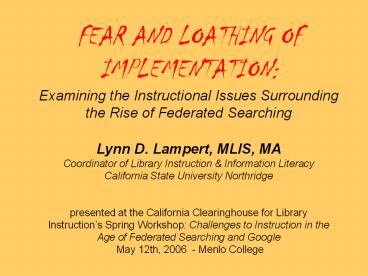
FEAR AND LOATHING OF IMPLEMENTATION Examining
the Instructional Issues Surrounding the Rise of
Federated Searching
- Lynn D. Lampert, MLIS, MACoordinator of Library
Instruction Information LiteracyCalifornia
State University Northridgepresented at the
California Clearinghouse for Library
Instructions Spring Workshop Challenges to
Instruction in the Age of Federated Searching and
Google May 12th, 2006 - Menlo College
2
Why fear AND loathing?
- Paranoia is just another word for ignorance
of technology ?)Kingdom of Fear Loathsome
Secrets of a Star-crossed Child in theFinal Days
of the American Century (2004) That's the
common delusion of undergraduates everywhere.
They think that in using Google, they're getting
relevant materials and a sufficiency of relevant
materials to write papers and to do research--and
it's simply not true. ALA President Michael
Gorman One College Librarian Worries About
'Atomizing' Books .Source Chronicle of Higher
Education 6/3/2005, Vol. 51 Issue 39, pA25-A25,
2/3p, 1c
3
Google, Federated Search User Perceptions of
Libraries Information Resources
- Success of metasearch and federated search
is often spoken about as if it is tied to
libraries collective futures. Federated search
is seen as pivotal and with it we are being
judged on, Our ability to meet the expectations
and needs of the Google Generation (Luther,
2003).Yet the public still largely sees
libraries as linked to dusty booksold fashioned
and not keeping up.OCLC. (2006). Perceptions of
libraries and information resources A report to
the OCLC membership Retrieved May 2, 2006, from
http//www.oclc.org/reports/2005perceptions.htm
Source OCLC. (2006). Perceptions of libraries
and information resources A report to the OCLC
membership. Retrieved May 2, 2006, from
http//www.oclc.org/reports/2005perceptions.htm
4
Perceptions of libraries and information
resources A report to the OCLC membership.
- Most information consumers are not aware of, nor
do they use, most libraries electronic
information resources. - 62 of the college students surveyed are aware
that libraries have databases, but 31 are still
not sure. - 84 total use search engines to begin an
information search. - 90 of respondents were satisfied with their
search engine search results. Source OCLC.
(2006). Perceptions of libraries and information
resources A report to the OCLC membership.
Retrieved May 2, 2006, from http//www.oclc.org/re
ports/2005perceptions.htm
5
- Topic MySpace.com and the Socialization of
the WebImplications for libraries discussed by
Dr. Noshir Contractor, University of Illinois
Urbana ChampaignThe way people interact,
access, and share information is
changingfriending, smart-mobbing, changing
content creation and theway we think about
curating content are all different. - Some of the opportunities and challenges for
traditional librarians are the changing
taxonomies we are seeing higher educationa
massive departure from pre-organized taxonomies
classifications of books old search engines to
the technology getting and giving students the
ability to shape information organically into
folksonomies (not passive web sites). - Students tag information like they tag
bands, activities, people(social
tags).Accessed from http//kcrw.com/cgi-bin/ra
m_wrap.cgi?/tp/tp060412MySpace_and_the_Grow
5/9/2006.
6
Examining the trends more closely and thinking
about our fledgling federated search pilots
- OCLC respondents to the survey generally seem to
choose electronic resources in the same ways they
choose other types of information resources. - 61 identify friends as their top choice in
identifying new electronic resources to use. - lt15 of the respondents indicate that they
discover new electronic resources from librarians
or teachers.Source OCLC. (2006). Perceptions
of libraries and information resources A report
to the OCLC membership. Retrieved May 2, 2006,
from http//www.oclc.org/reports/2005perceptions.h
tm
7
Are students looking for a metasearch tool?
8
(No Transcript)
9
Steven J. Bell Submit or Resist
Librarianship in the Age of Google
- Googlelizing our resources will no doubt
satiate the end user's need for an easy,
convenient gateway to databases bloated with full
text where there are no requirements for critical
thinking or search preparation...But these
strategies will ultimately fail if our mission is
to triumph not over Google and search engines,
but over the real obstacle we now confront as a
profession--getting our end users to care about
the quality of the information they obtain (Bell,
2005, 69-70).
10
Competing with Google?
11
Or are we competing to thrive as teachers within
the shifting landscapes of users interest
information seeking behavior?
12
Thinking Deeply about the Future
- Dr. Ilene Rockman Reference Services Review
Vol. 31, No 1, 2003. - When we examine the metasearching behavior of
users, we know they prefer intuitive, clearly
designed interfaces. Portals that are
interactive and instructional are powerful
learning tools. More importantly, if designed
well, such portals can help the user spend less
time searching for information, and more time
evaluating its qualityThis brings me to the
point of reasserting the teachingrole of the
librarian.the increasingly confusing roleof the
Internet increases the valuable role that we
playas information selectors, organizers and
teachers. We must continue to firmly,
consistently and creatively assert our
expertise.
13
Emerging Schools of Thought Within Librarianship
about Federated Searching Products
- One group admonishes that federated/metasearch
technologies will further exacerbate students
habitual pattern of not critically evaluating
retrieved information. - The other group feels that this new way of
packaging our full text resources is the best
way to compete with Google and reach our newest
generation of students - the millennials or
digital natives. (Prensky, 2001) - The learning styles of millennials have triggered
increased speculation about their impact on the
future teaching role of librarians
Digital natives- perceive technology as their
friend and rely on it to study, work, play, relax
and communicate (Culligan 2005). Digital
immigrants- are those who were not born into the
digital world but have, at some later part in our
lives become fascinated by and adopted many
aspects of the new technologies (Prensky, 2001).
14
The Role of the Librarian as Teacher The
Challenges of IL Instruction
- Not a new concept but it is receiving increased
study, as is our role to perform as teachers in
Learner Centered Universities - If all libraries are now teaching libraries,
then all librarians can benefit from thinking
about what research and practice has taught us
about instructional improvement S. Walter RUSQ
Spring 2006. - Have we librarians retooled our instructional
approach past a database analysis tour to a
research process style sage on the stage vs.
guide on the side constructivist approach. - Targeting single or multiple ACRL IL Student
Learning outcomes in one-shot and beyond.
15
Federated Searching is Gaining on our Rear View
Mirror Reflection
Future Presentations Today at WILU 35 Speaker
Patrick R. Labelle, Concordia University
on Federated searching's potential impact on
information literacy ALA 2006 -
Federated Search How Do We Teach It? - a
pre-conference workshop with
Christopher Cox, University of Wisconsin, Eau
Claire Special Issue of Internet
Reference Services Quarterly on
Federated Searching. The issue (12 1/2) will
tentatively be published 2/07 Past
Presentations The Myth, Magic and
Reality of Federated Searching Implications for
Reference Instruction, CARL South
Mini Conference December 9. 2005.
LITA October 2005 (San Jose, CA) "Falling Down
the Portal Undergraduate Adventures
in Federated Metasearch Technology at
California State University Northridge L.
Lampert K. Dabbour.
16
Federated search technologies, Academic Libraries
and Information Literacy
- Webster, Peter. (2004) Metasearching in an
Academic Environment Online, v. 28, no. 2
(Mar./Apr. 2004). - McCaskie, Lucy (2004) What are the implications
for information literacy training in higher
education with the introduction of federated
search tools?, University of Sheffield (M.A.
Thesis) - Zimmerman, Devin (2004) Metasearchings Teaching
Moments. Library Journal Sept 1, 2004 - Tallent, Ed. (2004) Metasearching in Boston
College Libraries A Case Study of User
Reactions. New Library World, Vol 105, No 1/2
69-75.
17
What do we know already and/or need to think
moreabout when it comes to Federated Searching?
- Federated searching is one of many changes that
signals a shifting paradigm within higher
education and the academic library landscape by
providing users with the opportunity to search
simultaneously across multiple databases, library
catalogs and search engines from a single
interface. - Federated search tools appeal to novice
searchers who, faced with an overwhelming number
of resources, remain unfamiliar as to which tools
will best meet their needs. - Federated searching's potential impact on
information literacyrepresents a serious and
real concern for instruction reference
librarians. - The role of teaching, pedagogical renewal and
creative integration of IL into the curriculum
in light of the emergence of Federated Search,
other technologies and our users growing
dependence on search engines is more important
than ever.
18
Librarians Teaching Roles MetasearchThree
Assessment Projects
- Two focused on librarians reactions to
metasearch technologies from a reference and
information literacy perspective. - One user survey that attempted to capture early
student experiences with metasearch.
Lampert, L.D. Dabbour, K.S. Librarian
Perspectives on Teaching MetaSearch and Federated
Search Technologies (Working title),Internet
Reference Services Quarterly 12 (January/February
2007). Expected 2007
19
Initial Survey of Librarians Attitudes Toward
Federated Searching
- 2005 LITA National Forum Data10 open-ended
questions - Online Survey distributed to
- ILI-L (Information Literacy Instruction Listserv,
ACRL/ALA), - CALIBACA-L (California Academic Research
Libraries Listserv, ACRL/ALA), - CSULIB-L (California State University Librarians
Listserv, California Academic and Research
Libraries)
20
How many libraries had implemented federated
search?
- 34 of the respondents in this survey
answered dont have or stopped using to the
first question about when their libraries first
offered federated searching to their patrons.
21
Federated Searching Taught in Class?
- The second question asked if the librarian
taught federated searching in a formal setting,
such as during a library instruction session
Federated Searching Taught in Class?
22
Why NO for 61 surveyed?
- Librarians who do not teach federated
searching said that their biggest impediments
were - The loss of controlled vocabularies and
specialized features of individual databases,
such as limiting to peer-reviewed journals only.
- Suspicion of the precision and recall of
federated search systems - Thought it too time-consuming to teach in a
50-minute session - Perception that is was too confusing for
students, - Felt that they tended to reinforce the Google
approach to searching and overlooking specialized
databases. - Barrier that not all library databases are
available via a federated search system.
23
For the 21 who said yes they do offer
federated search instruction
- Respondents explained that they found the
ability to save citations and search strategies
enables them to introduce undergraduate students
to information management. - Reported that they covered both the native
interface and federated searching, outlining the
disadvantages/advantages of each approach. - Asked students to search both the native and
federated interfaces to find out which students
thought were more useful and to identify the
differences. - Librarians promoted federated searching as a
starting point to identify relevant databases,
controlled vocabularies listed in the full record
displays, and to connect students to the native
interface.
24
Impact of Federated Searching on IL Skills of
Students
- Most of the respondents thought the impact was
negative or neutral. For those who
indicated a negative impact, common themes were - That students could not recognize the benefits
of using a particular database if they relied
on federated search systems. - Students do not know what they are searching,
are overwhelmed by too many results. - Have difficulty distinguishing between the types
of sources retrieved. - In addition, the librarians considered the
concept of encouraging Google-thinking as
negative.
25
More Positive or Neutral Responses
- Some neutral impact responses related to the
respondent not being sure yet because they had
not thought about it and/or their library had not
had federated searching long enough.A few felt
the impact neutral because they considered it
another tool in the students search option
toolbox. - For the 10 who felt it had a positive impact,
one respondent said that it,Helped teach the
variety of resources availableA quick and
easy way to get students thinking about their
resultsIf you teach both native and federated
interfaces you give students a choice.
26
Librarian Assessment Findings
- Q5 Are you confident teaching federated
searching in instruction sessions and/or at the
reference desk?
27
Librarian Assessment Findings
- Q7 Do you prefer to teach the native interface
for individual databases over federated searching?
28
Librarian Assessment Findings
- Why librarians stated that they prefer teaching
the native interface - Limiting ability
- Sophisticated search options
- Distinguish easily between scholarly vs. popular
- Controlled vocabularies
- Most students dont need a lot of databases
29
Quotes from open ended comments in Librarian
Assessment Findings
- Federated searching is a path of despair that
assumes that either we do not have time or a
venue to teach more sophisticated search methods,
or our students are incapable or unmotivated to
learn how to search with more sophistication.
Federated searching produces muddled results that
take us only a few baby steps beyond Google.
Anonymous
30
Martin Gordon (1986) Article Access -- Too
Easy? Serials Librarianship in Transition
- Lamentation of growth of online databases and
stagnation of student research skills. - The limited level of undergraduate subject
knowledge and Lack of analytic selection from
the resulting citations produced by the search
as well as initial error in qualifying limitation
placed on the search further exacerbate
problems. - It remains the responsibility of the librarian
to see to it that important steps are not
excluded in the assembling of the bibliography
the realization of both expediency and
comprehensiveness without the sacrifice of the
true exercise in research that the library has
always advocated the careful, conscious
discrimination in the students selection
ofsource material.
31
Content Delivery Mechanisms for Higher
Education are Being Challenged
- All of Higher Education
- Pedagogical stretches
- Podcasts
- Online supplemental learning / tutorials
- (Elluminate) synchronous /asynchronous
- Student centered learning
- Library Specific Changes
- New multiple source formats for databases
- Built in citation formatting
- More information than ever in multiple formats
- Personalization My folders in several databases
32
(No Transcript)
33
(No Transcript)
34
(No Transcript)
35
(No Transcript)
36
List of Problems to Think About for Instructional
Integration
- Students will click before they think
- Students wont know what databases theyre
searching - Not all databases can be included
- Cant use special features available on some
databases (field limits, thesauri) - Search reduced to the lowest common denominator
- Students wont understand what sources are
included - Cant recognize scholarly literature no limit
- Risk getting too many results
- Makes evaluation of information more complicated
C. Cox Federated Search How Will it Change the
Way We Teach? Brick and Click Conference 2005.
37
Other issues that impact showing users metasearch
and other resources
- Speed of results
- Quality of results
- Students ability to discern content of results
(scholarly v. popular type of resource
location) - Students feeling of being overwhelmed less is
more - - Student familiarity with library research
- How it works with the rest of the curriculum of a
librarys instructional programming. - Who is the target population (undergraduate,
grad, faculty?)
38
Federated Search and the Information Literacy
Competency Standards
- What are the real information literacy
implications of federated searching? - What is the most effective way of introducing it
into our IL curricula? - What are some examples of ways to bring this into
the classroom? - Which ACRL IL Standards are best to target when
working with federated search tools?
39
Standard Two is a key factor for IL instruction
- Standard Two
- The information literate
- student accesses needed
- information effectively
- and efficiently.
- 1. The information literate
- student selects the most
- appropriate investigative
- methods or information
- retrieval systems for
- Accessing the needed
- information.
- 2. The information literate student constructs
and implements effectively-designed search
strategies (problematic due to simplistic search
capability).
40
Evaluation
- Standard Three The information literate student
evaluates information and its sources critically
and incorporates selected information into his or
her knowledge base and value system
41
Integrating Federated Search Exercises into IL
Sessions
- Compare results from a search of an individual
database (native interface) with a federated
search and search engine. - Discuss document retrieval types prior to
introducing federated searching. - Apply source criteria to evaluate federated
search results list. - Careful comparative analysis/annotation of
results from databases included in a federated
search and native search interface.. - Search term discovery exercise in native
interface to deepen topic search before
evaluating results in multiple databases. - Set search queries for class, divide class into
native search vs. federated and have them report
back on results. - Have students annotate results from comparative
search using federated interface and native
search interface.
42
Exercises Like These Call for a Shift in
Instructional Philosophy
- Move from focus on what tool to teach
(federated search or ) to how to get students to
learn a concept) - It makes no sense to decide how one is going
to teach before one has made some study of how
people learn. - (Eric Sotto When Teaching becomes Learning 1994)
- Create a rich, problem-solving environment
- Present authentic contexts and tasks rather than
predetermined (canned) instructional sequences - Reflective practice needed (hands-on)
- Focus on knowledge construction not reproduction
(deep versus surface learning)
43
Lack of Curriculum Development?
- Enhancing the quality of library instruction
is not about devising more brief activities or
even slicker performances (video, Powerpoint,
etc.) but about recognizing the need to build the
learners' needs and priorities into induction. - With this focus induction might look quite
different engaging students in discussion about
their expectations of the library or about
experiences of using libraries, working to meet
the information needs that students have at that
time, ...or involving them in looking at how they
currently find things in libraries.
Sharon Markless Learning about Learning rather
than about teaching. IFLA 2002
http//www.ifla.org/IV/ifla68/papers/081-119e.pdf
44
Defining Key IL Issues Sadeh, T. (2004) The
Challenge of Metasearching New Library World, v.
105, no. 1198/1199, p. 104-112.
- Metasearching, also known as integrated
searching, simultaneous searching, cross-database
searching, parallel searching, broadcast
searching, and federated searching, refers to a
process in which a user submits a query to
numerous information resources. The resources
can be heterogeneous in many respects their
location, the format of the information that
they offer, the technologies on which they draw,
the types of materials that they contain, and
more.
- Key UndergraduateInformation LiteracyIssuesHe
terogeneity of - Locations
- Formats
- Technologies
- Materials
45
To teach students how to learn how to use
federated searching tools we must engage the
learner
- Remember that learning is messy
- Learners interactions with information are
complex and initially not always fully understood - the search process has cognitive and emotional,
as well as behavioural aspects - confusion, hesitation and uncertainty must be
acknowledged as part of the search process - students need to own the search process it must
fit into how they think and operate
satisfycing may happen initially need to
introduce comparisons.
46
Market emphasize our deep understanding of the
relationship between people and information
47
Other Issues Federated Search Technology at the
Reference Desk and in the classroom
- Steven J. Bell There needs to be a balance
between integrating library resources into Google
and educating users to understand that they
sometimes need to be where the library is. - The value of the reference interview and
one-on-one instruction that works to develop
student familiarity with resources, search
concepts, and disciplinary research resources.
48
Future Research Questions
- Student/User self ratings of IL skills pre post
metasearch focus group - Student satisfaction with IR results
- Citation analysis of bibliographies produced by
students using a metasearch product - Focus groups on what students want to learn at
the reference desk/ and in information literacy
sessions - Metasearch/federated search assessments of user
satisfaction
49
Contact Information
- Lynn Lampert MLIS, MA
- Coordinator of Library Instruction Information
Literacy - Oviatt Library, 8327
- California State University Northridge
- Email lynn.lampert_at_csun.edu
- Phone (818) 677-7104
- Home page http//library.csun.edu/llampert
Recommended

