

Probability and Genetics PowerPoint PPT Presentation
1 / 9
Title: Probability and Genetics
1
Probability and Genetics
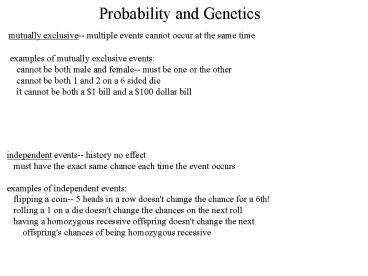
mutually exclusive-- multiple events cannot occur
at the same time
examples of mutually exclusive events cannot
be both male and female-- must be one or the
other cannot be both 1 and 2 on a 6 sided die
it cannot be both a 1 bill and a 100 dollar
bill
independent events-- history no effect must
have the exact same chance each time the event
occurs examples of independent events
flipping a coin-- 5 heads in a row doesn't change
the chance for a 6th! rolling a 1 on a die
doesn't change the chances on the next roll
having a homozygous recessive offspring doesn't
change the next offspring's chances of
being homozygous recessive
2
Probability and Genetics
addition rule overall probability of mutually
exclusive outcomes is the sum of their
individual probabilities for Aa x Aa, what is
the probability of the offspring being true
breeding? ie. 1/4 AA 1/4 aa 1/2 true
breeding
multiplication rule the probability of 2
combined independent events equals the
product of their individual probabilitites for
Aa x Aa parents, what is the probability that 2
of 2 offspring are aa? ie 1/4 aa for each
offspring 1/4 x 1/4 1/16 addition and
multiplication rules are often used together in
genetics P(3 even on a 6 sided die) P(2)
P(4) P(6)3 (1/2 1/2 1/2)3 1/8
3
Probability and Genetics
mathematically, inheritance follows the binomial
probability formula ie. 2 possible options
(bi) with probabilities that add up to 1 ie.
what is the probability of having exactly 2 boys
of 3 children? BBG, GBB, BGB are the 3 possible
ways of doing that (1/2)3(1/2)3(1/2)3 3/8
or use Pascals triangle 3 x (1/2)2 x (1/2)
3/8 comes from (b g)3 (bg) x (b2 2bg
g2) b3 3b2g 3bg2 g3
4
Probability and Genetics
Assuming two outcomes A and B are independent and
mutually exclusive, if probability of outcome A
is p and probability of outcome B is q, the the
probability that A occurs s times and B occurs t
times is
n!
0!1 1!1 2!2 3!6 4!24 5!120 6!720 7! 5040
psqt
s!t!
number in Pascal's triangle n!/(s!t!) ! stands
for factorial, and means 1x2x3x...n factorials
increase very, very quickly for genetics,
because of independent assortment and 2 possible
alleles, probabilities are 1/2
5
Probability and Genetics
probabilities do NOT have to be 1/2 for the
binomial theorem to work
probability of hitting the daily number 2 out of
3 days P(hitting on 1 day) 1/1000 p
p(missing on 1 day) .999 q 2 out of 3 days
is therefore P(2 out of 3) (3!/2!1!)
(.001)2 (.999)1 (6 from pascal's
triangle) P(hitting)2 times P(missing)once
3.996 x 10⁻⁶ (or really
really bad) any probability MUST be between 0
and 1 near 0 means very unlikely to happen,
near 1 means very likely
6
Probability and Genetics
the addition and multiplication rules can be
combined what is the probability of at least 3
heterozygous peas of 5 being green? p(green)
3/4 p(yellow) 1/4 there are several ways that
this can be true p(at least 3 of 5) p(3 green)
p(4 green) p(5 green) p 10(3/4)3(1/4)2
5(3/4)4(1/4)1 1(3/4)5(1/4)0 p 270/1024
405/1024 243/1024 918/1024 0.896 or 89.6
the wording of the problem will determine what
conditions are true!
7
Probability and Genetics
Geneticists need to determine if a set of data is
consistent with a genetic hypothesis or
whether it is unlikely that such an explanation
is valid goodness of fit how well does actual
data fit expected ratios chi squared test
(c2) statistical test used to determine goodness
of fit c2 S ((observed-expected)2/ expected)
summed over all possibilities chi squared is
calculated using the observed and theoretical
numbers the larger the chi squared value, the
less likely the hypothesis is true level of
signficance is pretty much assumed to be
.05 degrees of freedom (n) of classes (ie.
terms in the summation) -1
n
1
8
(No Transcript)
9
Probability and Genetics
for Mendels peas, if he got 20 green and 10
yellow pods, does this fit a 31
ratio? expected results for a 31 ratio from
201030 pods total P(green) total
(.75)30 22.5 P(yellow) total (.25)30
7.5 must add up to the observed
total next, substitute into the chi-squared
equation S (o-e)2/e c2 (20-22.5)2/22.5
(10-7.5)2/7.5 .277778 .83333 1.111111
and therefore this is still consistent with a 31
ratio rejecting a hypothesis is sometimes hard
to do with small numbers for 200 green and 100
yellow pods, c2 (200-225)2/225 (100-75)2/75
625/225 625/75 11.11111 and it is
rejected (p0.001 lt0.05)
Recommended

