

NWS Alaska Region: Challenges in an Era of Changing Climate PowerPoint PPT Presentation
1 / 12
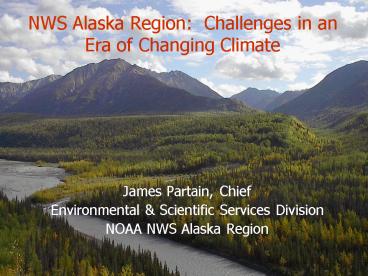
Title: NWS Alaska Region: Challenges in an Era of Changing Climate
1
NWS Alaska Region Challenges in an Era of
Changing Climate
- James Partain, Chief
- Environmental Scientific Services Division
- NOAA NWS Alaska Region
2
NOAA NWS Alaska Region - Overview
- 3 Weather Forecast Offices
- 12 Weather Service Offices
- River Forecast Center
- Tsunami Warning Center
- 2 Aviation weather centers
Mission of NOAAs NWS Protection of life
property support safe efficient Commerce
Transportation
3
NOAA NWS Alaska Region - Facilities
4
(No Transcript)
5
NWS Alaska Region Climate Challenges
- Climate change in Alaska is WAY beyond academic
- Decades-old warming at locations all across
Alaska - Greatly reduced extent and thickness of
multi-year sea ice - Later freeze-up in Fall and earlier break-up in
Spring - Glaciers retreating, Permafrost melting with
attendant issues - For us, debate over cause of warming is moot
NOAAs weather customers are impacted on a daily
basis they are looking to us for expertise!
6
The Weather Climate Connection
- Climate is the long-term record of weather
- Weather is what happens in the next few days
- Climate has most certainly changed in the last
few decades, and therefore weather (the daily
changes in weather) has also changed - Climate changes has negatively changed most
everything in all our daily lives
7
Climate Impacts on NWS Service Programs
- Aviation more frequent icing conditions, low
visibility changed flying paradigms - Public - more frequent extremes in weather
- Marine - more frequent high-impact events, esp.
in areas of reduced sea ice (e.g. coastal
erosion, water quality) - Wildfire - more variable regime-dependent
fuel-moisture conditions
8
Climate Impacts on NWS Service Programs
- Hydrology - greater variability in river volume
related flooding and erosion ice-dammed glacier
lake releases - Tsunami sea-level rise may have eventual
impacts - Volcanic Ash resuspension of relic ash.
9
(No Transcript)
10
Climate Science Needs - Observations
- Observations form the backbone of forecast and
warning services - vertical, spatial and temporal distributions of
moisture, temperature, and kinetic energy equal
weather - the need to know whats really happening (to
calibrate both our brains and our weather/climate
models) - which results in a heavy dependence on surface
(land, marine, ice) and space-based observations - remotely-sensed (e.g. profilers, radars,
radiometers, scatterometers, GPS-moisture) - and in-situ (e.g. weather observations, buoys,
weather cameras, upper-air).
11
Climate Science Needs - Models
- In Alaska, guidance from numerical models is
especially critical for forecasts warnings
beyond 6-hours - NWS atmospheric models generally do worst at the
poles. Alaska in particular suffers with poor
model quality due to its position within and
downstream of one of the most data-sparse, yet
dynamic weather regimes on the planet - Observing system tests have proven the value of
observations to improving our models (esp.
vertical atmospheric observations, plus
land/ocean observations of antecedent conditions) - Improved models lead to improved and more
confident services by forecasters and
decision-makers
12
Climate Science Needs Decision Support and
Outreach/Education
- Decision-support assistance bridges the realms of
observations, models, research, and human factors
and their implications for real-world application - In Alaska, help is needed by many, including
those involved in transportation, subsistence
activities - Outreach and education are the tools by which
decision-support outputs are made effective - A perfect forecast or warning is entirely useless
unless the customer understands its meaning and
impact and can make appropriate decisions to
mitigate the impactsa horrible, yet critical
lesson from the Indian Ocean catastrophe
Recommended

