

What Men Need to Know about PSA and Prostate Cancer PCa PowerPoint PPT Presentation
1 / 30
Title: What Men Need to Know about PSA and Prostate Cancer PCa
1
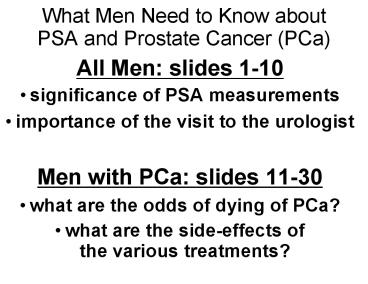
What Men Need to Know about PSA and Prostate
Cancer (PCa)
- All Men slides 1-10
- significance of PSA measurements
- importance of the visit to the urologist
- Men with PCa slides 11-30
- what are the odds of dying of PCa?
- what are the side-effects of the various
treatments?
2
Prostate Specific Antigen (PSA)
- PSA is made by the prostate gland and, perhaps,
a prostate cancer tumor - a raised PSA is most commonly
- a) the result of benign prostatic
hyperplasia (BPH) -75-, or - b) an early indication of prostate cancer
-25- - knowing your PSA is your responsibility ask for
copies of blood test reports put them in a
binder and keep track of them!
3
PSA Screening
- Patients with prostate cancer have a survival
rate equal to or greater than patients without
prostate cancer they are tested regularly! - Screening for prostate cancer may trigger other
tests and a general health evaluation that may
lead to treatment not related to prostate cancer.
Walsh RM, Thompson IM J Urol. 2007
Apr177(4)1303-6 - People residing near the former Fernald uranium
processing plant in south-western Ohio are living
longer and enjoying healthier lifestyles than
those in the general population. Why? They were
medically examined frequently. http//healthnews.u
c.edu/publications/findings/?/4054/4064/
4
PSA Details I
- The first PSA test should be taken at age 40 by
men with prostate cancer in the family, and by
Afro-American men. Others should start at 50. - PSA tests only for those with a life expectancy
(LE) exceeding 10 years - a 75 year old man with
average health has an LE of 9.3 years, but it
could range between 14.2 years and 4.9 years.
Walter LC et al JAMA. 2006 Nov
15296(19)2336-42 - PSA measurements can be off because of BPH
(enlarged prostate), and also ejaculation, or a
DRE and medications such as Proscar or Avodart,
or prostatitis (inflammation of the prostate).
5
PSA Details II
- For men in their forties if PSA repeat at age 45 if 0.6 ng/ml, repeat
annually. - Determine at each successive measurement the PSA
Velocity (PSAV) the PSA increase per year.If
the PSA is 2.6 ng/ml in April 2006, and 3.3 ng/ml
in April 2007, the PSAV is 3.3-2.60.7
ng/ml/year. Yu X et al J Urol. 2007
Apr177(4)1298-302 - the PSA should be repeated if in doubt
- measurement of a PSA should be accompanied by a
Digital Rectal Examination (DRE)
6
PSA Details III
- 44 of men without known prostate cancer and an
initial PSA 4 ng/ml had repeat PSA levels ng/ml - patients should undergo repeat PSA
testing before being referred for prostate
biopsy. Eastham JA et al JAMA. 2003 May
28289(20)2695-700 - Median PSA for men 40-49 years 0.7 ng/mL and 0.9
ng/mL for men 50-59 years. A baseline PSA level
between the age-specific median and 2.5 ng/mL was
associated with a 14.6-fold and 7.6-fold
increased risk of CaP in men aged 40 to 49 and 50
to 59 years, respectively. Loeb S et al
Urology. 2006 Feb67(2)316-20
7
Visit the Urologist when .
- the PSA is 2.5 or) 4.0 ng/ml
- the PSAV is 0.3 or) 0.7 ng/ml/year
- the DRE is positive
- only after a repeat PSA (for those with a PSA
biopsy, particularly when - the PSA 10,
- the DRE is positive,
- the Free PSA
- the PCa3 Plus Test makes prostate cancer likely
- or) the experts disagree
8
Free PSA Percentage of Men without PCa
Lacher DA et al Adv Data. 2006 Dec 4(379)1-12
9
Free PSA and PCa3 Tests
- a free PSA test can be ordered by any physician
who orders a PSA test - free PSA 25 lower risk of PCa
- free PSA et al Urology. 2003 Apr61(4)760-4
- PCa3 Plus 35 high likelihood of PCa the test
is a urine test prostate-cancer.org/education/pre
clin/Torres_PCA3.htmlwww.bostwicklaboratories.com
/about/PCA3.html
10
What can be Expected from a Biopsy?
- 20-25 of patients with a PSA 2.5 ng/ml and ng/ml will be found to have cancer
- 30-35 of patients with a PSA 4 ng/ml will be
found to have cancer - 67 of patients with a PSA 10 ng/ml will be
found to have cancer - extra-prostatic cancer more common with a
positive DRE than with a negative DRE - NCCN - Practice Guidelines in Oncology v.1.2004
11
What Should be in the Biopsy Report if there is
Cancer
- type of cancer (most likely adenocarcinoma)
- volume of the prostate
- number of cores and their length (in mm)
- amount of cancer in each core (in mm)
- presence or absence of perineural invasion
- total amount of cancer as a percentage
- Gleason score 6 (3,3), 7 (3,4) or 7 (4,3), 8
(4,4), 9 (4,5) or 9 (5,4), 10 (5,5)
agressivity of cancer
12
You have Prostate Cancer!
- dont panic, but learn the basics
- prostate cancer is common
- only a small percentage of men diagnosed with
prostate cancer will die of prostate cancer
13
Prostate Cancer is Common
- autopsies showed
- men in their 30s 29 have prostate cancer
men in their 40s 32 have prostate cancer men
in their 50s 55 have prostate cancer men in
their 60s 64 have prostate cancer
Sakr WA et al, In Vivo
1994, 8(3)439-43 - most men with prostate cancer do NOT develop
symptoms - more biopsies simply find more men with prostate
cancer
14
Few Men with Prostate Cancer die of Prostate
Cancer
- the American Cancer Society estimates that about
27,050 men will die of prostate cancer in 2007 - this is 16 of those diagnosed with prostate
cancer - while 1 man in 6 will get prostate cancer during
his lifetime, only 1 man in 34 will die of this
disease.American Cancer Society, 2007 statistics
15
The Odds of Dying of Prostate Cancer
- Average odds is 16 after diagnosis
- For the great majority of men diagnosed with PCa
the odds are much better, similar to the odds of
dying of heart disease - For an unfortunate few the odds are worse
16
Prostate Cancer Mortality
- The chances of dying from prostate cancer are
high for those diagnosed with cancer in the
bones, and for those with local cancer and with a
high Gleason score, 8, or with a PSA 20 - The chances of dying from prostate cancer are
slim for those diagnosed with localized cancer
(cancer only in the prostate) and with a Gleason
score of 7 or less
17
Prostate Cancers Conundrum
- Is cure possible when it is necessary and is
cure necessary when it is possible? (Willet
Whitmore ) - Dr. Whitmore recognized two classes of PCa
patients - Class 1 diagnosis and treatment are burdens
because the disease will never cause a problem
for the patient, and - Class 2 the disease defies any form of treatment
and results in death.
18
Prostate Cancers Third Class
- Clinicians involved with prostate cancer believe
that there is a third class of prostate cancer
patients - Evangelists believe that lives may be lost if
this class is not treated. - Snails believe that promoting an invasive
therapy in healthy individuals goes against
primum non nocere first do no harm. They think
that standards should be very high when
advocating treatment of men without symptoms.
Iscoe NA CMAJ. 1998 159(11)1375-72
19
PCRIs View of the Three Classes
prostatecancer.org/education/preclin/StrumPogliano
_EveryDocShouldKnow.html
1 tortoise no need to stop 2 raven, will
escape 3 hare may be stopped
20
Treatment Choices
- First-line choices local therapies such as
surgery (open, laparoscopic, or robotic
laparoscopy) radiation (EBRT, Brachytherapy or
both) other local therapies - Second-line choices watchful waiting (WW) or
active surveillance hormonal therapy (androgen
deprivation therapy or ADT)
21
Treatment Considerations
- no randomized controlled trial to date has proven
the superiority of one type of treatment in terms
of cancer control - primary treatments for localized prostate cancer
appear to result in equivalent cancer control for
most patients but with disparate side effects
22
Side Effects I
- Urinary control and sexual function were
better after EBRT, although bilateral
nerve-sparing surgery diminished these
differences among potent men undergoing RP. BT
caused more obstructive and irritative urinary
symptoms, while both forms of radiation caused
more bowel dysfunction. Litwin MS et al Cancer.
2007 Apr 23 - EBRT External Beam Radiation
- RP Radical Prostatectomy
- BT Brachytherapy
23
Side Effects II
- ..48 had radical prostatectomy (RP) and 52
had radiotherapy (RT). General wellbeing measures
demonstrated a definite advantage favoring men
treated with RP. .. RT-treated men were slightly
more likely to report bowel-related problems than
RP treated men. Urinary QOL measures were not
different between the two groups. RP men reported
lower level of sexual function than RT men.
Rodgers JK et al Arch Androl. 2006
Mar-Apr52(2)129-33
24
Dont Be in a Rush if That is Not Necessary
- Men diagnosed with PCa, but the PSA was less
than 10 - Some patients were treated within three months
of diagnosis, other patients were treated later - no difference in the results!
25
Surgery versus Watchful Waiting (WW)
- A clinical trial showed that fewer men died after
surgery but in order to have one man survive, 17
had to be operated.Bill-Axelson et al N Engl J
Med. 2005 May 12352(19)1977-84 - 32,022 men had been treated with surgery or
radiation, and 12,608 men with WW. - After 12 years, prostate cancer
specific-mortality was 1.9 in the treatment
group and 2.5 in the WW group.
Wong YN et al JAMA. 2006 Dec 13296(22)2683-93
26
Hormonal Therapy Seldom in the USA
- In Japan 57 of all patients and 46 of those
with T1c to T3 disease had primary androgen
deprivation therapy (PADT). Mizokami A, et al
BJU Int. 2007 Jan99 Suppl 16-9 discussion 17-8 - Akaza H BJU Int. 2007 Jan99 Suppl
110-2 - Clinical trials showed that patients with locally
advanced prostate cancer (stage C) treated with
PADT were likely to have a life-expectancy
similar to that of the normal population.Wakami
J et al Cancer. 2006 Apr 15106(8)1708-14 - Akaza H BJU Int. 2007 Jan99 Suppl 110-2
27
Watchful Waiting (WW) and Active Surveillance (AS)
- WW and AS do not exclude local therapy. For
example, when the PSA doubling time (PSADT)
becomes less than 3 years, local therapy may be
advised. Repeat biopsy is also common. - Active surveillance based on PSADT and repeat
biopsy represents a practical compromise between
radical therapy for all patients which may result
in overtreatment and watchful waiting which may
result in undertreatment L Klotz Curr Treat
Options Oncol. 2006 Sep7(5)355-62
28
Active Surveillance
- 299 patients were followed with active
surveillance .. Patients had PSA of 7, and T 2b.. . . With a median follow-up of 64
months, 101 patients (34) came off watchful
observation 3 for clinical progression, 4 for
histologic progression, and 12 due to patient
preference. . . . Only 2/299 patients have died
of prostate cancer. Klotz L Eur Urol. 2005
Jan47(1)16-21
29
A Question
- If prostate cancer is detected at any stage,
grade or volume in almost any age group it is
almost uniformly treated. Are at least some of
these men candidates for active surveillance?
Interestingly, despite the increasing numbers of
men with favorable disease characteristics,
prostate cancer treatment patterns appear to be
more aggressive today compared to those of a
decade ago. Peter Carroll J.Urology, 173
(2005), 4, 1061-1062
30
PCNG
- We respect any treatment decision of a newly
diagnosed patient - We hope that this decision was made after
evaluating the risk of dying of prostate cancer - We assume that the various treatment options and
their side effects have been investigated and
compared in detail
Recommended

