

Changing Sources of Competitive Advantage PowerPoint PPT Presentation
1 / 23
Title: Changing Sources of Competitive Advantage
1
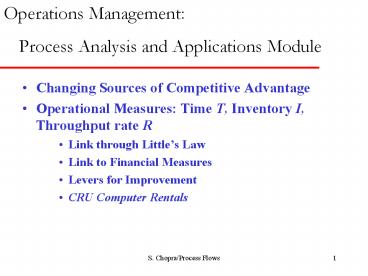
Operations Management Process Analysis and
Applications Module
- Changing Sources of Competitive Advantage
- Operational Measures Time T, Inventory I,
Throughput rate R - Link through Littles Law
- Link to Financial Measures
- Levers for Improvement
- CRU Computer Rentals
2
How can operations help a company compete?The
changing sources of competitive advantage
- Low Cost Scale Economies (
- You can have any color you want as long as it is
black - Focused Factories (mid 1960s)
- Flexible Factories and Product variety (1970s)
- A car for every taste and purse.
- Quality (1980s)
- Quality is free.
- Time (late 1980s-1990s)
- We love your product but where is it?
- Dont sell what you produce. Produce what sells.
3
Operational Performance Measures
- Flow time
- Throughput
- Inventory
- Process Cost
- Quality
4
The business imperative creating economic value
Improvement levers
Price
- Increase price
- Increase throughput
Revenues
Quantity
Profit
Material
Labor
Costs
- Reduce costs
- Improve quality
Energy
Economic value added (EVA)
Overhead
PPE
- Reduce capital intensity
- Reduce inventory
Capital invested
Inventory
Opportunity cost
Other
Reduce time
Weighted average cost of capital
Operational metrics
Financial metrics
5
Relating operational measures (flow time T,
throughput R inventory I) with Littles Law
Flow rate/Throughput R units/hr
Inventory I units
...
...
...
...
...
Flow Time T hrs
- Inventory Throughput x Flow Time
- I R x T
- Turnover Throughput / Inventory
- 1/ T
6
Process Flow Examples
- Customer Flow Taco Bell processes on average
1,500 customers per day (15 hours). On average
there are 75 customers in the restaurant (waiting
to place the order, waiting for the order to
arrive, eating etc.). How long does an average
customer spend at Taco Bell and what is the
average customer turnover? - Job Flow The Travelers Insurance Company
processes 10,000 claims per year. The average
processing time is 3 weeks. Assuming 50 weeks in
a year, what is the average number of claims in
process. - Material Flow Wendys processes an average of
5,000 lb. of hamburgers per week. The typical
inventory of raw meat is 2,500 lb. What is the
average hamburgers cycle time and Wendys
turnover?
7
Process Flow Examples
- Cash Flow Motorola sells 300 million worth of
cellular equipment per year. The average
accounts receivable in the cellular group is 45
million. What is the average billing to
collection process cycle time? - Question A general manager at Baxter states that
her inventory turns three times a year. She also
states that everything that Baxter buys gets
processed and leaves the docks within six weeks.
Are these statements consistent?
8
MBPF Inc. Consolidated Statement
9
MBPF Inc. Balance Sheet
10
MBPF Inc. Inventory and Cost of Goods
11
MBPF Business Process Flows
12
MBPF Inc. Flow Times
13
(No Transcript)
14
Why the Difference in Performance?
15
CRU Computer Rentals
16
Case CRU Computer Rentals Flow Chart
Status 40
Ship
Receiving
Repairs
30
70
Status 24
Parts places order Receives from Supplier
15
Customer
Pre-Config
Status 41
Status 32
Repairs
Config
Ship
Status 20
Status 42
17
CRU Situation in Previous YearCustomer term 8
wks, Demand 1000 units/wk
18
CRU Situation in Previous Year Financial
Performance
- Number of units on rent 8,000
- Total number of units 14,405
- Utilization 0.56 (56)
- Revenue rate 8,000 x 30 240,000/wk
- Variable Cost rate 25 x 1,000 (R) 25 x 1,000
(S) 4x700x.85 150 x 405 113,130/wk - Contribution Margin 126,870/wk
- Depreciation 14,405 x (1000/156wks)
92,340/wk - bottomline 126,870-92,340 34,530
19
CRU Situation in Current Year flow times
unchanged, Demand 1400 units/wk
20
CRU Situation in Current Year flow times
unchanged, Demand 1400 units/wk
- Number of units on rent 8,000
- Total number of units 16,967
- Utilization 0.47 (47)
- Revenue 4,800 x 30 3,200 x 35 256,000/wk
- Cost 25 x 1,400 (R) 25 x 1,400 (S) 4 x 980x
.85 150 x 567 158,382/wk - Contribution Margin 97,618/wk
- Depreciation 16,967 x (1000/156) 108,763/wk
- bottomline 97,618 - 108,763 -11,145
21
CRU Potential situation in Current Yearwithout
sales drive, Demand 600 units/wk
22
CRU Potential situation in Current Yearwithout
sales drive, Demand 600 units/wk
- Number of units on rent 4,800
- Total number of units 8,643
- Utilization 0.56 (56)
- Revenue 4,800 x 30 144,000/wk
- Cost 25 x 600 (R) 25 x 600 (S) 4x420x .85
150 x 243 67,878/wk - Contribution Margin 76,122/wk
- Depreciation 8,643 x (1000/156) 55,404/wk
- bottomline 76,122 - 55,404 20,718
23
Learning Objectives Basic Process Analysis
- Process Measures time, inventory, and throughput
- What is an improvement?
- Link financial measures to operational ones
- Good operational measures are leading indicators
of financial performance - Using Littles law for process flow analysis
- Targeting areas and performance measures for
improvement link financial and operational flows
Recommended

