

Nintendo The Launch of Game Boy Color PowerPoint PPT Presentation
1 / 34
Title: Nintendo The Launch of Game Boy Color
1
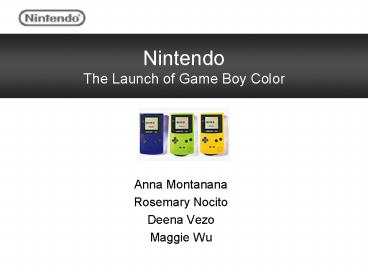
NintendoThe Launch of Game Boy Color
- Anna Montanana
- Rosemary Nocito
- Deena Vezo
- Maggie Wu
2
Nintendo History
- 1889 Nintendo was founded by Fusajiro Yamauchi
as a manufacturer of 'Hanafuda - Japanese
playing cards. - The name 'Nintendo' actually means 'leave luck to
heaven - 1970 first field of video entertainment after
creating the Beam Gun with opto-electronics - 1980 launched Game Watch which was an LCD
based platform that had 59 games - 1983 introduced first home console, Nintendo
Entertainment System (NES) - 1989 released Game Boy, a smaller portable
version of Game Watch that had great potential
in terms of graphics and interchangeable games
3
Nintendo History
- Since the release of Game Boy, Nintendo has also
introduced, Super Nintendo, Nintendo 64, and Game
Boy Advance to the market - 1997 it was estimated that more than 40 of U.S.
households owned a Nintendo game system - Nintendo is the worldwide leader in home gaming
systems.
4
Game Boy History
- 1989 Game Boy was initially released coupled
with the addictive puzzle game Tetris for 169 - 1993 Original Game Boy was offered in various
colors including, blue, yellow, and red - 1993 Game Boy Pocket introduced to the market
- 1994 Super Game Boy was launched enabling gamers
to play Game Boy games on TV through the Super
Nintendo system - 1996 Original Game Boy was released in a new and
improved slimmer version - 1997 Game Boy Pockets released in six new colors
- July 1998 expected launch of Game Boy camera and
printer additions that will turn Game Boy into a
digital camera with printable pictures and
stickers - November 23 1998 Anticipated launch of Game Boy
color in North America and Europe
5
SWOT
Strengths
Opportunities
Weaknesses
Threats
6
Strengths
7
Strengths
- Game Boy is the most successful gaming platform
in history - sold more than 70 million units during its almost
10-year life - Nintendo was the leader in the worldwide US15
billion retail video game industry. - Nintendo manufactured and marketed hardware and
software for its game systems - Nintendo 64 is named Time Magazines Machine of
the Year for 1996. - Control of the games that ran on its game
machines, keeping its third-party software
providers under tight control - Improvements
- In 1994, an add-on for the Super Nintendo
Entertainment System was launched, enabling
gamers to play Game Boy games on that system. - In 1996, Game Boy was relaunched in a slimmer
housing with further improvements in screen
clarity. - In 1997, Game Boy Pocket was introduced in six
new colors.. - The new Game Boy color would display sharp and
vivid color graphics. Game Boy Colors screen
was also not backlit, which meant two AA
batteries would last about 12 hours. - Nintendo Canada would have access to a broad
selection of ads from the US that could appeal to
all the target segments being considered for
their launch plan.
8
Weaknesses
9
Weaknesses
- Both Game Boy hardware and software sales had
declined steadily from 1992 to 1996 on a
worldwide basis. - By 1998, support of third-party developers for
Game Boy was waning. Many viewed it as a spent
force in the market and were reluctant to invest
the US200,000 to US300,000 to develop a new
Game Boy cartridge, when there were more
attractive opportunities in the much larger
console market. - The marketing communications budget for Nintendo
in Canada was only a small fraction of the
Nintendo budget in the US. Also, Nintendo Canada
selected its ads from the pool developed by
Nintendo in the US. - When the original Game Boy was launched in 1989,
it had been priced slightly higher in Canada than
the US, attributing to Game Boys proportionately
greater sales in the US.
10
Opportunities
11
Opportunities
- On November 23, 1998, a color version of
Nintendos Game Boy would be released
simultaneously in North America and Europe, one
of the most important launches in Nintendos
history. - Game Boy Camera and Game Boy Printer were
scheduled to be released in July 1998. - Retailers had open to buy dollars that could be
shifted around during the year to support the
hot products. - Sega and other competitors lacked new exciting
software for their handheld hardware. Handheld
users seemed to want exciting, current software. - Six new games, specifically developed to take
advantage of the 56-color palette on Game Boy
Color, were expected to be available at the
launch date.
12
Threats
13
Threats
- In 1998 Nintendo began to lose momentum as some
of the third-party developers began focusing more
of their development effort on Sony Playstation,
which was viewed as an easier platform on which
to develop games, and the Sony business model was
viewed as being a more profitable one. - Sega had been much more aggressive in promoting
its console business in Canada than in the US. - Third-party developers were spending fewer
marketing dollars in Canada due to the relatively
small size of the Canadian market. Canada
represented only about 3 percent of the global
Game Boy software market, whereas the US
accounted for between 35 percent to 40 percent. - As sales velocity slowed in the mid to late
1990s, retailers shifted more of their shelf
space to Nintendo consoles and competing
platforms and reduced their advertising and
promotional support for Game Boy. - In the late 1990s, a number of specialty stores
had delisted Game Boy because they felt that they
were not achieving competitive returns on their
sales of Game Boy hardware and software. - Competition
- Atari Lynx, the worlds first color handheld
video game system. - TurboExpress
- Segas Game Gear
- Segas Nomad
14
Issue Identification
- Issue 1 Choosing the right target market and
the right positioning - Issue 2 Choosing the right market approach
- Issue 3 How to price Game Boy
- Color in Canada
- Issue 4 Product
15
Issue 1 Target Market and Positioning
- Alternative 1 Focus on teens who were more
likely to already own a Game Boy - Alternative 2 Focus on new kid/tween users
16
Issue 2 Marketing approach
- Alternative 1 In-store interactive display
- Alternative 2 Mall tour
- Alternative 3 Cross Canada tour
17
Issue 3 Pricing
- Alternative 1 Price Game Boy Color according to
the mid-1998 exchange rate conversion of U.S.
price - U.S. 79.95 Cdn 120
- Alternative 2 Price Game Boy Color at a lower
cost of Cdn 100
18
Issue 4 Product
- Alternative 1 Continue to offer the Black and
White version of the product - Alternative 2 Stop offering the black and white
version Game Boy - Alternative 3 Bundle a game cartridge with the
Game Boy Color - Alternative 4 Do not bundle a game cartridge
with the Game Boy Color
19
Group Discussions
- Issue 1 Choosing the right target market and
the right positioning - Issue 2 Choosing the right market approach
- Issue 3 How to price Game Boy
- Color in Canada
- Issue 4 Product
20
Issue 1. TM and Positioning
- Alternative 1Focus on teens who were more
likely to already own a Game Boy - PROs
- If successful in getting teens to adopt, this
might spur sales among kids and particularly
tweens, who often aspired to use the same
products as teens - Teens tended to purchase machines with their own
money, making their purchases all year round, not
just at holiday times - If teens already owned a Game Boy we know that
they are interested in this type of handheld
device, and we know how to target them because
we have reached them in the past - CONs
- If Nintendo Canada targeted teens that had used
Game Boy in the past, they might view the Game
Boy as a product that was great when they were
younger but not sophisticated enough to meet
their current gaming needs - If Nintendo was unsuccessful in getting teens to
adopt, then perhaps kids and tweens would avoid
it as well - Many in this segment already had a black and
white Game Boy and a library of five or six games
and viewed the product as old technology - Many teens appeared to have moved past the
handheld machines to consoles, which offered
greater speed and game complexity - Only represent 6.7 of the total population of
Canada
21
Issue 1 TM and Positioning
- Alternative 2 Focus on new kid/tween users
- PROs
- If Nintendo targeted kids and tweens and was able
to convince kids/tween nonusers of Game Boy that
Game Boy Color was a cool product, it could
become a gotta have for the younger set - This younger audience was less likely to already
own a Game Boy product - Kid/Tween users represent 19.9 of the total
population of Canada - CONs
- The difference between being cool or not cool
with the younger set was a very fine line - If focused on the kids and tweens, it might turn
off the teens because Game Boy Color was a kids
toy - Game Boys were typically purchased for kids and
tweens by their parents as gifts, resulting in
peak sales occurring in November and December for
holiday gift giving and in June as a graduation
or great report card present
22
Issue 2 Marketing approach
- Alternatives 1 low-cost interactive display
- Pros
- generate brand/product awareness when
teens/kids/tweens visit the stores - Estimated in store interactive displays would be
used approximately 20 of store hours for an
average of 3 min/use. - No sales staff required to monitoring the
displays ( easy to operate) - 1000 potential outlets and Nintendo could achieve
an 80 placement rate - Low Cost
- Cons
- No one is there to explain the new product or the
benefits of the product if kids/tweens/teens have
questions - Most sales clerks knew little about Game Boy
Color hardware or software - Competitors have similar displays ? Direct
Competition
23
Issue 2 Marketing approach
- Alternative 2 Mall Tours
- Pros
- Nintendo reprehensive is highly knowledgeable
gamers, and would show game insights and tricks
that kiosk visitor could use to improve their
scores on popular games - Incentives encourage trial among
teens/tweens/kids ? Mall tour visitors can enter
contests for Nintendo products and would receive
a temporary Nintendo tattoo when they left - 6-8 minutes on the product ( more than store
displays which lasts only 3 minutes) - Teens/kids/tweens spend a lot of time in the mall
- Cons
- Expensive 10,000 per Mall visit, means only 25
mall tours per year - Mall selection problems
- staff is limited/place is limited
24
Issue 2 Marketing approach
- Alternative 3 Cross-Canada tour
- Pros
- Most likely to generate buzz/PR
- Automatically high awareness due to scale of the
events - More freedom to promote in a bold manner
- Bigger kiosks, more staff to promote the new
product - High reach due to the size of audiences attending
each event ---80 - Cons
- costly 150,000 per year for major regional or
national events CNE, Klondike Days, and the
Calgary Stampede - Events only take place in summer months
25
Issue 3 Pricing
- Alternative 1 Price Game Boy Color according to
the mid-1998 exchange rate conversion of U.S.
price - Pros
- Remain consistent with pricing in the US
- Nintendo Canada wouldnt experience
proportionately lower sales than the US similar
to when the original version had been launched in
1989 - Prevent black market trafficking and sales from
the US to Canada because of the cheaper price - produce a retail margin of 20 on Game Boy
consoles - Cons
- Hardware price would be too high to drive-high
volume sales in Canadian market - Higher cost make it unaffordable for kids/tweens
market - Could lose business to competitors because of
high cost of gaming system
26
Issue 3 Pricing
- Alternative 2 Price Game Boy Color at a lower
cost of Cdn 98 - Pros
- Lower price makes the gaming system more
attractive and affordable to buy, especially for
kids/tween market segment - Retailers could make more profitable returns per
square meter - Lowest sale price of Game Boy to date
- Cons
- Could lead to black market exporting of product
to other markets - Nintendo Canada would only receive a gross margin
of 5 instead of the past 6 - With a lower margin received from each Game Boy
sold, retailers might chose to spend their money
on carrying and aggressively marketing other game
systems
27
Issue 4 Product
- Alternative 1 continue to offer the black and
white version of the product - Pros
- Low price ? Cdn 49
- Backward compatibility of game boy color games
mean that consumers could buy the black and white
version and then trade up at a later date with
out making their games obsoletes. - Cons
- With the low price, the black and white version
would not generate any profits - Cannibalizing sales of Game Boy color
28
Issue 4 Product
- Alternative 2 do not continue to offer the
black and white version of the product - Pros
- Avoid losing money producing the black an white
version - Avoid cannibalizing sales of Game Boy color
- Cons
- Excludes consumers looking for a more affordable
option
29
Issue 4 Product
- Alternative 3 Nintendo Canada should bundle a
game cartridge with Game Boy color at Launch - Pros
- Incentive to purchase
- Teens/Tweens/Kids can see the difference between
color and black and white gamesand if they think
color is superior, they would keep purchasing the
color games instead of just keep using their
old/already owned black and white games - History could repeat itself with Game Boy having
the same success it experienced when packaging
Tetris with the original Game Boy - Increased perceived value of game system
- Cons
- A high price will be charge??
- Lose revenue from independent game sales
30
Issue 4 Product
- Alternative 4 Nintendo Canada should not
bundle a game cartridge with Game Boy color at
launch - Pros
- Avoid higher retail prices
- Higher profits from the individual game sales
- Cons
- Less incentive to buy
- Consumers may expect Game Boy to come with a game
cartridge because that is what they have
experienced in the past
31
Recommendations
- Focus on both teens already own a Game Boy and
new kid/tween users - The best marketing approach is a cross-Canada
tour because we felt this is the best way to
generate buzz and increase brand awareness and
same time it is the most informative way to
educate users on the new product. We also felt
the other two approaches can be carried along
after the launch of Game Boy Color - PR
- we also recommended what has been stated in the
case - Sales Reps visit leading magazine/web
publications three month before product launch
and let the writers to play the game for 5-6
hours - We decided to price Game Boy Color at Cdn 120 to
best satisfy factors such as profitability,
consumer price sensibility and sufficient
motivation for retailers to carry the product. - Lastly, we have decided that Nintendo should stop
offering the black and white version Game Boy and
bundle a game cartridge with Game Boy Color.
This will not only encourage users to try new
Game Boy Color but also make them adopt to the
new product faster.
32
Expert Choice
- See printouts
33
Implementations
- short-term
- focus advertisements and literature on the 120
price, which includes a game cartridge, and
towards both teen and new kid/tween user markets - begin research and creation of the cross-canada
tour - gather information about consumer response and
satisifaction - advertise aggressively in the beginning to
promote the new Game Boy Color to both target
markets with separate campaigns focused at each
market individually - long-term
- execute the cross-canada promotions tour
- sign a young celebrity as a spokesperson for Game
Boy Color to appeal to the young target markets
34
- Thank You
Recommended

