

U.S. Animal Detectives Fight Crime in Forensics Lab PowerPoint PPT Presentation
1 / 36
Title: U.S. Animal Detectives Fight Crime in Forensics Lab
1
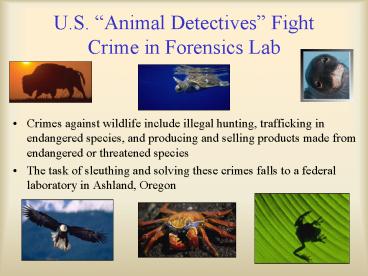
U.S. Animal Detectives Fight Crime in Forensics
Lab
- Crimes against wildlife include illegal hunting,
trafficking in endangered species, and producing
and selling products made from endangered or
threatened species - The task of sleuthing and solving these crimes
falls to a federal laboratory in Ashland, Oregon
2
U.S. Fish and Wildlife ServiceNational Fish and
Wildlife Forensics LaboratoryScotland Yard for
Animals
- Only lab in the world dedicated to solving
wildlife crimes - Lab works with federal agents, the 50 state Fish
and Game Commissions and the roughly 155
countries that are signatories to CITES the
Convention on International Trade in Endangered
Species of Wild Fauna and Flora that oversees
trade in wild plants and animals - Every year the lab currently a team of 33
handles about 900 cases
3
Ken Goddard
4
http//www.lab.fws.gov/labs/index.html
5
Michigan Department of Natural Resources, Law
Enforcement Division Lab Director or Forensic
Specialist Name Dr. Stephen M. Schmitt,
D.V.M. Title Wildlife Veterinarian Address Rose
Lake Wildlife Disease Lab, 8562 East Stoll
Road City East Lansing State/province
Michigan Postal Code 48823 Telephone
517-373-9358 Fax 517-641-6022 E-mail
schmitts_at_state.mi.us How many staff work on
wildlife forensics? Three (3) Part Time What
forensic techniques are available at (within)
your laboratory? Cause of death determination,
X-ray, aging techniques, species identification,
some hair, identification and elimination. What
species can be identified with these techniques?
Deer, beaver What new forensic techniques or
other data are being developed within your
laboratory? None. We do the work as a service to
our Law Enforcement Division and fit the work
into our existing schedules, which deal primarily
with wildlife disease and various furbearer and
bear surveys.
6
Alaska Department of Public Safety Lab Director
or Forensic Specialist Name Jim Wolfe Title
Criminalist III Address Alaska State Crime
Laboratory, 5500 E. Tudor Road City
Anchorage State/province Alaska Postal Code
Telephone 904-269-5683 Fax 907-338-6614 E-mail
james_wolfe_at_dps.state.ak.us How many staff work
on wildlife forensics? One (1) Part Time What
forensic techniques are available at (within)
your laboratory? The Alaska State Crime Lab
provides Forensic science support for all law
enforcement agencies in the state, including all
wildlife law enforcement agencies. We provide
analyses n most of the standard forensic
techniques, i.e., firearm/tool marks,
fingerprints, trace evidence, shoe prints/tire
tracks, etc., and also provide the following
wildlife specific techniquesspecies
identification of big game hairs, physical
matching of game animal parts and post-mortem
exams. What species can be identified with these
techniques? We no longer do species
identification of meat and blood. The hair
identification can identify hairs from Alaskan
cervids moose, elk, caribou, blacktail
deer. Other comments about your lab or
capabilities We are finding that the requests
for wildlife specific tests are limited (partly
because we have our wildlife officers send meat
and blood evidence for species identification and
DNA directly to the USFWS laboratory). Last year
30 cases came in from Wildlife Law Enforcement
agencies and only three cases requested wildlife
specific tests. The rest of the cases included
analyses such as fingerprints, shoeprints, etc.
7
Examples of evidence items that are sent for
examination
- blood samples (ideally, in a fresh or dried
condition) - tissue samples (same as above, only include
frozen) - whole carcasses (same as the above, except we're
rarely that lucky) - bones
- teeth
- claws
- talons
- tusks
- hair
- hides
- furs
- feathers
- leather goods (purses, shoes, boots...)
- poisons
- Pesticides
- stomach contents (uh huh)
- projectiles (bullets, arrows...)
- weapons (rifles, bows, traps....)
- Asian medicinals (rhino horn pills, tiger bone
juice...) - And pretty much anything else you might imagine
that could have come from (or been made from) an
animal.
8
Differences between Wildlife Crime and Police
Crime Labs
- The only real difference between a wildlife crime
lab, and a 'typical' police crime laboratory is
that the victim is a nonhuman animal. - Whether they are police or wildlife oriented---do
two things - They examine, identify, and compare evidence
items using a wide range of scientific procedures
and instruments... - And in a triangular manner, they attempt to link
suspect, victim and crime scene with physical
evidence.
9
Case Histories Molecular Genetic Approaches
10
Mitochondrial Genome
- 17,000 bp, circular in structure
- 37 genes involved in production storage of
energy - 13 involved in oxidative phosphorylation
- 22 transfer genes
- 2 ribosomal RNAs
11
Molecular Genetic ApproachesMitochondrial
Control Region also known as the D-loop or the
Hypervariable Region
- Control Region contains the signals that
control RNA and DNA synthesis - Hypervariable region termed hypervariable
because accumulates point mutations at a rate
5-10 times that of nuclear DNA - (The high mutation rate of mtDNA is almost
certainly due to the fact that the mt genome is
located in close proximity to the respiratory
machinery of the cell - a known source of potent
mutagens called oxygen free radicals) - D-loop early phase of replication forming a loop
12
Detecting the Sale of Meat from Protected Whales
- A global moratorium on commercial harvest of many
cetacean species was established by the
International Whaling Commission in 1985 - But whaling never completely stopped whale
meat continues to be sold in eastern Asia and
Scandinavia - Could be from small cetaceans like porpoises or
dolphins that are still legal to harvest
13
Detecting the Sale of Meat from Protected Whales
- In the early 1990s Baker and Palumbi began
purchasing whale products from Asian markets
for mtDNA analysis - By comparing unknown samples against a reference
database of cetacean mtDNA sequences, they were
able to identify species and sometimes geographic
source of each sample
14
(No Transcript)
15
Detecting the Sale of Meat from Protected Whales
- By 1999, 954 samples of whale meat had been
purchased in Japan and Korea - 773 were from whales, 9 were from protected
whale species (including blue, humpback, fin and
Brydes whales) - Samples that were not from whales included
dolphins, porpoises, sheep and horses - Demands that whales be genetically typed to
monitor distribution
16
Web-Based Molecular Identification of Whales,
Dolphins Porpoiseshttp//www.cebl.auckland.ac.n
z9000/
Data Entry
- GAAAATATATATTGTACAATAACCACAAGGCCACAGTATTATGTCCGTAT
TAAAAATAAC TTATTTTATTGCATACTGTTATGTAACTTGTGCATGTAT
GTACTCCCACATAACCCATAG TAGTTAGTATTCCCCTGTGAATATGTAT
ATGTACACATACTATGTATAATTGTGCATTCA
ATTATCTTCACTACGGAAGTTAAAGCCCGTATTAAATTTTATTAATTTTA
CATATTACAT AATATTTATTAATAGTACAATAGTACATGTTCTTATGCA
TCCTCAGGTCATTCTAGACGG AATGACTCTTATGGCCGCTCCATTAGAT
CACGAGCTTAATCAGCATGCCGCGTGAAACCA
GCAACCCGCTCGGCAGGGATCCCTCTTCTCGCACCGGGCCCATCAATCGT
GGGGGTAGCT ATTTAATGATCTTTATAAGACATCTGGTTCTTACTTCAG
GACCATATTAACTTAAAATCG
17
Grouping All Cetaceans Vs3.1, Region mtDNA
control Region (D-Loop)
18
Solving Wildlife Crime
- Lorenzini, R. DNA forensics and the poaching of
wildlife in Italy A case study. Forensic Science
International 153218-221.
Wild Boar (Sus scrofa)
19
mtDNA Cytochrome b
- The cytochrome b gene is the most widely used
gene for phylogenetic work - Although it evolves slowly in terms of
non-synonymous substitutions, the rate of
evolution in silent positions is relatively fast - Cytochrome b is conserved enough for clarifying
deeper phylogenetic relationships
20
Cytochrome b
- PCR amplified 307 bp fragment of mtDNA cytchrome
b - Restriction digested Hsp92II, Tsp509I, HinfI
- Restriction morphs of bloodstains compared to
reference samples of cattle, sheep, swine/wild
boar, goat, chicken, roe deer, red deer, fallow
deer, brown bear, rabbit, wolf/dog, cat,
porcupine, and fox - Species-specific separation except for domestic
pig and wild boar
21
Restriction of mtDNA D-loopSeparates Pig from
Wild Boar all 3 bloodstains from knife matched
poached animal
Wild Boar
Wild Boar
Pig
Pig
531 bp mtDNA D-loop
Restriction digest AvaII
22
12 Highly Polymorphic Microsatellites Profile
Matching Wild Boar Bood on Knife
23
- Poached animal, 7 of 12 microsatellite loci were
heterozygous, with a total of 18 alleles - Comparison of STR (short tandem repeat) patterns
showed a 75-80 difference in total number of
alleles - Probability that two individuals share the same
12-loci genotype by chance is 1150,000
acceptable for discriminating an individual
within a population of a few hundred
Lane Microsatellite 1 Microsatellite 2
Microsatellite 3 . Band a
Band b Band a Band b Band a Band
b Knife 92 100 196
198 200 200 . 1
92 100 196 198
200 200 2 104
106 198 202 204
206 3 108 112
192 194 206 206
. . 30 94 98
196 200 188 190 .
24
Perpetrator was convicted of poaching and of
cruelty to animals based on the forensic evidence
25
Illegal Wildlife Trade
- 1950s
- Endangered by IUCN, Appendix I of CITES
(Convention on International Trade of Endangered
Species of Wild Fauna and Flora) - 1993 Chinese Government stopped trade of tiger
parts (skin, bone, gall bladder, blood, meat) of
wild or captive animals
26
Tiger Parts
- Tiger SkinSit on skin to reduce fever.
- Tiger Brain LotionMix with oil and rub on
body to prevent acne and laziness. - Tiger Claw AmuletPut in your pocket for
courage. - Tiger PenisAdd to soup and take at bedtime
for virility - Tiger Hair Repellent
- Burn to drive away centipedes.
- Tiger Eyeball Pills
- Take one a day to prevent convulsions.
- Tiger Gallstone SalveCombine with honey and
rub on abscesses as needed. - Tiger Bone PowderDrink with wine at bedtime
for spring tonic. - Tiger Whiskers CharmUse as protection against
bullets. - Tiger HeartTake three times a day at meals
for courage and cunning. - Tiger Tailbone OintmentMix with soap and rub
on skin rashes.
27
Illegal Wildlife Trade
- On November 25, 2001 a citizen informed
authorities that a member of a circus in Ningbo
City was selling tiger meat, bone and other parts
in a local marketplace - Police confiscated meat from the only buyer that
could be located - The circus was known to have only one tiger on
visiting the circus facilities the cage had been
carefully cleaned and only a single unidentified
hair could be collected
28
Illegal Wildlife TradeComparative material
- Also available for study single plucked hair
from a tiger at Hangzhou Zoo - Tiger fecal sample
- Dried skin from tiger, leopard, clouded leopard,
snow leopard, leopard cat, Asiatic golden cat,
pala desert cat, muping tufted deer, and domestic
cow
29
mtDNA Cytochrome b Sequence Data from Genbank
30
Amplification Patterns
Tiger
Non-Tiger
Con
M S H F CH
582 bp 408 bp
31
Results
- D-loop analysis indicated that the meat and the
hair from the tiger cage had identical sequences
consistent with coming from the same individual - Under the wild animal protection laws of China,
the carcasses of wild and captive animals listed
on the CITES appendices must be disposed of by
State authorities - If carcasses are traded, both buyers and sellers
are liable for a fine and/or 1-7 years
imprisonment
32
Development of New Forensic Methodologies
- Shivji, M. et al. 2002. Genetic identification
of pelagic shark body parts for conservation and
trade monitoring. Conservation Biology
161036-1047
Shark Finning is Really, Really Bad, But We Want
the Money Says Disney
33
North Atlantic Sharks
- Dusky
- Blue
- Longfin Mako
- Shortfin Mako
- Porbeagle
- Silky
34
Intergenic spacer between the 5.8S rDNA and 28S
rDNA
9-15 Sequence divergence
35
Amplification Results - 3 Primers
36
Amplification Results 8 Primers
Recommended

