

Inverse Problems for Vibrating Beams ICTCM 2002 Orlando, FL' PowerPoint PPT Presentation
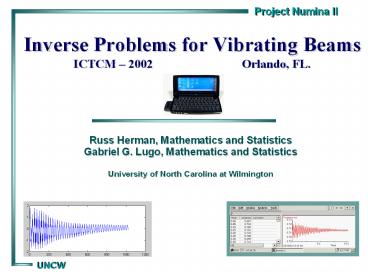
Title: Inverse Problems for Vibrating Beams ICTCM 2002 Orlando, FL'
1
Inverse Problems for Vibrating BeamsICTCM 2002
Orlando, FL.
- Russ Herman, Mathematics and Statistics
- Gabriel G. Lugo, Mathematics and Statistics
- University of North Carolina at Wilmington
2
Outline of Presentation
- Mathematical Modeling
- Pedagogical Gains
- The Cantilever Beam
- NC State Modeling Course
- Centennial Campus Lab
- Experimental Setup
- Modeling Results
- UNCW Project
- Course Preparation
- Experimental Setup
- Experimental Results
- Data Analysis
- Summary
3
Mathematical Modeling
- Objective
- To develop a quantitative description of a
physical problem. - Inverse Problem
- Make observations and Acquire Data.
- Develop equations from basic principles.
- Make assumptions to simplify equations.
- Solve the equations and run simulations.
- Test how well the model fits the data.
- Revise model if necessary.
4
Pedagogical Gains
- Students learn how to apply mathematical concepts
to solve real problems. - Solutions of differential equations is more
meaningful when students collect their own data. - Group interaction.
- Inter-departmental applications.
- Practice in writing reports
5
The Cantilever Beam
E Modulus of Elasticity I Moment of
Inertia r Mass density A Cross-sectional
area L Length of Beam k damping
6
NC State Modeling Course
- CRSC
- Math lab at Centennial Campus
- NCSU - Experimental Setup
- Main NCSU DAQ Instrumentation
- Beam Data
- Modeling results
7
NC State Modeling Course
- Center for Research and Scientific Computation.
Director Dr. H. T. Banks - Math Instructional and Research Lab
- Dr. H. T. Banks and Dr. H. T. Tran
- Course Math 573
- Level SMETE Upper division and graduate students
- Math Background ODEs, Linear Algebra.
- Sample Labs
- Vibration of Beams
- Heat Conduction
- Reflection of Acoustic Waves
8
NCSU Lab at Centennial Campus
Heat Conduction Lab
Beam Lab
9
Lab at Centennial Campus (Cont.)
Acoustic Waves Lab
Group Project
10
NCSU - Experimental Setup
11
Main NCSU DAQ Instrumentation
- HP Dynamic spectrum Analyzer
- Cost prohibitive
- Piezoceramic Actuator
- Hard to install
- Great to control Force
- Accelerometer
- Fast response. Proximity meter would be better
- Electronic Impulse Hammer
- A hammer really worth 800
12
Beam Data
- Collect data at one point. PDE ? ODE
- Consider data after Force has been turned off
- Simplified model.
13
Modeling Results
- Data Array
- Model Solution
- Cost Function
- Minimize cost function.
- Matlab Fmins
- Mathcad Minerr
14
Modeling Results (Cont)
Matlab
Mcad
15
UNCW Model
- Probeware History at UNCW
- Course Preparation
- Experimental Setup
- Experimental Results
16
Probeware History at UNCW
- IBM PSL
- MBL Explorer
- Vernier
- Data Harvest
Typical Labs gt
17
Newtons Law of Cooling
18
Uniform Acceleration
19
Simple Harmonic Motion
- Spring
- MBL Interface
- 750g Mass
- Sonar Probe
20
Course Preparation
- Introduction to Harmonic Oscillators
- Pre-project Work
- Verify form of solutions
- Graphing Typical Solutions
- Fitting Simulated Solutions
- Few hints about difference between mass-spring
and beam systems
21
Project Description
Differential Equations Project Part 1 Analysis
of the Damped Harmonic Oscillator and Simulated
Data In this part you will explore the behavior
of solutions to the damped harmonic oscillator by
answering questions given on the Part 1 handout.
You will also test the Nonlinear Least Squares
Curve Fitter listed at the course Links page.
This will prepare you for doing the other two
parts with real data. Part 2 Data Collection
and Analysis for Spring-Mass Oscillations In this
part of the lab you will collect data with the
Data Acquisition Equipment for at least three
different mass-spring combinations. Using the
techniques from Part 1, you will determine the
system parameters from your data (b/m and k/m)
and the frequency of oscillation. Part of your
report should describe your setup and any
relevant observations you made during the
experiment. You should provide plots of the data,
the fit based upon the parameters you determined
and a discussion of your results. Part 3 Data
Collection and Analysis for Beam Oscillations In
this last part you will study the behavior of a
vibrating beam, namely a meter stick. The meter
stick will be clamped at several points and data
taken for the oscillation of a point on the beam.
The data will be analyzed similar to that of the
system in Part 2 and a similar report written.
Note differences and similarities between the
systems and support any differences with data
analysis.
22
Pre-Project Work
23
Experimental Setup
- Handheld Computers
- Data Harvest DAQ
- Simple Spring and Meter Stick
24
HP Jornada 720 Handheld Computers
- StrongArm CPU (206 MHz)
- 32 MB RAM
- 640 x 240 Color Display
- Compact Flash Type I PC Card Type II Slots
- RS232C Serial IrDA ports, 115Kbps
- 56k Modem
- 9-Hour Li-ion Battery
- MS HPC2000 v. 3 OS
25
HP Jornada 568 Pocket PC
- Intel StrongArm CPU (206 MHz)
- 64 MB RAM
- 240 x 360 color display
- Compact Flash slot
- 14-hour Li-ion battery
- Pocket PC 2002 OS
- MS Pocket Office suite
- Internet Explorer
26
Data Harvest DATAQ System
- 12-bit DATAQ system
- Numerous probes
- Serial interface or CF unit
- Software runs on HPC, PPC, and desktop computers
27
UNCW - Experimental Setup
28
Experimental Results
29
Modeling Results
- Nonlinear Least Squares Curve Fitter was
unwieldy - http//members.aol.com/johnp71/nonlin.html
- All data taken at one time
- Fits done in Excel and some in Maple.
- Fits done by hand more pedagogical
30
Modeling Results - Maple
31
Modeling Results - Excel
32
Nonlinear Fit - Maple
33
Data Analysis Functions
- Nonlinear Regression
- Matlab (bar_lsq2.m)
- Load Reads files
- Ode23 Solver (RK)
- Fmins Simplex method
- Mathcad (Beam1_model)
- Readprn Loads files
- Odesolve (RK)
- Minerr Simplex Method
- Maple (SHOData)
- Readdata Reads files
- Dsolve
- LeastSquares
- Linear vs
- Nonlinear (NLFit2.mws)
- Excel (Beam1_d11a, Harmonic.xls)
- Fit manually
- Nonlinear Least Squares Fitter
34
Comparison of Projects
- Student Demographics
- NCSU - Senior/Grads
- UNCW First course in ODEs
- Common Problems
- Students not comfortable with CAS and data.
- Weak backgrounds in Physics
- Common Solutions
- Working in groups
- Help files on Web
- Project Differences
- UNCW Rougher experiment, portable DAQ,
classroom only once.
35
Summary
- The Problem
- NC State Model
- UNCW Model
- Data Analysis
- Comparison of Models
36
Thank you!
Russ Herman, hermanr_at_uncw.edu Gabriel G. Lugo,
lugo_at_uncw.edu
Recommended

